Hanoi in the rain

Friday, April 9, 2010

I already mentioned that Hanoi was not a four-day city, but that’s probably really unfair. Hanoi was certainly a worthwhile stop, so maybe it was the constant drizzly rain and mucky streets that left me a bit cold. Or maybe it was that I arrived in the dark in the rain and was expecting to land in a hotel room that would be home for FIVE WHOLE NIGHTS, which I was genuinely excited about, and which did not work out at all. When I got to the Rising Dragon Hotel I was told, very apologetically, that I’d have to spend one night at a place down the street because a freak electrical failure had caused a small fire and there was no power in my particular room and no one could fix it until morning and on and on and on. I was really stricken by this, but it quickly became clear that no amount of whining or brandishing of credit cards would change the facts, and the people at the hotel were very very very very nice about everything, even about me being all cranky with them. So nice, in fact, that I smartened up and moved to the other hotel, and tried to get them to stop fawning over me. I also left them a decent tip when I checked out.

But back to Hanoi. I spent most of my first day just walking around the old quarter of the city. It’s a good place for walking, if you don’t count all the motorcycles that are either a) parked on the sidewalk, thus forcing you to walk in the road, or b) zooming down the road where you’re trying to walk because the sidewalk is full of motorcycles. It’s not a great system.

This is a sidewalk in Hanoi.

There were lots of shops and small cafés and a bit of a French feel to the place, though it’s certainly not the “little Paris” that the guidebooks hint at. There’s a hint of French in some of the architecture, which was more European than a lot of Asian cities, but not so pronounced as in, say, Macau. There were lots of small balconies and louvred shutters and things, so I was kind of reminded of what I imagine New Orleans to be like. I was kind of expecting bakeries and baguettes and stuff, but it’s still very much an Asian city. There were a lot more pho stands than baguettes.

My first official tourist sight in Hanoi was the Hoa Lo Prison museum, which might be better known to you by the colloquial name given to it by the American pilots imprisoned there during the Vietnam War – the Hanoi Hilton. It was a well done little museum with a good amount of information on the prison, originally built by the French to house Vietnamese revolutionaries and repurposed to house American soldiers in the 70s. Some of the commentary was quite jingoistic, but you really can’t blame them for that – it’s their country, so I guess they have a right to spin things how they want to. (Aside: There was a sign outside the prison outlining the rules, one of which was “No frolicking is allowed during the visit.” I did my best to keep my frolicking down to a minimum.)

John McCain’s flight suit and other gear, on display at the Hoa Lo Prison Museum

My hotel in Hanoi was very close to Hoan Kiem Lake, what the LP calls “the liquid heart of the Old Quarter.” It’s a small, green lake with a pleasant walking path around it that’s a popular spot for locals and tourists alike. There’s a nice little temple on an island, and a monument on another tiny island, and it’s a somewhat calm spot in the midst of the turmoil that is central Hanoi. Of course I immediately recognized it for what it really is – a reasonable place for a run. It turns out that one circuit of Hoan Kiem Lake is almost exactly one mile, and over the course of my time in Hanoi I ended up making 13 complete rounds of it, on three separate days. This included two crappy short runs where my shins burned and it felt like I was running on dead stumps instead of legs, and one magical run where I got over the hump and did 11.2 km (7 laps) feeling happy and strong. I even struck up a nodding/waving acquaintance with a local runner – an older guy who ended up running clockwise while I was going counter clockwise, meaning we passed each other twice per lap. The second day I saw him he gave me a big smile and a wave just when I needed a pick-me-up, and I cruised through the end of my big 11 km run. Thanks Friendly Local Runner Guy!

Tortoise Tower on Hoan Kiem Lake. The name “Hoan Kiem” means “Lake of the Restored Sword” and has to do with a legend about Emperor Lai Thai To, who had a magical sword he used to drive the Chinese out of Vietnam, and about a giant golden tortoise that grabbed the sword from him and stole it away into the lake.

One of the great things about traveling in southeast Asia is the cost of living. For us westerners it’s just really really cheap. My hotel (The Rising Dragon – highly recommended) was a mere $20 USD per night and included air con, private bathroom, satellite tv, wifi and free breakfast. I’m living the high life these days. This was especially true the night I got back from Halong Bay when I decided to try the nice LP-recommended restaurant just across the street from the hotel. The Green Tangerine turned out to be a pretty posh place – right out of the Food Network. At first I was hesitant, but then I just decided to go for it and it was great. Here’s what I had:

  • Starter: Beef carpaccio marinated in balsamic vinegar mixed with red wine and red fruits topped by toasted wedges of Camembert cheese and herbs.
  • Main: French crusted galette in curry stuffed with seafood (shrimp, scallop and squid)
  • Dessert: Chocolate cake "no flour" and frozen Green Tangerine yoghurt in Cointreau (though I almost went for the cheese course instead: Roquefort cheese mixed with red fruits and goat cheese presented as a cake with candied green and red pepper, coriander seeds)

Needless to say it was, err, not bad. Certainly I was able to choke it all down, especially the carpaccio, and the frozen yogurt, which I would happily walk over crushed glass in bare feet to have again. It was an extravagant night but all that food, with two large bottles of beer and a generous tip ended up costing me $45 USD. That’s astronomical for Vietnam (most other meals cost me less than $5.00, with drinks) but anywhere in the Western world I suspect it would have been triple that.

Wednesday morning I planned to visit Ho Chi Minh’s mausoleum and the associated museum. It’s little ways out of the area where I was staying so I arranged with Erin, Wendy and Joan (my buddies from the boat) to share a cab that morning, leaving at 9:00 am. The tomb is only open from 8:00 am to 11:00 am, so we figured that would leave us lots of time. Well, as is often the case with groups of people larger than one, we got a late start. (I’m not blaming anyone like *cough* Erin *cough*, but let’s just say that it was not me we were waiting for). We ended up getting to the mausoleum at about 10:20, which should have left us lots of time to see plenty of corpses on a slab, except that it turned out the LP was wrong wrong wrong about the opening hours of the site. In the winter the hours are 8:00 am to 11:00 am. But starting on April 1st they switch to 7:30 am to 10:30 am. This did not leave us a lot of time, especially after we had to check our bags, and then go through a security check, and then make a wrong turn and end up at the museum instead of the mausoleum, and then be told we had to go through security again. You can guess what happened: we didn’t make it. So here’s a picture of me outside Ho Chi Minh’s tomb. You can’t take cameras in anyways, so it makes little difference to you guys.

Me, the tomb, and half of some guy on the left.

I was pretty pissed off about the whole thing, but I got over it. After all,I’d seen Lenin’s Tomb in Russia, so it’s not like I haven’t had my share of dead communists. I fumed for a bit, but then I got distracted by the Ho Chi Minh Museum which certainly wins the prize for Most Bizarre Museum I have visited. In fairness, the LP did give a bit of a warning saying “Find an English-speaking guide, as some of the symbolism is hard to interpret on your own.” This is understatement of the highest form. The first floor of the museum was pretty standard – captioned photos of Ho Chi Minh at various stages, with bombastic statements and flag-waving sentiments to go along with. The second floor was… well, it was where you needed a guide, and perhaps a shot or two of something strong to help you out. For instance, what is one to make of a display with a sign that reads “Coc Bo Cave, presented here in the form of a human brain was President Ho Chi Minh’s headquarters from where he engineered the Vietnamese revolution in 1941-1945.” What the hell? I swear, it actually said “presented here in the form of a human brain”. The whole place was like that. Abstract displays of art or video or kinetic sculpture, coupled with actual historical artifacts annotated in Vietnamese, French and English, giving an overall impression of… I have no idea. Bafflement, certainly.

Giant table and chairs, with giant fruit. Symbolic of… God only knows.

After we recovered from the museum, we got another cab to an area that EWJ (Erin, Joan, Wendy) wanted to go for some pho – the quintessential Vietnamese soup that’s eaten for breakfast, lunch, dinner, snack… basically all the time. I’m not a huge fan of pho (pronounced like “fuh” NOT “foe”) but it was fun having people to chum around with, so I went along for the ride. (Aside: I saw a great t-shirt on my last morning that showed very Apple/Mac-like icons for soup, cow, noodle etc… and the caption was “iPho” Heh.)

Hanging around in a group has its drawbacks (see above notes re: starting on time), but one advantage of the group is that it’s easier to be brave and dive into a side street and sit at a tiny low table like a local and have your pho. The girls were keen to have me try some bugs, because I’d explained to them about Steve’s Weird Food, and they swore they saw a plate of something appropriate at a table down the street, but luckily I was able to divert attention away from that plan, and just had a nice bowl of noodles and soup instead.

Here’s JWE (Joan, Wendy and Erin) at lunch. No bugs.

After I lunch I parted with JWE and stopped for a bit of coffee and ice cream before heading to the next event of the day – water puppets! Water puppetry is a distinctly Vietnamese art form that was developed in rice paddies. It’s performed in a pool of water about waist deep and the water serves to mask the mechanisms of the puppets, which are controlled by long rods by puppeteers who are hidden behind a screen. It’s mostly aimed at kids, and, not surprisingly, the subject matter runs heavily to aquatic themes – fishing, working in the rice paddies, catching frogs, hanging out on boats – that kind of thing.

The “Dancing Fairies” act. These puppets are two to three feet high, about a foot of which remains under the water.

The water puppets were quite cool, and the show was short enough that even if you got a bit tired of the splashing and cavorting there really wasn’t time to get restless about things. I thoroughly enjoyed it.

With the puppets done, the lake run around, and Ho Chi Minh ticked off the list there was really just one thing left do deal with in Vietnam. I’m going to admit right now that I kind of lost my patience for the Steve’s Weird Food project a bit while I was in Hanoi. Maybe because so many of my meals were provided – breakfast at the hotel, and all the food on the boat – or maybe because I’d just done dog, durian and sheet o’ meat in pretty quick succession. Whatever the cause, I was ready to just throw in the towel for Vietnam. After all, it wouldn’t be the first country I’d missed. (Big bonus points for anyone who can name the three countries that did not get a Weird Food. This is extra tough because the second one appeared only as a tweet and I think the first one never appeared at all…) However, Karen browbeat me long enough that I ventured out to the market street a few steps away from the hotel. It was actually several blocks long – small stalls one after another selling everything from bananas to pig trotters to coffee beans to brains to things that were still wriggling, swimming or flopping. At one point during the many times I walked those streets I watched a woman scaling a big fish with a cleaver. She’d already chopped off its tail, but it was still flailing around a bit, so she smacked it with the flat of her cleaver and then kept working. That’s life, baby.

Here’s a so-so shot of part of the market.

Anyways, in deference to my so-so enthusiasm for the project hat day, I elected to take it easy on myself and got a weird candy (the first one since Denmark). Lotus Candy seemed like a good compromise between no Weird Food at all and… bugs. The candies were white and smallish – bigger than M&Ms but smaller than jawbreakers. And they were sort of crunchy on the outside and soft in the middle, in the way of things that have been soaked in sugar syrup, to which family they clearly belonged. The taste was mostly just sweet and plain, and reminded me of what it might taste like if you candied small bits of firmly boiled potato. Not bad at all, and handy to have in your day pack if you happen to mistakenly down a large chunk of chili at lunch and need something to douse the flames, say. Not that this happened to me.

The bag of lotus candy. Steve’s Weird Cop-out for Vietnam

I sense there is more to day about Vietnam, but those thoughts may have to wait for a general southeast Asia wrap-up of some kind. This post is already a bit long, so I’ll just get it uploaded now and start figuring out what to say about Laos, because all I can think about that right now is, “HOT!”

Escape from Hanoi*

Thursday, April 8, 2010

Ok, I’m aware that the whole point of going to Hanoi was, you know, to see Hanoi. Not to leave after two nights. However, after wandering the old quarter of the city all day on Sunday it became abundantly clear that I did not need another three and a half days there. My original plan was to take a simple day-trip to nearby Halong bay, which had been recommended by a friendly hasher in Hong Kong, but every agent I talked to said they did not recommend such a short visit. Even the LP was adamant:

“Don’t even think about a day trip to Halong, as the real beauty of the bay is best experienced from the deck of a junk over a gin and tonic as the sun sinks into the horizon.”

Well the gin and tonic thing sounded pretty good, and since I’d already determined I could live a happy and fulfilled life without four whole days in Hanoi, I decided to go for the two day, one night option. I was nervous because the number of tour companies in the tourist quarter of Hanoi offering these kind of trips to Halong Bay is exceeded only by the number of 7-11s in Hong Kong. I checked with three or four different LP-recommended places and the prices for the kind of cruise I was after ranged from $40 to $125. It was impossible to tell the difference, though one could assume that the quality of the boat, food and possibly the company on the $40 trip would be decidedly more down-at-heel than the $125. In the end I booked through my hotel, despite the fact that the LP specifically recommended against booking through your hotel… daring! My trip cost $100 USD and included the three and a half hour bus ride between Hanoi and Halong City, a private cabin on the boat, two lunches, one dinner and one breakfast, sightseeing around the bay, kayaking in the bay and an English-speaking guide for the whole shebang. I handed over my weary credit card and crossed my fingers.

Well, it was great. The boat turned out to be really nice, and my cabin was better than almost any hotel room I’ve had on the whole trip.

My Cabin. Niiiiiice.

The other people on the boat turned out to be lovely as well. It was a diverse group, from Australia, England, Scotland, Denmark, the US, France, Germany and Malaysia, and all ages from little kids to retirees. I ended up taking my meals with the three American women, Erin, Joan and Wendy, and with Stefan from Denmark and his friend Kelvin from Singapore. And though it seems ungracious to say it, I had longer, easier and more enjoyable conversations with that gang right away than I had with my Intrepid China group after three weeks.

The reason Halong Bay is considered a “must-see” site in Northern Vietnam is all about the scenery. Remember the karsts in Yangshuo? Well Halong Bay is crammed with the same formations, but instead of rising out of the land like they do in Yangshuo, they’re little tree-covered islands dotting the bay. Officially 1969 (according to satellite photography) islands fill the bay in the Gulf of Tonkin, though the LP claims there are more than 3,000. Whatever the number, they are impressive to look at.

Karsts in the mist. There was a LOT of mist.

Once we arrived at the dock at Halong City, it quickly became clear why there are so many tour agencies in Hanoi selling cruises to Halong Bay. It’s because there are an enormous number of boats there. Keeping them all full of rich western tourists would keep a thousand thousand travel agencies busy. There was never a time when I couldn’t look out from the deck of our boat and see at least a dozen others and sometimes as many as twenty or thirty. And at Halong City there must have been over a hundred.

Here’s a look at the assembled throng near the most famous cave at Halong Bay.

We took a small tender boat from the dock at Halong City out to our big boat – the Amber Gold Cruiser. Once on board we enjoyed a welcome drink (tasting suspiciously like Tang) and checked into our cabins. Then we had a beautiful seafood lunch with shrimp and other fruits du mer, and beer, and fruit and coffee. It was a nice spread and I had a good time chatting with Erin, Wendy, Joan, Stefan and Kelvin.

After lunch we steamed off to one of the major sites in the area, the Amazing Cave or Hang Sung Sot. (Once again, like with Chinese, I’m omitting all accents in these Vietnamese words. In Vietnam the accent business is even more complicated because there are six different tones for each vowel sound instead of four, and some letters look like they’ve got two different accents on them. Yeesh.) Hang Sung Sot is called the Amazing Cave or sometimes the Amazing and Surprising Cave. It’s actually a series of caves – the first one is small, the second larger, and the third is positively massive. That’s the Surprise. “Hey, there’s a cave here. Hey! There’s another one through here and it’s even bigger! Hey, this is surprising, there’s another cave…” You get it. They’re all gratifyingly cave-like, filled with weird rock formations and stalactites and stalagmites.

It’s a bit hard to get your bearings in this photo but if you look in the bottom left corner you can see some people, so that gives you an idea of the scale.

The cave was fun, and the local people have given names to a lot of the odder rock formations, so we got to try and puzzle out why one particular blob of rock might be called the Lovers when it could just as easily have been the Fighting Dragon or the Shopping Cart or the Pile of Dirty Laundry. I guess it’s all about your perspective.

Back at the water’s edge the more sedate members of the group got back on the tender for the trip to the big boat. Us younger, fitter types hung around for an hour of kayaking around the area. We got fitted up with somewhat dodgey life jackets and put into two person kayaks. We were also strongly cautioned not to let our paddles fall into the water because, bizarrely, they had steel shafts, which meant they would not float. Now I’m certainly not a kayak paddle expert but this seems to me to be a grave design flaw. Also it made the kayaking a real workout because it was a bit like you were paddling with a barbell. Nonetheless, off we went. I was paired up with Erin, and we had some fun exploring a few of the islands up close. I was even brave/foolhardy enough to take my camera with me in a leaky ziploc bag, so I got a few photos while we were paddling.

Wendy and Joan doing their upper body workout.

The most interesting part of the kayaking was when we made our way to a little fishing village. Our guide Quang (again… no accents, and I’m not even sure if that’s the right spelling. Sorry Quang!) had mentioned we’d visit a village, so I was imagining a cluster of shacks on a shore somewhere. But of course that’s not a very efficient sort of settlement for a group of people who need to go where the fish are, and the karsts don’t really have shores at all anyways because they rise almost vertically out of the water. The village Quang was talking about was actually a floating collection of houseboats that could move wherever it needed to. Some of the dwellings looked like proper little houses, and some were just small boats with a bit of covered cabin area. They were all tiny, and looked quite ramshackle, kept afloat on plastic barrels or chunk of foam. And there was garbage everywhere – this was a sad theme for our whole trip on the bay – slicks of floating debris snaking their way across the surface of the water. It was sad.

Visiting the village was another of those fascinating but uncomfortable experiences. We paddled, essentially, right into these people’s front yards. It felt incredibly intrusive and though I wanted to take a thousand photos I only took a few, and none of them were great. We were greeted by some enthusiastic children, but I could sort of sense the adults were fed up with living on display.

A long view of several of the houses.

After an hour of paddling we got the tender back to the big boat. There was enough time before dinner that I was able to lay about in my cabin reading for a while and even had a short nap, which was positively luxurious. Dinner was just as tasty as lunch, and there was plenty of beer (drinks weren’t included in the package price, but at a mere 30,000 VND per beer – about $1.50 – they weren’t expensive either). We sat around the table chatting for a long time, and it was fun and easy and great. I even had the promised gin and tonic, though the misty rain that was the background to my entire time in Vietnam meant there was no lounging on the deck or picturesque sunset that night. Still, I took myself off to bed feeling pretty pleased with my lot.

There was a nice breakfast in the morning, and no scheduled activities while we headed back to the dock at Halong City. This in itself was a small miracle. Usually these kind of tours are crammed with activity, so having a whole morning to lounge around was fantastic. In another small miracle, the weather had cleared up some so we were able to sit up on the sun deck and enjoy the scenery. Though in this case the term “sundeck” was a bit of a misnomer because it was still terribly grey. (I never saw the sun the whole time I was in Vietnam.) Still, it was a comfortable and relaxing time chatting, reading, mingling and taking photos.

Me with crossword, novel and iPhone. All set.

And I was able to take a bit of time out of my busy crosswording, reading and dozing schedule to snap a few photographs. I like this one best.

Tiny Vietnamese boat with large rock.

Too soon it was time for another tasty lunch and then we found ourselves back at the dock at Halong City along with a thousand other boats. We waited quite a while to disembark, but it was a pleasant wait with more chatting and exchanging of email addresses. Along with Erin, Wendy and Joan (who will feature in the upcoming Hanoi post as well), I met Cheryl and Andrew, Australian ex-pats who are living with their adorable kids in Kuala Lumpur. They gave me some good tips on things to do in KL and promised to pass on some contacts for the hash there. The bus ride back to Hanoi was long, but made much shorter since we were now a bus full of friends with lots to talk about.

And what did I learn from my trip to Halong? Well, as I’ve experienced before on the felucca in Egypt, the sailboat in India, and the cruise boat on the Yangzi, life on a boat, regardless of the size of the vessel, is relaxing and generally worth the effort. It’s a great way to watch the world go by, catch up on your reading, and unplug for a while. I’ll certainly be keeping my eye out for other nautical opportunities from now on. I hear there’s an overnight boat from Luang Prabang to Huay Xai in northern Laos…


*For the cryptic crossword fans, the alternate title of this post is “Worthless eastern vessel (4)”, whose answer is also a fair description of the quality of the clue.

It’s China. No, it’s Portugal, Wait, it’s BOTH!

Tuesday, April 6, 2010

Getting to Macau was much more frustrating than I anticipated. It turns out that showing up at the ferry terminal at 9:00 am on Good Friday with no ticket booked and expecting to waltz onto a boat at 9:30 am is ridiculously ambitious. When I got to the terminal it was a madhouse. The lines to buy tickets were long, and though it wasn’t quite 9:00 am signs at the ticket window announced that the next available tickets were for departures at about 3:00 pm. This was not good. Macau was a bit of a whim to begin with – a short stop before I flew to Vietnam the next day. If I didn’t arrive until 4pm, and then had to leave the next day at 2:30… was there any point in going at all?

A bit more investigation revealed that I could get a first class ticket for an extra $100 HK and arrive at the southern ferry terminal on Taipa island by about 1:30pm. A compromise, but an acceptable one. I still wondered whether it might not be easier just to turn tail back to my cozy hotel room and spend another day in Hong Kong but in the end I decided that it was better to do something than to do nothing, and I bought the ticket and settled in to wait for the departure.

Well it turned out to be a very smart decision because Macau was instantly charming. If I thought I was in love with Hong Kong it must have been mere infatuation because clearly Macau and I were meant to be together. It’s tiny, just 28 sq. km in area, but with a population of just over 531,000. This makes it the most densely populated place in the world. I say “place” instead of country because like Hong Kong, Macau is designated as a “Special Administrative Region” of the People’s Republic of China. Also like Hong Kong, there were border controls and a new currency, so I’m counting Macau as country number 25. The charming part though is that unlike Hong Kong, which was a British colony, Macau was colonized by the Portuguese. Having visited Portugal I saw their influence right away. All the signs are in Chinese characters and Portuguese, and most of them are rendered in that familiar blue-and-white tile. And the streets! The sidewalks are paved with those little square white and black stones that are everywhere in Portugal. It was great.

Those Portuguese cobblestones, and, of course, Pam’s feet.

I knew I didn’t have much time in Macau so as soon as I’d settled into my hotel room I headed out into a rainy afternoon to explore. The hotel was near the old Porto, and not far from the main drag of Avenida de Almeida Ribeiro. But first I had to walk through a more local Chinese area and almost right away I stumbled onto what I am declaring Steve’s Weird Food for Macau. I think it’s called yuk gon, but I will simply call it the Sheet o’ Meat! It was EVERYWHERE. You could not walk 10 feet without seeing another sheet o’ meat vendor. And what, exactly is a sheet o’ meat? Well, just what it sounds like.

See what I mean?

They were large sheets – about the size of an 8-1/2 x 11 (A4) piece of paper, and about a quarter of an inch thick. The vendors all had tongs and scissors and would happily snip off a corner of any variety for you to sample before buying. I tried a bit and it was really good! I think the kind I had was pork and it was sort of halfway between a dry jerky and a juicy burger brushed with sticky sweet sauce. And it was warm, because the stacks are placed under warming lights. When you buy you just indicate how much you want and snip, snip, it’s in a bag and on the scale. I got three pieces about 3” x 4” each, and that cost $27 HK, about $3.50 CDN. (Macau does have its own currency, the pataça, but Hong Kong dollars are accepted at par, so I didn’t need to change money. Amusingly, the three letter currency code for the pataça is MOP!).

So I munched on my sheet o’ meat and quickly made my way to Largo de Senado, the main public square. The architecture was very European, and there were more Portuguese cobblestones. It didn’t feel like Asia at all.

Largo de Senado. If you had to guess, would you say this was Asia?

My ultimate destination was the Macau Museum, which the LP touted as one of the best in Asia, so clearly it was not to be missed. And I’m happy to report that the LP was right. Maybe I was just in a receptive mood, having conquered the ferry fiasco and chalked up another Weird Food, but I thought the Macau Museum was just great. It’s small, like Macau, and does a nice job of covering the history and culture of the place with well-maintained displays and nice bits of multi-media that all worked. I spent about an hour there, and I was taking my time.

The museum is located at Monte Forte, a literal high point in Macau, so I also wandered around the ramparts there and played with the automatic timer on the camera, so I can post the Rob H mandated picture of me for this post.

Me and a cannon

By this point it was clearly time for an aperitif, so I wandered around in the tourist area some more, dodging the sheet o’ meat vendors who were pushing samples on everyone passing by. There were also shops selling that quintessential Portuguese pastry the pastel de nata, which I’d sampled in Lisbon so many months ago. Again and again I’d run into something weirdly Portuguese, but Chinese at the same time. Buildings had signs outside naming them Farmacia Si Da Hau or Ferreiro Yim Kei or Mercearia Tak Cheong. And of course there were those distinctive blue and white Portuguese tiles, but with decidedly Asian subject matter.

I really had to look twice, because at first glance these tiles seemed to be standard-issue Portuguese stuff, but zoom in like this and you see the Chinese.

Without much difficulty I found a little café, had a glass of wine and availed myself of the free wifi, which was also everywhere in Macau. That done I went back to my room for a nap before tackling the issue of dinner, which I’d been looking forward to all day. I took the precaution of consulting the friendly guy at the Macau Museum reception desk about where he’d recommend and his suggestion tallied neatly with that in the LP, so I hiked south from the hotel and ended up at Litoral, a lovely place that featured Macanese / Portuguese fare. Since I was back in Portugal, sort of, it seemed appropriate to have some bacalhau (cod), and the piece I had arrived golden brown and surrounded by thick potato wedges. On top of it all was an absolute drift of crispy fried slices of garlic and it was all swimming in fragrant olive oil. Coupled with a bottle of beer it was exactly what I wanted. And naturally to top it all off I had a dish of chocolate mousse and a small glass of tawny port. I returned to my hotel room perfectly content.

The next morning I got up early so I could get the most out of my last few hours in Macau. My first stop was a small café where I enjoyed an iced coffee and a couple of those tasty pastel de nata custard tarts. Then I wandered around a bit more, killing time before the opening of the site of the day – the Pawnbroker’s Museum. Again it was small, but again I was really pleased by it. Pawnbrokers used to be a big industry in Macau, and they tended to build their shop with tall fortress-like towers behind to store the pawned goods with the most security possible. The Pawnbroker’s Museum was a restored shop and tower, and though it only took about twenty minutes to see the whole thing, it was twenty minutes and 75 cents well spent.

With more time on my hands than I’d anticipated I took a quick spin through the Leal Senado, home to Macau’s main municipal government and the mayor’s office. I didn’t get very far in though, because I was diverted by an art exhibit right inside the main doors. It was a presentation of works by Wucius Wong, and it was just astonishing. They were ink and water colour on paper and in a mostly Chinese style – lots of landscapes, but also lots of more abstract stuff. It was intricate and grand at the same time. The pieces ranged in size, but one of my favourites was a scroll about 18” high and 25 feet long, a rambling landscape of trees, mountains and streams. I tried to take some photos, but the they really don’t give the right impression. I would be ecstatic to own any piece in that exhibition and would have stayed much longer if I didn’t have one more thing to do on Macau before my time ran out.

Part of a piece by Wucius Wong

My last activity in Macau took me to Taipa island, south of the main Macau peninsula. It’s still part of Macau, connected by three different soaring bridges, but in some ways its a very different world. When I said Macau is part China and part Portugal that wasn’t entirely accurate. In fact, it’s part China, part Portugal and part Las Vegas. The gambling industry is big in Macau and growing bigger every day, and it’s mostly centred on the islands of Taipa and Coloane. Taipa and Coloane used to be connected by a narrow causeway, but land reclamation and development have created what’s called the Cotai strip, and it’s there that most of the big casinos are located.

I was heading for a casino complex called the City of Dreams. A friend of a friend had promised to give me a quick look behind the scenes at a new Dragone show* that’s set to open this summer. Because the show isn’t open to the public yet I won’t say anything specific about it, but I did spend a lot of time picking my jaw up off the floor, and I think I will be polishing up my resumé and sending it off to both Dragone (and the Cirque du Soleil) when I get home. It looks like incredibly challenging but incredibly exciting work.

And then, all too soon, my time in Macau was over. Just 25 hours after I arrived I took a short taxi ride to the ferry terminal where I was able to get a ferry directly to the departures area of Hong Kong International Airport. They even checked my bag all the way through to Hanoi, which was brilliantly convenient. Back in International Airport Land – a place where everyone speaks English and you can buy the Daily Telegraph – I had a nice lunch and tackled a fresh crossword. Does anyone think that “Actress presents poet with set of books” could be BARDOT? And does anyone besides me care? Comments, please.


* Edited because it was a Dragone show I looked at in Macau, not at Cirque du Soleil show, and I am stupid and always get the two companies mixed up. Sorry Dragone!

Three more days and the love affair continues

Saturday, April 3, 2010

Hong Kong continues to please me. I’m not sure if it’s just because this is the first time I’ve been at liberty in a proper city in a while, but I don’t think that’s all of it. It’s probably because it’s got all the amenities you could want – an efficient public transit system, fantastic museums and galleries, theatre, music, more shopping I will ever need, great restaurants of every possible cuisine, hilly parks, stunning views, a harbour, Guinness on tap, and at least three different Hashes. I think I could probably live here quite happily for a while.

Hong Kong is also remarkably clean for a big city, almost obsessively so. There are always people sweeping up public spaces, and I constantly see signs that say things like “This door handle is sanitized every two hours” or “This handrail covered with anti-bacterial coating.” There are scrolling LED signs imploring you to cover your nose and mouth when you sneeze, and stickers in the metro cars request that you contact station staff if you are feeling unwell. Sometimes I’m a bit worried that if I cough in the wrong place I’ll get carted of to some kind of reeducation program. I suspect it’s a SARS / H1N1 thing, but it’s still a bit Big Brother.

Woman sweeping the pristine square outside the Hong Kong History Museum

On Monday I parceled up yet another package home and sent it off via the friendly, efficient and reasonably priced Hong Kong postal system (another reason why I think of this as a separate country – not just the border controls and the different currency – they also have their own postal system.) This made it much easier to put everything that was left back in the Aeronaut and make my way to yet another hotel room and to bed number 135 (for those who are keeping score). As I mentioned, my new room has a window and wifi, so it’s been quite nice. It’s not the Ritz (as evidenced by the cockroach found belly-up and twitching outside the elevator) but for $40 CDN a night it suits my needs.

After the big move I decided to explore my new neighbourhood a bit, hoping to find a good spot to go for a run later that day. The new hotel is very close to Hong Kong Harbour and Victoria Park, so it seemed reasonable to think there’d be some good waterfront running, and maybe some more verdant park-like business as well. Humph. Not exactly. Victoria Park is pleasant enough, but exceedingly small. And the waterfront started out promisingly but soon deteriorated into a maze of dead ends, six lane highways, overpasses, tunnels, closed docks and construction zones. It is emphatically NOT a pedestrian-friendly zone, and is one of the few things I’ve ended up not liking about Hong Kong. Eventually I found my way to the Hong Convention and Exhibition Centre, which the LP claimed had a nice harbour view. I did find the view, but was tired and footsore and fed up with being a pedestrian on the Causeway Bay waterfront, so it’s hard to wax rhapsodic about it.

Here's the view from the the Convention Centre. The LP says I was looking through the “world’s largest ‘glass curtain’ – a window seven stories high”. I think that’s Victoria Peak in the background.

By the time I was back at the hotel I mostly just wanted a nap, so of course I dug out my running shoes and headed out to attempt a run of some kind. I ended up having to do laps around Victoria Park, due to the aforementioned shocking lack of waterfront access. I later learned that of all the spots in Hong Kong in which to base myself, Causeway Bay is perhaps the least runner-friendly of all. Great. Nonetheless I did manage a respectable 6 km and felt better for it, as usual.

That evening I ate supper in my room. There’s a big grocery store right across the street, so I went over and picked up a takeaway box of sushi and some beer and supplies for breakfast. I thought it would be a quick errand, but ended up spending half a lifetime in line behind a woman with a giant cartload of stuff who needed to have such a long discussion with the cashier about the price of every item that eventually paperwork needed to be filled out and supervisors consulted. People in the other lines breezed through like they were on fast-forward; in my line children were born, grew to old age, and died all while this woman argued about the price of a packet of instant noodles. Civilization rose and fell. Tectonic plates shifted. Stars went supernova. And more importantly, my beer got warm. Humph.

On Tuesday I planned to get back to some serious tourist stuff and visit a few sights on the mainland in the Kowloon peninsula. First though, I needed to get some laundry done, so I stopped in at reception to find out about that. That’s how I ended up meeting Frank, an American traveler in Hong Kong who befriended me, showed me where the cheap laundry was, bought me a latté, and talked my ear off for a pleasant hour that morning. Frank is a retired US Navy man and has that super-friendly, talkative, instant best-buddies manner of many of his countrymen. He also has a Brompton folding bicycle. Bromptons are one of my Favourite Things (check out the video on this page to see why) so I was keen to have a look at one up close and let Frank talk to me about it. Frank was off to Macau later that day, which is where I’m headed next. So you never know, I may get the chance to buy him a coffee there, and hear more about his travels with the Brompton. If not, it was still lovely to meet him and have some friendly conversation with a fellow traveler.

Frank, and the partially folded Brompton, both fun discoveries

Once I left Frank and put my official tourist hat back on it was a quick trip to Mong Kok to check out the famous Flower Market. It was pleasant, but not the big open market I’d been expecting. Instead it was a long block of individual shops, each selling cut flowers, plants, bamboo, bonsai and other flower-related stuff. It was diverting for a few minutes, but it wasn’t long before I turned my steps to the other sight in the area, a small spot called the Bird Garden. This purported be a park where people brought their songbirds in cages to “air” the birds and chat with each other. Once again, expectations were defied. The Bird Garden was more an outdoor mall of stalls selling birds, bird cages, bird accessories and live bugs to be used as bird food. I didn’t see any old Chinese men airing their birds, smoking, playing ma johng and feeding crickets to their charges, which is definitely what the guidebooks implied would be found.

Mong Kok’s last chance was the Goldfish Market, a street full of shops selling fish and aquarium supplies. This was mildly diverting too, and at least yielded an interesting enough photo to warrant putting here.

A few of the fish on offer

The rest of the afternoon was taken up with a nice lunch and a visit to a travel agent to buy a two-week Japan Rail pass. (They must be bought before arriving in Japan, and I reasoned that doing this in Hong Kong would be the simplest thing). All this was just killing time though, because that night I was going to hash! The Ladies Hong Kong Hash House Harriers were the usual fun and friendly bunch and I made it to the start point of the run thanks to their help, the number 72 bus, and Google Maps on the iPhone.

Rob H-mandated shot of me for this post, on the top deck of bus number 72 (which also had the best bus sign ever, reading “Please do not obstruct the periscope”)

Despite their name, the Ladies Hash is a co-ed bunch, though they have an unwritten rule that a woman must always lead the pack while on the run. Because the run started at 6:45pm everyone arrived equipped with flashlights and headlamps. Everyone, that is, except the visitor from Canada who didn’t have the wit to realize that the sun would set that day, and that running in the dark in an unfamiliar city might be tricky. Never fear though, I was able to stick with other more prepared hashers and had a good run.

Unlike a Winnipeg hash, there was a very very big hill in the area. Other than in Causeway Bay, there is always a big hill in the area in Hong Kong. So naturally we went straight up about 600 steps all the way to the top. This was a bit tedious, but the view at the top was rewarding.

The view from the top

After the run we decamped to a local Thai restaurant and had beer and good food and down-downs. Once again I was confirmed in my belief that hashers are good people, and even made plans to hash with a different local group the very next night, in the very same place. (It seemed that since I’d already figured out the bus system there wasn’t much reason not to come back.) Eventually I made my way back to the hotel that night sweaty, tired, tipsy and content.

Wednesday was free museum day in Hong Kong and I took full advantage by visiting the History Museum before lunch and the Art Museum after. Both were excellent, even if they were filled with bargain-hunting crowds and school kids. At least because it was free I didn’t feel compelled to linger over every display case, however dusty, so as to extract maximum possible value from my admission fee. Instead I skipped happily through several thousand years of history until I got to the first really juicy bit – the Opium Wars. I’d heard of this event before but really knew nothing about it, so I was glad to learn anything. For those who are similarly uniformed, here’s my incredibly simplified Opium-Wars-for-dummies:

Britain had a huge trade imbalance with China due in part to much importation of Chinese tea to please British palates, and much lack of interest in European products among the Chinese. Britain then discovered that opium from its Indian colonies was a huge hit with the Chinese population and the trade imbalance tipped in their favour. China slapped restrictions on opium trade, and trade in general, but smugglers ignored them and eventually it all came to blows. Despite their smaller numbers the British won because they had superior machinery of war, and they imposed the harsh Treaty of Nanking on China in 1842. Among other things, the treaty ceded Hong Kong to Britain.

Simple. And all laid out in easy-to-understand fashion at the Hong Kong History Museum. I also really enjoyed the section of the museum devoted to the Japanese occupation of Hong Kong during WWII – another bit of history about which I was woefully uninformed.

The Art museum was also a hit. I was lucky enough to arrive just in time for a guided tour of one of the galleries of antiquities. (Aside: Let me take a moment here to clarify the difference between what I call a guided tour and what I call a group tour. A guided tour is a short-duration visit to a single sight or area, conducted by a knowledgeable, usually local person. A group tour is a seemingly never-ending series of early morning wakeup calls, overnight trains and one night stands, done in the company of 6-12 people among whom the only common denominator is that they all surrendered their credit card details to the same company.) (Ok, perhaps that’s harsh. Let’s just chalk it up to my group tour hangover and move on with the Art Museum.)

The tour I took was of a collection of antique Chinese accessories – hair pins, belt buckles, snuff bottles and the like. It is, potentially, a dry subject, but the woman conducting the tour was very knowledgeable and make it all quite interesting. She knew about all the layers and layers of symbolism on every embroidered knot and amber bead. Talking about the hats and fans and things was really just a way in to a discussion of Chinese life, thought and culture, and well worth an hour of my time.

Then it was time for another hash and another trip up the same hill, though this time we took the jungle route up. It was a hands-and-knees job for much of the way. The Little Sai Wan Hash is clearly a much more energetic bunch than the Ladies of Hong Kong. At least this time I remembered to bring my headlamp, though it turned out to be only slightly brighter than a glow-in-the-dark Halloween mask. Here’s word of advice: Do not attempt the Little Sai Wan “Double Rambo” trail with a dodgey headlamp and tired legs. A little blood and a lot of cursing is the inevitable result. However, the LSW has were kind enough to give me a key chain and a badge, and I left as tipsy and content that night as I’d been the night before.

Finally, it's been nice to have the leisure time and resources to sit down and plan the next leg of the trip. I’m off for a quick stop in Macau then I’ve got flights and hotels pre-booked for Vietnam and Laos, which is a relief. It also looks like my standard of living is going to be pretty decent in southeast Asia. Private bathrooms and wifi seem to be pretty standard in the $20-$40/night range, and I’m determined not to cheap out unnecessarily. I’ve stayed in enough 8-bed dorms, shared enough skanky bathrooms and endured enough long distance bus rides in the last nine months. From now on it’s flights, decent hotels and prearranged airport pickups. I’ve been out here long enough to know what keeps me happy, so now I’m actually going to try to put that knowledge to use. Damn the bank account, I want fluffy towels!

Steve's Weird Food for Hong Kong: Pass the noseplugs.

Friday, April 2, 2010

As much as Hong Kong is very very different from mainland China, there are still some things that are the same. True, there are so many 7-11s, McDonald’s and Starbucks that you can usually stand in the doorway of one and toss a half-caf double mocha frappuccino into the next. But there are also noodle shops and little butcher stalls with barbequed ducks hanging in the window and those places selling desiccated sea creatures.

Along with newspapers, cans of Coke and bags of chips, 7-11s here sell things with TENTACLES. We are not in Kansas anymore.

Finding weird food here is not a challenge. Not in the slightest. When the supermarket sells lychee flavoured gum and vaccuum-packed chicken feet and durian, digging up an appropriate weird food is not an issue.

Yes, I said durian. For those of you not familiar with this fruit, durian is one of those foods with a really bad reputation, sort of like tripe or worms or pig ears or… well you get the idea. Clearly, this was something I had to try. A durian fruit is large – up to twelve inches long and six inches in diameter, and is covered with a hard, thorny husk. Inside the flesh is pale yellow and divided into sections that in turn have large seeds.

A picture of durian, from Wikipedia

Not so weird, you say? Well it’s not the durian’s looks that give it its bad reputation, it’s the smell. The smell of durian has variously been described as “dirty diapers left out in a dumpster at midday, with a top note of sweaty gym socks” or my favourite, “rotting flesh”. And it’s not just that it smells bad, it’s that it smells a lot. The smell of durian is so strong that the very presence of even the unopened fruit is banned in some hotels and public transit in Southeast Asia. Having just spent a few minutes intentionally inhaling great snootfuls of durian’s unique aroma, I’d say it most reminds me of raw onion. This is a fine quality in an onion, but not perhaps a good one in a fruit.

For another perspective on durian’s unique qualities, here’s an oft-quoted bit from the 1856 writings of British naturalist Alfred Russell Wallace, whose love affair with durian is evident from this description:

“The five cells are silky-white within, and are filled with a mass of firm, cream-coloured pulp, containing about three seeds each. This pulp is the edible part, and its consistence and flavour are indescribable. A rich custard highly flavoured with almonds gives the best general idea of it, but there are occasional wafts of flavour that call to mind cream-cheese, onion-sauce, sherry-wine, and other incongruous dishes. Then there is a rich glutinous smoothness in the pulp which nothing else possesses, but which adds to its delicacy. It is neither acid nor sweet nor juicy; yet it wants neither of these qualities, for it is in itself perfect. It produces no nausea or other bad effect, and the more you eat of it the less you feel inclined to stop. In fact, to eat Durians is a new sensation worth a voyage to the East to experience. ... as producing a food of the most exquisite flavour it is unsurpassed.”

I didn’t buy a whole durian. Instead I got one section of the flesh, packed in a styrofoam tray and barcoded, from my local grocery store ($16.00 HK, about $2.10). Even sealed behind clingfilm the smell was evident, and I was a bit worried about putting it in the communal fridge at my hotel. But I know what you’re really wondering… what’s it like to eat? First, I opened the window in the room, and then I sliced open the clingfilm, with some trepidation. Then I dug in - with a spoon - I didn’t want to get any on my fingers and have the lingering smell of durian follow me to the end of my days. The texture of the flesh is smooth and creamy, with a few stringy bits. As for the flavour – it does have a bit of onion about it. It’s also like custard, and very strong cheese, and a bit like mango. Definitely unique.

This is what durian flesh looks like when it’s been reluctantly prodded with a spoon and then dug around in to find bits of the creamy custardy part. One large pit is showing.

Russell claimed that more you eat, the more you want to eat. I can’t say that was my experience, though I did notice that the second and third and fourth morsels I tried seemed more custardy and less Roquefort than the first. I didn’t finish it off though, and quickly wrapped the remainder in seventeen layers of plastic bag, to be smuggled out of the room and disposed of in a back alley somewhere. Once the experiment was over, but before the offending bundle was removed from the room, my nose had a weird tingly feeling, almost as if it was simply over stimulated and didn’t quite know what to do about it. Poor thing.

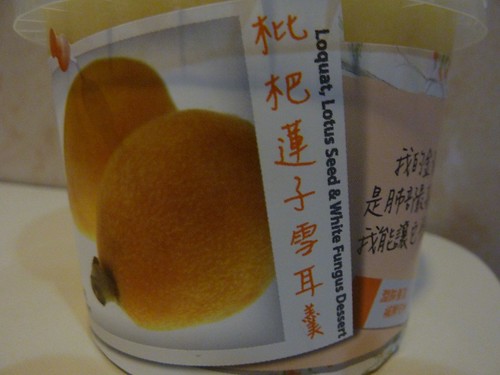
And just to prove how easy it is to find weird food here, I’m going to include two bonus weird food items. These were both procured from a small kiosk in the Tsim Sha Tsui metro station, in between a cookie shop and (of course) a 7-11. So it’s not like I had to make a special trip to a Weird Food Store in a dim alley to get them. And what are we talking about? Well, how about a little loquat, lotus seed and white fungus dessert? It’s not just tasty, it’s also medicinal! To quote the side of the tub, it’s “Suitable for: dry skin, dry mouth with thirsty feeling, discomfort in the respiratory system, gets coughing easily, suffers from insomnia frequently, dreamy.”

There’s nothing like a little white fungus to clear up that persistent cough

The contents of the tub were a pale creamy-coloured soup with a mild coconut-like flavour. It was reasonably pleasant except for the large, rubbery bits of fungus floating in the mixture. I’m sitting here with the tub open and my spoon poised and I just cannot think of a way to describe those fungus bits. They really have no flavour, but the texture is… words fail me. A bit like frilly, very firm gelatin. Yup, that’s about as close as I can come. Imagine very strong, clear Jell-O in the shape of tiny curly lettuce leaves. Sort of rubbery, sort of toothsome, and certainly not exactly at home in a cup of dessert.

So perhaps Loquat, lotus seed and white fungus is not your cup of tea. Well surely then you wouldn’t object to trying some Kidney-strengthening five bean dessert? Especially if you are “experiencing deficiency in the function of the spleen and stomach, poor digestion, gets tiredness easily and excessive depletion of energy or have poor immunity and suffer from influenza easily”. Just pop open the tub and dig in!

Five, count ‘em FIVE kinds of beans in every dessert.

This one was more agreeable, maybe simply because the texture and flavour of beans was familiar. The juice, or broth, or whatever was a bit sweet, but mostly the beans just tasted like beans. I don’t think it will replace cheesecake or chocolate on my list of top desserts, but I finished it off.

So there you have it, lots and lots of weird food, and more to come as I move into Vietnam, Laos, Thailand and Cambodia. Until then I’ll just add that I’m doing fine, and my kidneys have never felt better.