Showing posts with label England. Show all posts

Pic of Pics: Plymouth

Wednesday, September 29, 2010

P1070856
Me and the fambly, on the water taxi in Plymouth. (To mollify Rob H, and to show everyone that I'm still hanging in there with the Longer Hair Experiment.)


And, for those not plugged into the Twitter feed, I GOT THE JOB. I'm now working full time, and have just finished Day 3. It's good, and busy, and frustrating (already) and yet all feels eerily familiar. If I had time to catch my breath I might be able to blog about it, but I'm suddenly too busy working, searching for a long term flat, and generally trying to remember how to function when 8-10 hours a day is taken up with... work. It's been a looooooong time.

Hanging in there

Thursday, September 23, 2010

(Insert obligatory apology for long long long break between blog posts here.)

First things first – I’m still in London. Well actually that’s not strictly true. As I write this I’m just outside Reading, on a train to Plymouth for a few days visiting with family. So while I am not, strictly speaking, in London right now, I am still very much more in London than I would be if I were in, say, Winnipeg, if you get my drift.

P1070826
Oooh. She does not look happy about having her picture taken.

The original plan, for those who remember it from way back in July, was to hang around for six weeks trying to see if the crazy idea of moving over here and finding a job is actually feasible. That is to say, if I could reasonably expect to find enough work to survive without ending up sleeping under a bench in Paddington Station or stocking shelves in a Tesco Express. However, as the days passed it became clear that six weeks is a ridiculously short amount of time in which to restart a career that’s been dormant for a year, on a new continent. It seems that even I – world traveler, insanely popular blogger, and possessor of a now almost infinite supply of anecdotes on which to dine out – even I cannot expect to land on my feet in such a short amount of time in such a big city.

So I’ve extended the plan. I rebooked my return flight for November 1st, and am hoping fervently that I’ll get to rebook one more time and change that flight into the first leg of a trip home for Christmas. (Never mind that the change fees for two rebookings will mean that it would have been cheaper for me to get a one way ticket. We are not thinking about that. Nor are we thinking about the ever-dwindling savings account. Not thinking about that at all. Nope.)

Extending my stay in London meant that I had to find new accommodations, which was not a bad thing at all. You may have detected, in my last few posts, a certain lack of enthusiasm for the neighbourhood and flat where I spent my first six weeks. Willesden Junction was a hard place to love, and living in one tiny, stuffy, somewhat rundown room there only added to the general sense of desperation that attended my days. Yes, it’s true that the decidedly “efficient” size of the flat meant that you could fry an egg from bed, but I knew it was time for a change.

I ended up finding a place that is so perfect I could hardly have managed better if I’d been ordering from a menu. I’ve got a beautiful big bedroom in a shared house in Brixton, which is south of the Thames. (Note to those who only know Brixton from riots and unrest in the eighties – it’s WAY different now. Cleaner, safer, happier and just nicer.) The house is a three story Victorian inhabited by three other people, and it’s all clean white walls and dark wood floors and book cases and comfy furniture.

P1070806
The gigantic kitchen, looking out onto the tiny but perfect back garden

There’s a washer and dryer, dishwasher, TV, DVD player, and wifi, and my housemates are friendly and welcoming and smart and play Scrabble and do crosswords and are interesting and fun. And to top it all off, it’s actually significantly cheaper that Willesden Junction. Go figure.

P1070802
My bedroom. It’s about a third bigger than the WJ flat. (In fact, when I finally found a reasonable pub in WJ, there was a projection screen tv on one wall, and I swear that screen was bigger than the WJ flat. And I’m not even exaggerating this time.)

P1070803
I even have a desk and a small comfy couch. Bliss.

So things on the home front are much improved. Things on the work front have improved too. I actually worked! For money! For a whole week! In two different places! I was asked to fill in at the last minute and ended up working days at one theatre and evenings at another. It made for a really busy week, but it’s a real foot-in-the-door, and I can already tell that it’s earned me not just a few extra pounds to keep the wolf from the door, but, more importantly, some more good contacts that may already be bearing fruit. Things are looking up.

P1070792
My first day of work necessitated a very very early start, which meant I was walking across the Thames from Embankment (my favourite tube station) while the sun was rising over London. Yup. That’s St. Paul’s Cathedral. Even with all its frustrations, this city is still magic.

I’m impatient for the big break, but I also know I need to be careful and patient. I had drinks this weekend with a friend from the business in Canada, and a local guy who’s been a huge help in getting me connected with a lot of useful people. They were both really impressed with how far I’ve come in such a short time, and cautioned against getting nervous and taking a job that won’t be right in the long run. They think the best thing would be to get short term work in a lot of different places, which will help get me known around town, and give me experience with as many different theatres and people as possible. What I need to be wary of is ending up in a long term, full time job that takes me out of circulation and tucks me away somewhere there’s no chance of meeting new people and advancing my cause. (Like running the stage at St. Snortleby School for Girls, Slough Branch. Steady work, I’m sure, but just kill me now…) In some ways it seems counter-intuitive to reject permanent work in favour of something riskier, but I think it may make sense for the long run.

So that’s the report from the 11:06 to Plymouth. And I have to say that it’s really really nice to be traveling by train again. A proper train, that is, not a tube train. I’m very much over the whole Underground system. It’s true that it’s generally efficient, except on weekends when random closures for “planned engineering works” can shut down significant chunks of the system, which adds a frustrating level of complication to any journey. And except when there’s a tube strike that leaves one with a 45 minutes walk from Euston Station to the south bank. Or when there’s an unexplained cancellation of service resulting in everyone being ejected from the train at Queens’ Park at midnight on Saturday, leaving one walking all the way to Harrow Road only to turn in the WRONG direction on that road and spend another ten minutes walking back the way one has just come, then realize one’s mistake, causing one to stomp impatiently across the street and wait ages for a bus and get home around 2 am. For instance.

Like I said, it’s still nice to be on a proper train again.

P1070820
Bucolic but unfocused view from the train. Those little white dots are sheep!


Late-breaking news: This afternoon I’m going back to a scenery shop I visited a few weeks ago to talk to the boss man about an actual job to do actual, full time paid work. It would be short term, but that’s perfect for me right now. Cross all your fingers for me!

Two Days, Two Pams

Wednesday, July 8, 2009

I had a great couple of days in Harrogate, which is a lovely town, but doesn't have a lot to draw the RTW traveler. I was there to visit family, and in response to Rob's comment about how I keep talking about visiting family but never talk about the people themselves, I am devoting a chunk of this post to the family I visited, specifically, my grandfather's cousin. That makes her my first cousin twice removed, but for our purposes we shall simply refer to her as Pam which, happily, is her name.

It turns out that cousin Pam is quite fun. (She's the mother of Anne, my steel-nerved driving buddy and hostess in Plymouth.) Being of my grandfather's generation she's somewhere north of 80 years old, and referred to the great-grandmother I called "Nanny", as "Auntie Kit", which was just lovely.

Despite being of advancing years, Pam was happy to drive me all over the area in her tiny silver car, which was quite handy and only occasioned a few very brief rushes of traffic-related adrenalin. The evening I arrived she declared that she didn't feel like cooking and took me out to dinner at a nice country pub, so she was instantly in my good books. Then upon examining the menu she declared that she'd skip the starter (appetizer) to save room for dessert, which fits perfectly with my philosophy of leaving no dessert uneaten. We both had the sticky toffee pudding with vanilla ice cream; it was excellent, and now joins ploughman's lunch and flapjacks on my list of favourites.

After dinner we drove to the neighbouring town of Knaresborough so I could see the ruined castle there, which was really excellent. It was another one of those moments when I was struck with how thickly the history is spread over this tiny island. Here I was in a very small town that seemed quite insignificant in most ways, yet there was a brilliant 14th c. ruined castle sitting there on a high cliff, with a lovely river valley below, and a great stone viaduct that proved to be highly photogenic.

The ruins of Knaresborough CastleThe photogenic viaduct

Ok, perhaps I was hasty in declaring that Harrogate had little to offer the RTW traveler. In fact, it has Bogs Field, whose commemorative plaque reads as follows:

"Behold Bogs Field, a wonder of the natural world where a greater number of unique mineral springs come to the surface than at any other known place on Earth! 36 of Harrogate's 88 mineral wells are found here, of which no two are alike. The waters are Magmatic or Plutonic in origin, having never existed as rain, and have flowed deep beneath the earth for 20,000 years before surfacing through vertical shafts in the strata.... Bogs Field was investigated and developed by the Victorians who piped the mineral waters to the Royal Bath Hospital and to the Pump Rooms and Baths of Low Harrogate."

So it's not enough that there are castles, Roman ruins and manor houses dotting the landscape as thick as empties at a hash run, there has to be a completely unique phenomenon of the natural world hanging around too. Did I mention I really like this country?

We had a turn around the tiny but charming Pump Room Museum, which was diverting and (strangely) had a nice collection of Egyptian antiquities along with the obligatory displays about the weird ways Victorians used the springs in "taking the cure". And of course I had to try a taste of the water from the sulphur spring which was on offer at the reception desk of the museum. It was predictably foul and made me appreciate my pint at the country pub that evening much much more.

On Tuesday I had a nice (hilly) run through Harrogate while Pam was busy having a new radiator installed in the bathroom. I say the run was hilly, but really from now on you should just assume that all runs are hilly unless otherwise noted. In fact I was pleased to discover that the hills seemed less onerous, so I hope that means I'm getting used to them.

In the afternoon we drove to the neighbouring village of Ripon where Pam had an engagement, and so left me to have a wander around on my own which suited me just fine. I visited the Ripon Cathedral which was in danger of being simply "ABC" ("Another Bloody Cathedral"), but redeemed itself by housing a brilliant 7th century crypt that was open to the public. The crypt dates to Norman times (672 AD, to be precise) and is reached by a narrow stone staircase off to the right of the nave, near the crossing (after you've been in one or two cathedrals, the architectural terms get quite familiar: nave, crossing, transept, quire, blah blah blah... ABC). The stairs led to a short, winding stone tunnel, also very narrow, and ended up in a tiny room where a holy relic would once have been displayed. Then another skinny stone corridor, and another steep, narrow stone staircase, and I popped out near the quire. Very neat.

7th c. stone steps. No, really!

Ripon Cathedral's other claim to fame is that one of the seats in the quire (15th c.) has a wood carving on it that may have been the inspiration for Lewis Carroll's "Alice in Wonderland". Apparently, Carroll's father was dean of the cathedral for a number of years, and speculation is that young Carroll may have got the "down the rabbit-hole" idea from this carving:

Look closely and you can see one rabbit being hunted by a fearsome winged creature, while another one (on the upper right) is disappearing into a hole, with just his rear end showing.

Ripon Cathedral was another unexpected pleasure.

Supper on Tuesday was eaten in, and accompanied by a nice bottle of red wine that I opened before the meal was quite ready. "But there's no reason we can't get into that right now," said Pam, and I was forced to agree, and drink 3 glasses over the course of the meal. And of course we each had TWO helpings of dessert. Really, I think that cousin Pam is precisely the kind of 80-year-old I hope to become.

So all in all, Harrogate and environs were lovely. It was great to meet Pam, and we had a good time chatting. When I left on Wednesday morning she said something like, "I shall be sad to see you go, it seems like you've been here much longer than two days." I think that was meant in a good way, and not in a "My God, are you still here?" way. Or perhaps she was just glad to have me around because I helped her programs the timer on her new radiator. Either way, it was a good few days.

The Pams

P.S. I've had much more opportunity to upload photos lately, so head over to the Flickr page if you haven't been in a while. I've also divided things into some sets, and am trying to annotate them too.

Another brief look back

Way back in Deal (Day 13), I spent the morning having a look around Deal, before hopping to train to Tunbridge Wells. The day I arrived in Deal I had a walk along the seaside and noticed some beach art that someone had done on the sidewalk near the rocky beach. The beach in Deal is not sand, but an enormous collection of roundy rocks - mostly in white-ish, black-ish and red-ish colours. Some clever person had taken these rocks and arranged them in a collection of pictures on the sidewalk.

See? Pretty!

I decided then that I'd come back and leave my mark, and on the morning of Day 13 I did just that. And since it forms such a nice parallel to my sidewalk chalk art at Trafalgar Square, I had to post about it.

Awww...

The rest of the morning was spent at the perfectly excellent Deal Castle. Built in 1539-40 by Henry VIII, it's certainly not the oldest or biggest castle I've seen, but it was really really fantastic. It cost 4.50 to get in, and included a really good audio guide. It was worth every penny.

A nice aerial view of the castle (happily, there was an aerial photo crane available for inquisitive tourists).

Here's what Wikipedia has to say about it:
It is one of the most impressive of the Device Forts or Henrician Castles built by Henry VIII between 1539 and 1540 as an artillery fortress to counter the threat of invasion from Catholic France and Spain. It is shaped like a Tudor rose, being perfectly symmetrical, with a low, circular keep at its centre. Around the circumference of the keep are six bastions, with a further series of six bastions in the curtain wall, one of which serves as the gatehouse. All the outer walls of the castle and bastions are rounded to both provide strength and to deflect shot more efficiently than flat walls. Over 200 cannon and gun ports were set within the walls and the entire structure was completely surrounded by a very deep, wide moat.
It's really well preserved, and you can walk along the outer wall, and explore all levels of the keep inside, and even go down into the lower level gun emplacements, which was my favourite part (though sadly not good for photography). The lower level had a dark, damp corridor that ran all the way around the keep and you could walk the whole circumference of it, through deep puddles, and look at where the cannons used to be placed, and at the smoke holes in the ceiling, and it was all just great.

Me, at the Castle

Three things the British do well

Tuesday, July 7, 2009

A short post, submitted with great affection:

1. Cream: Apparently if it can't be sliced, it's not actually cream. Clever cows.

2. Queuing: If there's anything Brits do well, it's queuing. ("Standing in line" for those not fluent in the jargon). I feel like any self-respecting Brit would not pass up a chance to queue even if he didn't know what he was queuing for. Of course the flipside to this is that queue-jumping (cutting in line) is a social crime on par with serial murder and should be met with a fitting response, as noted below:

3. Restrained Expressions of Disapproval: Despite the gravity of an offense like queue-jumping (which might be a cause for handgun crime in the US) a serious incident here may elicit a raised eyebrow or, in the most extreme cases, a muttered, "Tut". Only the most flagrant violations will cause the average Brit to move from "miffed" to "peeved", and may even force him to murmur something like "Well that's just not cricket." before shaking his head slowly and exchanging a raised eyebrow with the person next to him.

I really like this country.

Streets and Gates, Gates are Bars, Bars are Pubs...

Sunday, July 5, 2009

As I write this, I'm sitting in a pub, on High Petergate, just inside Bootham Bar. Which is York-ese for "I'm in a bar in High Peter Street just inside Bootham Gate"*. It's like they're deliberately trying to confuse tourists. Then again, York has been around since the Romans were here in about 71 A.D., so I suppose they can be allowed their eccentricities.

York has been quite nice, not least because I splurged (just a bit) on what has turned out to be a very nice, quite modern B&B, with nary a doily insight, but with a double bed, and flat screen tv and en-suite bathroom! Luxury indeed. I've been doing sink laundry every night.

Once again, my faith in local tour guides has been confirmed - on my first morning I did a "Essential York" walk with an engagingly quirky guide named Chris who toured us around the ruined abbey, the city walls, and the winding streets and snickleways of the main tourist area. Chris was particularly colourful, with a talent for florid prose and a hatred of Henry VIII (I believe the phrase he used was "bloated tyrant"). He also warned us against investigating the dry ditch (not a moat) surrounding the city walls, warning that "the people of York empty their dogs there every morning." And he had a proper Yorkshire accent, which is good practice for my ears in these last few days before I hit Scotland.

One of the things I like most about York is the walls - there are still really long sections of them standing, and most of it is built on the foundations of Roman wall from more than a thousand years ago**. On the afternoon I arrived I went for a run that circumnavigated all the sections of wall that are still standing, and it was bloody brilliant. In fact, it was so nice I did a second loop, for a total of about 10km. And then I had an enormous ploughman's lunch with EVEN MORE cheese than on Dartmoor, and two pints. It was a good night.

On my right: the city walls, on my left (not pictured): an Enterprise Rent-a-car and a Just Tyres shop.

Chris toured us around the ruins of St. Mary's Abbey, which in some ways was more interesting than the preserved churches.

The ruins

My favourite part was the rock garden made up of salvaged stones from the abbey. The square-shaped stones were mostly recycled into other walls and buildings, but the decorative stones couldn't be used for that. A bunch of them are here:

Nothing like a few medieval carved stones to dress the place up...

The trip into the tangled streets of the area inside the walls was fun too, especially ducking through the little "snickleways" between streets (I mean "gates"). Though they were only dubbed "snickleways" in the last few years, by an author who wrote about them in a popular guide. They're basically little covered alleyways between buildings that act as short-cuts between bigger streets, and have names like "Little Hornpot Alley" and "Mad Alice Lane" and stuff like that.

A snickleway

And of course we visited "The Shambles", a small lane best known for its astoundinug concentration of camera-wielding Japanese tourists. Ha! I'm kidding, it's best know for its tipsy architecture, with 16th century timber-framed buildings that lean out over the street.

The Shambles

One nice find was a snickleway leading to a little hidden church (15th century), with a nice garden where I sat to eat my lunch two days in a row. On the second day I was joined by a lovely man who was the former keeper of the church (Holy Trinity Church in Goodramgate) who was very chatty, and told me lots about the church, and insisted I go see St. Wilfred's in Harrogate when I'm there, and recommended a B&B in Prague. (I'm not kidding, he wrote the details in my notebook...) It was the longest conversation I've had in days.

The afternoon was a bit of a bust. I followed Rick Steves' normally sound advice and visited the Yorkshire Museum, which was a bit boring and had too many cases of unearthed Roman pottery shards and such. I guess I just wasn't in the mood, so I cut out of there early and went for a long run. I've now come to the conclusion that it's going to be really hard to get long long runs in while I'm traveling. It's not the time that's a problem, it's the distances. It's really hard to find a place where I can run for 10 or 15km before having to turn around. On this run I started on my "usual" wall-circumnavigation route, but deviated when I got to the banks of the river Ouse, because there was a nice paved pathway there. I settled in on the path for a while, hoping it would last for miles. Instead I had to double back twice and eventually took a fancy new pedestrian bridge to the other side of the river and followed a smaller path there. Eventually that path tuned into a dirt track, and finally it ran up against a fence. There were steps leading up and over the fence, so I asked some nearby dog-walkers if it was ok to hop it. They assured me it was fine, and I could run as far as I wanted; God bless the English and their public footpaths.

See? There really were steps, and a little dog-door too!

The path went through several overgrown fields, and got really narrow, and passed under a highway, and then finally popped out on a residential street.

If you look closely at that green signpost, it says "Public Footpath"

There being no apparent continuation of the path, and it being about an hour into the run, I turned around, grateful that I wasn't facing an hour of Dover cliffs to get back to where I'd started. That's when the psychology hit. As I mentioned when I tweeted about the run, the scale of this place is really deceiving. I felt like I'd seen so much and been so far that it was a real shock to get back into York proper in about 15 minutes. I had to do another almost complete circuit of the walls to make it up to 20km, so though the distance wasn't epic, it was hard on the brain.

On Saturday I headed to the York Castle Museum, which gets 3 stars from Rick Steves and has nothing at all to do with castles. It was quite excellent, with a recreated Victorian street scene and lots of well-annotated displays on everyday life in England. It was loads better than the Yorkshire Museum and I ended up being there for hours. I hit the Clifford Tower after that. It wasn't really worth the £3.50 admission, though it did give me a chance to take a picture of myself on the ramparts.

Me, on the ramparts, as I said.

After lunch, I headed to what surely must be the main event for anyone visiting York - York Minster. The minster is a huge cathedral built between 1220 and 1472. Yes, it took 252 years to build, but they did a really nice job, so those of you who haven't even managed to repaint the bathroom can just stop sneering right now.

York Minster (Ok, I did not take this photo - the Minster is way to big for my tiny camera...)

I'm not sure of the numbers, but York Minster certainly feels bigger and taller and brighter than Westminster Abbey, and it's less cluttered too. (Ok, wait a minute, Rick Steves says it's the largest Gothic Cathedral north of the Alps - 540' long and 200' tall). I took the 275 winding steps up to the top of the crossing tower, for a really nice view of York.

The city, viewed from above and behind the two west towers of the minster.

And the Minster, viewed from about half way down.

York Minster also has more medieval stained glass in it than all the glass in all the rest of England put together. Much of it is in the Great East Window - the largest expanse of medieval stained glass in the world. Naturally, it is scaffolded inside and out right now for major restoration work, but that meant that a few of the panels were on display at person-level, which might actually be a better way to view stained glass than from 100 feet away. I liked the Minster, and even stayed for the evensong service so I could hear the choirboys sing, and it was a really nice way to end my visit.

There's a bit more York on tap for tomorrow, then a quick train ride to Harrogate for my last bit of family before the wilds of Scotland!

*And I'm having steak & kidney pudding, which I haven't had in ages! Yum!

** That's a blogger shortcut because honestly I can't be bothered to look it up.

The Eden Project

Saturday, July 4, 2009

As I mentioned in my last post, one of the places I visited in Cornwall was the Eden Project. Cornwall used to have a lot of open-pit mining of white china clay, which left some scars on the landscape. The Eden Project, started in 2001, fills one of these old pits with a one-of-a-kind collection of plant life scattered around outside and, most impressively, in two sets of gigantic "biomes", which look like geodesic soap bubbles clinging to the side of the valley.


The Biomes

Inside the larger set of bubbles they're recreated rain forest conditions from a few different areas of the globe, including some I will visit (like Malaysia). Walking in there was like walking into a wall of water - the temperature wasn't that hot, but the humidity was about 90%, so we weren't half way through before our shirts were sticking to our backs. If all of Asia is like that, I may just elect to come back to England for a bit. (For those in Saskatoon - think of the Mendel Art Gallery Conservatory, multiplied by a thousand.)

Yes, that's a waterfall, inside the bubble.

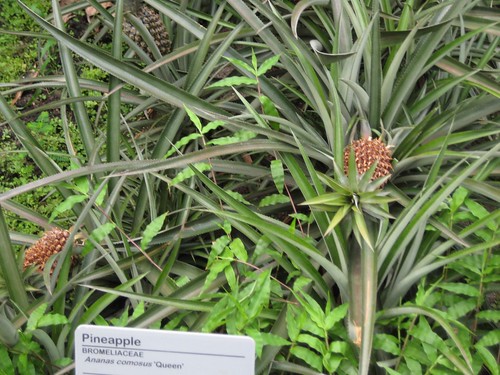
Besides the plants, they also had little vignettes set up that showed how people live in the various areas, with bamboo huts, and emergency shelters and such. And they spend a lot of time trying to educate visitors about environmental issues, food politics and sustainability. For instance, I honestly had no idea this is what pineapples look like when they're growing. ( And don't try and tell me you did...)

It's like they're growing out of little tufts of tall grass. Honestly, if I thought about it at all I thought they grew on trees like coconuts.

The other biome had a much more temperate Mediterranean set-up, so we had a look around there too. We also had a wander around outside, though it was a really odd sensation after being in the biomes. I kept having to remind myself that we actually really were outside, because the biomes are so big and well-designed.

It was also interesting to learn a bit more about the Eden Project, which isn't just about chucking a load of plants into an old clay pit. They're all super enviro-friendly, and community-minded and such. They've got solar power, and rain water recycling, and a little tractor train running on bio-diesel that's used to ferry around the lazy and infirm.

The propaganda that comes in the guide to the place is filled with high-minded talk:

"Eden is about spectacle, education, the application of science and social change... Burning underneath all this is a passion to bring together the batallions of business with the forces of social responsibilty to forge a new social contract capable of harnessing the power and expertise of the former to the needs of the latter."

Err.. what ever. I just has a nice time looking at the plants, and marveling at the engineering of the biomes, and looking pensive at the highly meaningful seed/pinecone/egg sculpture thingy in the middle of one of the newer buildings.

Me, and the seed

And that was my day at the Eden Project. The next time you're in Cornwall, check it out. And have a pasty.

Devon, Cornwall, and the south west

Friday, July 3, 2009

After a few days in Kent, I took a train back up to London, transferred to Paddington Station, and then had 3-hour train trip across the bottom of the island, ending up in Plymouth, with a new batch of family and a new bit of the country to see. It's been a bit strange visiting all this family that I really don't know. In most cases they have been perfect strangers, but in all cases they have been generous, welcoming and lovely. And in every new house I've been in I've had the arresting experience of glancing at a wall and finding an oil painting done by my grandmother, who was a prolific painter in her later years, and whose works are apparently scattered throughout the family. It gave me an oddly comforting sense of connectedness.

Cornwall was a lot of fun, and it was especially nice to be ferried around by my hostess Anne. Driving in Cornwall was a new experience (to clarify: I was not actually driving, I was passengering). There are some wide divided highways (dual carriageways), but we spent a lot of time on smaller roads. And by "smaller roads", I mean, in many cases, "roads barely wide enough for one vehicle, with overgrown stone walls on each side, but maintaining two-way traffic flow". I'm not kidding, those were some skinny cart-tracks; most driveways in Canada are wider. Apparently though, people are just used to it. Driving these roads takes nerves of steel and a lot of skill in backing up to the last wide spot to allow opposing traffic to pass by. It's picturesque though, I'll give it that.

I spent a day in Perranporth, which is a small seaside village with a fairly well-known sandy beach. I even went for a swim in the sea, complete with borrowed wetsuit. Photographic evidence below:

Not exactly "Baywatch"

The next day was a busy one: we drove in to Truro, where we spent a bit of time examining Truro Cathedral, which has some quite nice stained glass. There was also a nice street market where I picked up a genuine Cornish pasty to have for lunch. (I also got a lovely cherry and almond flapjack, which over here have absolutely nothing to do with pancakes, and are more like oat-y granola bars. I may be developing an addiction.)

My pasty just had beef, potato and turnip, or so they claimed...

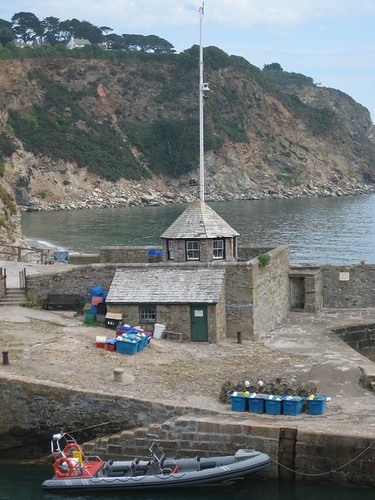
After Truro, we stopped for lunch in a nice fishing town called Charlestown, where we sat by the harbour and I ate my pasty and my flapjack and we watched some young lads diving into to water for no apparent reason other than to climb back out again, and dive in at a different spot. It was awfully mucky water for such an activity, so I can only hope there were some young women somewhere within sight they were trying to impress.

Chalestown Harbour

After lunch, it was on to the Eden Project which was quite brilliant and completely unexpected in the wilds of the Cornish countryside. In fact, it was so different that I've decided it deserves its own post so, you'll just have to wait a bit to hear about that. Instead, here's a picture of another lovely seaside town, Looe, where we stopped for supper. (Or dinner, or "tea" or whatever you call the sustenance ingested between the hours of 4pm and 9pm).

Looe

It was a long day. The next day was shorter, which was a mercy. The main event of the day was a trip up onto Dartmoor, which was quite neat. The moor is a somewhat sparsely vegetated, sort of barren area of high ground that is most famous in my mind for being the setting for "The Hound of the Baskervilles". And indeed, it was a very Sherlock Holmes-y kind of day - all rainy and misty and moor-like. The Cornish seem to be quite proud of the barren and fierce reputation of the moor - there's a famous Victorian-era prison there, so situated because even if a prisoner managed to escape he didn't stand much chance against the elements. In fact, while it was certainly much more sparsely populated and with far fewer trees and things than the surrounding countryside, it was still fairly civilized to my eye. There were loads of sheep all over (all over the road, in fact), and horses and ponies. And there were proper roads, and people and small villages. So while Dartmoor was appropriately evocative and picturesque, I didn't find it particularly threatening. I'm sure if I'd encountered it in a horse-drawn cart in January of 1850 I'd feel differently, but right now I can't help but feel that the average moor-man of today, tough as he may be, would be quite at a loss if he found himself in the middle of a prairie winter.

We did have a really nice lunch at a pub in Princetown, on the Moor. I had the Ploughman's Lunch, which may become another addiction. This is a cold plate that usually comes with bread, pickles, relish, some salad, and a ridiculous amount of cheese. I'm not kidding, the lunch I had yesterday had two enormous wedges of stilton cheese with it, and even I, professed cheese-lover, could not finish it all. (I had a Ploughman's again tonight in York and, impossible though it seemed, it came with MORE CHEESE than the Dartmoor variety. Again, cheese was left uneaten, which is a sad state of affairs.)

We rounded out the day with a quick visit to a National Trust property called Cotehele, which was quite nice, and helped by the fact that we arrived quite late. This meant that we were relieved of the responsibility to linger meaningfully over every tapestry, chamber pot and 15th century butter knife. We did, however, have a nice cup of tea in the restaurant.

And that was my time in the south west (there are more photos over at Flickr). Stay tuned for details on the Eden Project, and for the further adventures of Go See Run Eat Drink in York, Harrogate and on to Edinburgh!


Running the White Cliffs

Wednesday, July 1, 2009

Last week I finally dragged myself out of London and spent a couple of days in the seaside town of Deal, on the Kentish (south-east) coast, just north of Dover. I was there mostly to visit family, and to enjoy a couple of days of luxurious Bed and Breakfast living after ten days at Stalag Russell Square.

(Aside: The B & B was totally brilliant. I had a whole room to myself, with a bed, and sink and mini fridge and tv and a bathroom right outside the door. And the breakfast! As I said in my Twitter: "Full English Breakfast: egg, toast, sausage, bacon, fried potato, fried tomato, fried mushrooms, fried slice. Coronary bypass optional. Yum.")

I treated Deal like a bit of a break after the hectic pace and spartan accomodations in London, and decided it would be a good chance to have a nice long run. Looking at a ridiculously large-scaled map, I realized that it might be quite possible to run all the way from Deal, through St Maragaret's to Dover, a distance of about 14 miles round trip. The day was overcast and threatening rain, so it was good running conditions and I thought it would be really cool to run all the way to a whole other town and back. That's not generally something that's possible to do in North America (Dwayne notwithstanding).

I set off on a nice paved seaside path, and made good time until I got here:

Fair enough, I thought. It doesn't say "Go away", it just says "Stay on the path". And the alternative was this:

So I took the sea-level path, and had a nice view of some old bunker sort of things behind a fence, until I came to a complete dead end. What I hadn't really thought through was that Dover is situated at some fairly well-known White Cliffs, and I was starting in a sea-level town, thus implying that eventually I'd have to deal with a fairly significant elevation gain. So I turned around and braced myself for the trip up the cliff. In fact, there was a public footpath and a stone staircase. (Of course, there was as staircase, because as I've mentioned before, the entire island has been completely inhabited or about a thousand years. Also, the English take their public right-of-ways very seriously. I was a bit surprised there was no escalator.)

Once I got up the stairs, it was clear that the whole run was going too be very very hilly. I walked some of the really hard uphills, and made pretty good time until I ran across a WWI monument and veered off course to have a look. Here's a look at the dedication; the monument itself was a tall spire.

Getting on from there I think I took a wrong turn and ended up wending my way through a bit of a small town, through back roads, across cattle gates and finally managed to get back to the cliffside path. I didn't make it all the way to Dover, but the path seemed to end, and I'd covered a bit more than 10k, so I took a break. I stopped for some pictures, and Twittered, "Running the white cliffs of Dover. Sitting on the edge right now, higher than the gulls, France through the mist. This is what it's about."

See? I was really there!

It was a really nice moment, sitting there thinking, "I'm really doing it. I've got here, I've seen things, I'm running. It's actually happening. I actually made it happen."

And then there was the trip back. I found the return path, so I didn't have to visit the cattle gates and back roads again, and I enjoyed the (mostly) downhill terrain. Here's a look at that monument, on the way back. How's that for a scenic long run?

The run back was tough - I'm really not used to that kind of terrain, and the weather was heavy and humid so I was completely drenched in sweat. Couple that with the dirt and scrapes I picked up from a small tumble on the path and I must have looked like I'd been on maneuvers for a week. I'm sure I was a bit of a sight for the genteel English dog-walkers and seaside strollers back in Deal. So, having no face left to lose, I took off my shoes and socks, and waded in the sea a bit to rinse off. The whole thing ended up being a tough workout, but how can you complain about a run that takes you past two castles along the coast of the English Channel? No complaints here.

P.S. Don't get used to the video business. That 24 second video took about half an hour to upload, and that was on a wired broad-band connection. That ain't gonna happen in many places...

Looking back, already

Monday, June 29, 2009

It's Day 14 as I write this, and if my trip will be 50 weeks long, that means it's already 4% over. I was really negligent in recording my thoughts and impressions for those first two weeks, though I'm trying to catch up now with a journal. It seemed that there were far more interesting ways to spend my time than by writing things down. I'm now trying to make a habit of writing a little bit each day, and I'm slowly trying to remember things from those first 14 days too.

London was, in a word, fantastic. I'm sitting here at a bit of a loss for words because I'm not sure where to start, so I'll try Day One:

I am really really glad that I looked up the London Hashers. I thought it might be a bit ambitious to arrive at 8:25am after a trans-Atlantic flight, and then be in any shape to hash the same night, but it turned out to be a great plan. The London Hashers were friendly and fun, and it was a great start to the trip. Rather than being an anonymous tourist in a sea of other tourists (and London is a sea of tourists), I was welcomed as an individual, and learned people's names, and made some real connections. In fact, it was so much fun that I went the next night to run with the City Hash. (There are lots of different Hash groups in London. If I'd wanted to, I could have run on Wednesday in West London. There seems to be quite a bit of overlap between groups, but also some friendly rivalry.) Hashing was great, and if it turns out to be this good in the other places I visit, then that will be a fine thing indeed.

Me at that first London Hash. The guy on the right is another visitor, from Sweden.

Seeing the sights was also quite great. Here's a quick list of the stuff I saw in about 10 days: the British Museum, Trafalgar Square, Piccadilly Circus, the Houses of Parliament, Big Ben, the National Gallery, the British Library, the London Transport Museum, Covent Garden, Buckingham Palace, Westminster Abbey, the reconstructed Globe Theatre, the Cabinet War Rooms, the Churchill Museum, the Tower of London, the O2, Hyde Park, Speaker's Corner, Kensington Gardens, Regent's Park, Greenwich, blah blah blah... At each place I felt like I could have stayed for 3 days, and each place I visited was only one on a list of hundreds more that I didn't see. I could spend a year in London and not see everything, so it was all a bit overwhelming. At the same time, though, it was almost a relief. I mean it's so impossible to cover it all that you just have to let things go. I also figure that this isn't your average 2-week vacation, wherein one might be expected to cram in every possible attraction in a 50-mile radius. This is not a sprint... it is a marathon, and as such, pacing will be critical. I don't want to make the rookie mistake of starting too fast.

The wall tiles in the tube station a Baker Street. I love these.

And here's a taste of what I missed: either of the Tate Galleries (Modern and British), the Victoria and Albert Museum, St. Paul's Cathedral, Tower Bridge, the Natural History Museum, Portobello Road Market, Canary Wharf, the London Eye, the National Portrait Gallery, the Imperial War Museum, St. Martin-in-the-Fields, Madame Tussaud's, the London Zoo, blah blah blah. And really, I'm not particularly bothered. I just have to be confident that some day I will be back, hopefully sooner rather than later. Perhaps even next weekend.

And here are a few thoughts, somewhat randomly presented, on London, and England, and the trip and whatever:

1. It is absolutely worth the money to pay for a good, knowledgeable guide at major sights rather than bumbling around on your own, not sure of what you're looking at. England has a guild of Blue Badge guides who are highly trained and accredited and are totally brilliant. I'm at the point now where I'm not interested in anything anyone has to say unless they're wearing a blue badge. I hooked up with Blue Badge guides mostly through London Walks - a company that operates about 12 zillion different walking tours throughout London and the surrounding area. Each one starts at a tube station, and troops you around various sights led by a Blue Badge guide. I did London Walks through the National Gallery, around Westminster Abbey, through "Christopher Wren's London" and at the Tower of London. Each time I was totally convinced that it was worth the £7.00 for the commentray, anecdotes and information the guide provided. The National Gallery and Wren tours were quite small, but the Westminster Abbey and Tower of London ones were huge. However, despite the size of the group, I really didn't feel like I was short-changed at all. The trick is to stick close to the guide, and leave to stragglers to their fate. London sight-seeing is not for the weak of body or spirit. Both my big tours were conducted by the same guide - Brian. He was great - loud and funny and had lots of stories, and fielded every question I asked him, including the one about the odd species of trees planted in St. James's Park. I'm not convinced that all his anecdotes were entirely truthful, but they were fun and evocative, so who cares?

Brian gesturing at the multitudes inside the Tower of London.

2. The history here is just ridiculously ever-present. You can't turn a corner without bumping into another bloody 14th century church, or a monument to some grand battle, or a world-class museum, or chunk of Roman wall or something.

I wasn't even looking for this place. I just wanted somewhere to eat my tuna-and-sweetcorn sandwich on the way to the Globe Theatre, and I headed for a nearby patch of green on the map. Southwark Cathedral - 13th century.

3. Something else that strikes me is that the entire island is so thoroughly inhabited. Compared to Canada, it's positively tiny, yet the population is almost 61 million. There are some many people, and they've been here for so long that the entire place has been completely surveyed, mapped, occupied and tromped across for hundreds and hundreds of years. It's completely civilized, and I don't mean that in the "raised pinkie" sense. It's odd compared to Canada where there are vast areas of land where no one has ever set foot. I'm told Scotland is a bit more wild, but here in the south, it's anything but.

4. In North America a road might called "Milk Maid's Lane" so that it will sound charming and historical and hence fetch an extra $10,000 per property lcoated there. Here, a road is called "Milk Maid's Lane" because in the 15th century, that's where actual milkmaids lived or worked. And there are a thousand Milk Maid's Lanes.

Look closely at the street signs, and remember I saw "Priscilla, Queen of the Desert" the night before.

And now, from the last entry in the diary of Sir Walter Scott (original of which on display at the British Library):
"It seems a pity, but I do not think I can write more."