It’s really hard to know what to write about Ypres. It’s like the enormity of the thing, the place, the history… it’s beyond words. Again and again my expectations were challenged. Again and again the sheer lunacy of the thing and the unfathomable tragedy of the results were driven home. All I can really do is tell you about it, so here goes.
I started at the Menin Gate for the 8:00 pm Last Post Ceremony, armed with warnings from several people that I should take tissues. I had excellent instructions from Andre, my host at the B&B Hortensia (“Walk along the ramparts to the Gate.. get there by 7:30… go down the stairs here… try to stand here… the buglers will be here… ”). Right from the start it wasn’t what I was expecting. The Menin Gate is big. I don’t know what I was picturing, but it wasn’t that.*
 The Menin Gate
The walls of the "Monument to the Missing" are inscribed with the names of almost 55,000 Commonwealth soldiers of the Great War whose bodies were never recovered and so could not be properly buried and marked. Every wall is covered with names, organized by country and regiment. Naturally I looked for the Canadians, and I didn’t have to look hard.
 The Princess Patricia’s, one batallion now based at CFB Shilo, Manitoba
Just before 8:00pm they stopped the traffic going through the gate, and by this time there was quite a crowd gathered, probably a few hundred people. Most looked like tourists, but there was a fair number of uniformed people too, some obviously veterans.
 Some of the crowd
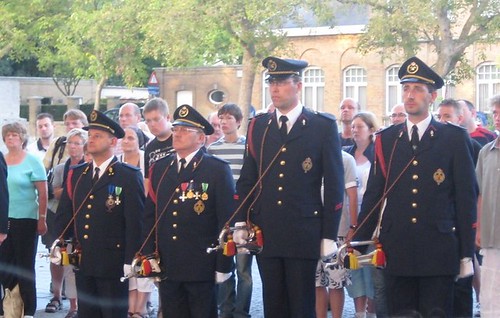
And then the buglers arrived – four of them, which is three more than I was expecting. I suppose this makes sense though - with just one set of lips, there’s always the chance of a wrong note or a slip-up. After one warm-up note, they launched into the Last Post and again I was surprised. It wasn’t slow and plaintive, it was loud and fast and almost defiant and the acoustics under all that stone made the notes reverberate. The whole thing was more stirring than mournful.
 The buglers
After that, a single soldier stepped into the centre of the opening and recited this verse from "For the Fallen" by Laurence Binyon.
They shall grow not old, as we that are left grow old:
Age shall not weary them, nor the years condemn.
At the going down of the sun and in the morning
We will remember them.
And then a series of wreaths were laid. Some by uniformed soldiers who must have been on active duty, and some by grey-haired veterans with medals and memories, and one by a group of spotty English public school teenagers. And then it was over for that day, but would be repeated the next day and the day after. They do it every night**. The whole thing was quick, but poignant, and a good warm-up for the next day.
For Thursday I’d booked a spot with Salient*** tours to see some of the famous WWI sights around Ypres. The tour was a small one – only 8 of us in a mini-van with a guide. We started at Hill 62 – at a memorial to the battle where Canadians fought to defend Ypres from April to August of 1916. Not a well-known battle, but once again I was face-to-face with the Canadian presence. Like almost all memorials, there was a little weather-proof enclosure that housed the Visitor’s Book. I signed it, little realizing how many more there were to come.
 The Memorial - everywhere I went that day had those little crosses and lots of Canadian flags.
After Hill 62 it was a very short ride to the Trench Museum, which I think was only a re-creation, but still chilling. There was a long series of trenches zig-zagging through a pleasant treed area called Sanctuary Wood, though back in the day the trees had been blasted to nothingness and the soil churned into a deadly soup of mud and blood and barbed wire – nothing like the quiet place I walked through. The thing that really hit home was seeing the shell holes that still marked the landscape. I walked through the trenches but it was impossible to imagine what it would be like to launch over the top into a rain of machine-gun fire, and end up, if you were really lucky, diving for one of those shell-holes into 6 inches of water and a few precious moments of cover.
 The trenches
 And the shell-holes
The “In Flanders Fields Museum” I visited later that day had a room with a big sign outside it warning people that the exhibit inside might be shocking, since it was meant to simulate something of what it was like to be in the trenches. It was a complete joke. A large, dark-ish room with two rear-projections screens showing black and white images, and some music and voice-overs, and the occasional flashing light. Ridiculous. It seems to me that in order to even remotely approximate the experience in the trenches you’d need dress everyone in wet wool and heavy leather boots, shove them face-first into 3 feet of mud, and leave then there for 2 weeks. Oh, and shoot at them at lot, of course.
And then it was cemeteries – Essex Farm first. It’s a small plot of land, but is the last resting place for 1,200 Commonwealth soldiers. That was another shock – such a small space of land, but so many dead. Essex Farm is especially significant because it’s at the sight of a former dressing station where Lieutenant Colonel John McCrae wrote “In Flanders Fields”. The guide pointed out a spot near the main road where McCrae apparently sat on the back of an ambulance and penned his famous poem. If you grew up in Canada you probably know them by heart, but hearing them read out loud on the very spot where they were first set down is a very different experience than hearing them at a Remembrance Day ceremony in a school gym in Saskatoon.
One set of five or six markers at Essex Farm were crammed tightly together, and our guide explained that this wasn’t for lack of space. It was probably because the men there had served together and were killed in the same battle – probably even by the same shell. Their remains couldn't be separated so they’re buried like they died – together. God.
Then it was a German cemetery – Langemark. Very different in style to the Commonwealth war graves. Much darker and more Teutonic somehow. Rather than standing stones, there were flat markers on the ground, each with around 15 names on it, making Langemark the final resting place of about 44,000, which includes 25,000 in a crypt at the same site. Again, the numbers were hard to fathom.
At each of our stops the guide unrolled a large map of the area around Ypres and pointed out an important hill or town or road. Different trench lines were marked in different colours, and you could clearly see the bulge in the lines around Ypres. It looked like a huge area until I saw the scale of the map – 3 inches to the mile. It was TINY. I could have run across the whole map in about an hour and a half. And how many thousands died there? So many that they’re still discovering bodies all over the area - 12 to 15 every year. And unexploded ordnance is unearthered regularly. Farmers dig it up and stack it by the side of the road and crews come and pick up.
 Pile of shells awaiting disposal – the pointy ones leaning up against the post still have their nose-cones, so they’re probably still live.
After Langemark we made our way to another important Canadian memorial. It was a short drive. In fact, they were all short drives. The scale was heart-breakingly small. Here’s where we went next:
 The Brooding Soldier (the Saint Julien Memorial) . Commemorating the Canadian defense against the first gas attack on the Western Front. Brilliantly designed by Frederick Chapman Clemesha and surprising to encounter in real life.
Finally, it was Tyne Cot, the largest Commonwealth war cemetery in the world, and our last stop. 12,000 graves, but again, it seemed small. Maybe it’s just my in-born Canadian sense of scale, or maybe I’ve seen too many perspective shots of “crosses, row on row”****, but the area covered by Tyne Cot was just smaller than I was expecting. The immensity and awfulness of the whole thing made me feel like there should be ranks of white markers stretching beyond the horizon, but in fact it only took a minute or two to walk from one end to the other. It seemed too small for the enormity of the events.
 Tyne Cot
As with my post about my black cab tour through west Belfast, I’m struggling with finding something to say about this experience. There’s nothing I can add here that hasn’t been said before, or that isn’t wholly inadequate to express the tragedy and stupidity of what happened in this place. It was horrible and mostly stupid and way too many people died.
Let’s just not do that again.
* This points out one of the things that’s been bothering me about this trip lately. There’s so much to see, and so much history behind it all that I feel like a complete moron most of the time. It’s like I’m bouncing off the surface of things with only the barest glimpse of what’s really underneath. For Ypres I feel like I should have read at least 1,000 pages of WWI history before being allowed to leave the train station and enter the town. And it’s the same everywhere I go. It’s depressing.
** From Wikipedia: "Except for the occupation by the
Germans in
World War II when the daily ceremony was conducted at
Brookwood Military Cemetery, in
Surrey,
England, this ceremony has been carried on uninterrupted since
2 July 1928. On the very evening that
Polish forces liberated Ypres in the Second War, the ceremony was resumed at the Menin Gate despite the fact that heavy fighting was still taking place in other parts of the town."
*** It turns out that “salient” has a military meaning here – it’s not the adjectival "having a quality that thrusts itself into attention" meaning I'm familiar with. In military parlance a salient is a military position that projects into the position of the enemy – one where the defending force is behind the front line but because of the bulge, is surrounded on three sides. Ypres was just such a position for the Allies in WWI. It’s also in a depression in the landscape, so not only were the Allies almost completely surrounded, they were surrounded by German guns on high ground, which helped contribute to the slaughterhouse effect.
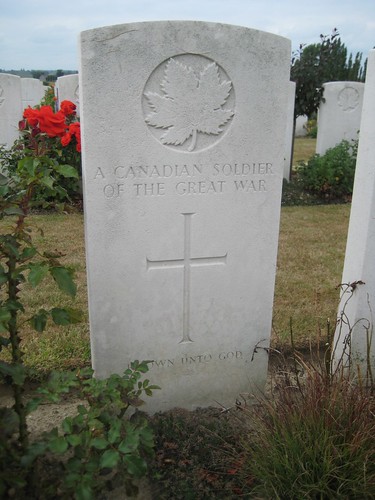
**** Another surprise – the graves aren’t marked with crosses. They’re plain white markers, as you can see - decorated with regimental badges for the UK soldiers, a rising sun for Australians, a springbok for South Africans and a maple leaf for Canadians. During the war when these cemeteries were started the graves were marked with simple wooden crosses, but the Commonwealth War Graves Commission replaced them all with permanent stone markers, and maintains cemeteries and monuments from the two World Wars all over the world.

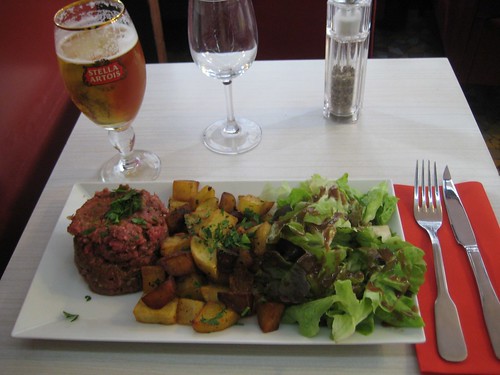 And it was a lot - a mound the size of a softball. Too much for me to finish.