
 This is a typical good luck charm hung outside shops in Old Delhi. They are composed of a black thread (always black, or sometimes dark blue) strung with 7 chilies separated by one lemon. Shopkeepers will often replace them daily before the start of business, or have them renewed by people in the neighbourhood who might also deliver the morning paper, or chai. (My old camera never could have got this shot!)
Pick of Pics: Delhi
Friday, February 5, 2010
This is a typical good luck charm hung outside shops in Old Delhi. They are composed of a black thread (always black, or sometimes dark blue) strung with 7 chilies separated by one lemon. Shopkeepers will often replace them daily before the start of business, or have them renewed by people in the neighbourhood who might also deliver the morning paper, or chai. (My old camera never could have got this shot!)
Down in Delhi (but NOT out)
Thursday, February 4, 2010
Well that makes FOUR. Four big, important, hard to replace items that are no longer with me. First was the computer – you may recall that I unintentionally stabbed it with a fork in Copenhagen. Then I left my wallet in the Barcelona metro. Smart. Very recently, my camera spontaneously stopped working. Now, it’s my beloved Palm Centro cell phone. I’ve said it before, but it was a really important bit of kit. It wasn’t just a phone, it was my calendar, address book, notepad, packing list, currency converter, alarm clock and backup camera. There’s a bit of a story about its demise, but let’s start at the beginning.
It was another night of overnight travel. I know all these nights on trains, buses, ferries and planes take their toll, but often it’s the only way, and I flew again with Emirates, so things were generally as comfortable as can be expected. I had a reasonable layover in Dubai and bought a new camera, a Panasonic DMC-TZ7, which I’m growing quite fond of. And my arrival in Delhi and cab ride out of the airport was relatively smooth and easy. I stayed the first night with my friend Patti, who’s joining me for the India-Nepal leg of the trip. She was staying with the father of a friend of hers, and he’d generously offered the room to me as well. I fetched up at the door around 11:00 am, and spent the next few hours in a sort of pleasant daze. Tired, a bit disoriented, making small talk, drinking chai, and sorting through the treats from home that Patti brought me (New, roomier pants! Long underwear! Gloves! A replacement sink stopper! And even a few un-asked-for gifts).
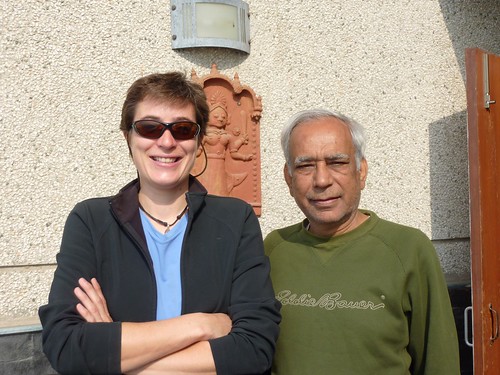
Later that afternoon we ventured out into Delhi to meet another of Patti’s friends - Non. We took the metro for an hour to get into the centre of town, which gives you an idea of how far out we were staying. It was a pleasant afternoon – we got some food and beer (yay!), and after dark we walked around an area full of narrow streets lined with shops, hawkers, street food vendors. It was really crowded, as is all of Delhi (and, in fact, all of India). At one point a couple of young boys bumped in between me and Non and I recognized immediately that they were pickpockets jostling for the wallet in his back pocket. I was standing right behind him and saw it all so I smacked the kid and he and his sidekick veered off. It made me feel like quite the smug, savvy traveler but stay tuned and you shall soon see how pride goeth before the fall.
The next morning we had an interesting cab ride down to the Good Times Hotel, where we were to join our Intrepid tour group. Even though we called a legitimate, reputable cab company, we still ended up with a driver who clearly had his own agenda. He seemed a bit hesitant about the location of the hotel, even though we had very good information, and then he had to stop for fuel. Shortly after that he tried to feed us a standard cabbie/hotel scam. This normally happens at airports when you tell the driver the name of the hotel you’re heading for and he claims it is closed, under renovation, full, demolished or otherwise unavailable. Luckily for you though, he knows a good place where he can take you (and then get a kick-back on the inflated price of your room). Our cabbie started to mumble something about how he’d got a call from our hotel manager, which was such an absurd claim that it was kind of sad. Patti and I both saw through it immediately, and were on our guard after that. It took some very firm words, a phone call to Sharma, and a suspiciously long time, but we eventually made it in time to bolt down some lunch and join the group.
The group is small – only five in total – which is unusal. Other than me and Patti, there’s Adam, Sheila and her son Jono. All three of them are Australian, and our group leader is a friendly and knowledgeable young Indian guy named Akshay. It’s nice being in such a small group, there’s a lot less waiting around for people, and we can travel a lot quicker. Happily, as is usually the case with these kind of tours, everyone is friendly and interesting, so it looks like it will be a pleasant few weeks.
After our group meeting we headed out on the metro for a tour through old Delhi. We took cycle rickshaws from the metro station to the biggest mosque in the city, and then delved into the narrow streets of Old Delhi. Akshay was pretty good at keeping us alive, but the volume of traffic – pedestrians, biclycles, cycle rickshaws and motorcycles – was so heavy that it would have been really easy to get run over. So of course, I did. It wasn’t a big deal – just the hard front tire of a delivery bicycle that ran over the side of my right foot. But I was wearing sandals, and the tire also managed to glance off my still-tender, possibly-formerly-sprained little toe, so I was a lot more cautious after that.

We stopped for a snack at a very authentic hole-in-the wall place where we tried parantha, a type of stuffed bread cooked on a grill. It’s not normally stuffed, but this place was one of only two or three – all in Old Delhi – where they’d mix things in with the dough before cooking. For 30 rupee (about 60 cents), Patti and I shared a plate with an assortment of sauces and chutneys with varying levels of explosiveness, and a mixed veg parantha. It was quite good, and left us ready for dessert, something India (unlike the Middle East) does very very well. Our next stop was a famous sweet shop, where we loaded up on a wide selection of treats, some of which we tried right away, and some we saved for the train trip the next morning.
Unexpectedly, the most fun and interesting stop of the afternoon was our visit to a Sikh temple. Each Sikh Temple – called a Gurdwara – is open to anyone of any caste, religion, gender or nationality. Everyone must take off their shoes and cover their heads before entering. We had a quick look at the central prayer area, but the best part was when we visited the community kitchen, called the Pangat. As explained in a pamphlet we picked up:
The two important features of a Gurdwara are the Sangat – the congregations and the Pangat – Community Kitchen, also known as Guru-Ka-Langar. This community kitchen is meant for providing food to all the devotees, pilgrims and visitors. It is a symbol of equality, fraternity and brotherhood. It is there that the high and the low, the rich and the poor, the learned and the ignorant, the kings and paupers, all share the same food sitting together in one row. The kitchen in run by the common contributions of the Sikhs. The institution of Langar (common kitchen) is instrumental in creating social equality among the whole mankind.
The fun part was actually visiting the kitchen. We got to try rolling chapatis with the other women volunteering, and I even spent a bit of time at the chapati grill, armed with a steel implement, trying to keep up with flipping the chapati at the right time, and then transferring them to the special grill where they puffed up and got that nice char. And we visited the communal dining area and had a bit of chai. It was a really nice visit, and it was fun that most everybody just dived in and tried things.

After the temple it was time to head back to the hotel, so we piled into the metro again. It was rush hour by this time and the whole place was crammed. In the Delhi metro you have to go through a metal detector and a pat-down every time you enter a station. They have separate lines for men and women, and on this occasion the line for the men was so long it stretched up the stairs and towards the street, I suspect there were a thousand men in line, and that was just at one entrance to one station. The women’s line was very short, so Patti and Sheila and I breezed through and waited for Akshay, Adam and Jono on the other side. (The ratio of men to women was interesting indication of exactly how few women are part of the 9-5 work force in Delhi.)

When we lined up to get onto our train the crush of people was astounding. And when the doors opened people just kept cramming themselves into the car. Patti and I got in and I can’t believe the number of people who were able to squeeze in behind us. It’s hard to describe how tightly packed we were (in fact I tried to write that last sentence three or four times before I gave up). It was actually a bit fun, and Patti and I laughed and joked and eventually we made it to our destination and headed out into the night.
That’s when I reached down to my pocket and realized my cell phone wasn’t there. It’s always there. I go for that pocket a hundred times a day to check to time, or make a note, or look up a currency conversion. I couldn’t quite believe it – I checked my other pockets, and my daypack, but deep down I knew it was gone. It must have happened on the train – it was so crowded that there would have been no way I’d notice someone getting at my side pocket. Even though the pocket was snapped shut and the extra zipper I put in was closed the ride was long enough and I was distracted enough that someone managed to grab it. At least that’s what I suspect happened but I’ll never really know. I guess it’s possible that I left it somewhere, or dropped it, or something. Probably not though.
So it was a sad, angry walk back to the hotel. And every time I remembered something else that device did for me, I was sad and angry all over again. Most of the information in it is backed up in my computer, which is a big relief, but I did lose hundreds or text message conversations that I enjoyed going back and reading, and I lost some sound recordings that I’d made as well that meant a lot to me.
So what now? I have a few choices. I can buy a cheap phone just for India and toss it away in a week; that would cost about $40. Or, I could hit eBay and order an exact replica of the phone I lost. This would be easiest, mean an almost seamless transition, and cost a very reasonable $150. But more and more I’m thinking about upgrading. I’d kind of promised myself a new fancy phone gadget at the end of the trip anyways, so I wonder it makes sense to just get it now. Gadget lust is coursing through my veins and I’m spending a lot of time cruising eBay for unlocked iPhones. I haven’t ordered anything yet, but it may be inevitable.
For now though, I’m just living without. Patti’s Blackberry is our alarm clock, and I’m wearing my running watch so I can tell the time, and taking notes with a pen, and reconstructing my packing list on paper. Now that I’m getting used to it, I think I may just stay unplugged for the next two weeks. But the whole thing left me kind of jittery – especially the following morning. I was paranoid about my stuff, and suddenly everyone and everywhere seemed really unsafe and dodgey. And I have to admit that dealing with the logistics of replacing another important piece of gear while on the road is tiring. I guess it was too much to think I could travel like I am for a whole year without losing something in this way, and I suppose I should be grateful that both my passports are still with me, and that I’m now experienced with overcoming these little hurdles.
But enough about my woes. I’m in India, and it’s just as big and noisy and squalid and colourful and spicy and smelly and incredible as everyone says. So screw you pickpocket!* I’m determined to have fun here, and you can’t wreck that.
* When I emailed my friend Karen about the incident that evening she promptly wrote back and asked if I wanted to send the guy a nasty text message. So she wrote him and told him he sucks. And he does.
Musings on the Middle East
Monday, February 1, 2010
Thoughts on two weeks traveling the Middle East, in no particular order.
----------
For reasons passing understanding, restaurants in Jordan and Egypt often provide kleenex instead of proper napkins for wiping one’s hands. All over the place – everywhere from the Bedouin camp in Wadi Rum to the posh seafood restaurant where we had supper in Dahab, Egypt, there were boxes of kleenex on the tables. At first I thought they’d been hauled out because the place had run out of proper paper napkins and was improvising, but in fact it seems to be the norm. As you’d expect, it sorta works, but not really.
----------
I'm finally – FINALLY – running again. Not regularly, but I ran twice in Amman on the treadmill in the Magic Hotel. And I hashed in Amman in the torrential rain. And best of all, I got to run outside twice, once along the waterfront in Luxor and once again in Aswan. I was a bit worried that I’d get hassled by the local men, and I did get quite a few comments, but they were all positive. “Good exercise!” and “Very nice!” and “Strong Woman!” and stuff like that. I even got some sporadic applause when I passed by one or two different groups. It was a nice change from the hassle you normally get when walking along touristy spots. Then it’s a constant barrage from touts selling felucca cruises or carriage rides or from taxi drivers or people manning the endless stream of stalls selling tourist tat. It’s exhausting trying to stay pleasant but asserting, for the eight hundredth time, that no, you do not want a taxi, or a felucca or a papyrus print or a scarf or a crystal pyramid with a 3D image of King Tut suspended inside it. When I was running I was immune to all that, maybe because I was moving too fast for them to bother with me.

And the other nice thing? I’d forgotten how good it feels after a run. It’s been so long since I’ve done regular exercise that I was surprised by the wave of contentment and happiness that washed over me after my run in Aswan. Great.
----------
Tipping – baksheesh – is a way of life in the Middle East. Hotel receptionists, bellmen, housekeeping staff, local guides, camel drivers, station porters, donkey wranglers, dive shop owners, felucca sailors, taxi drivers, guys at checkpoints, police, waiters - basically anyone drawing breath within a 10 metre radius of any activity in which you are involved - will expect a tip of some kind. As the Imaginative Traveller trip notes say:
Throughout the Middle East, tipping is part of the fabric of life. The local word is 'baksheesh', which when translated into English falls somewhere in between 'tip' and 'bribe'. Everyone constantly tips everyone else and foreign travellers are expected to comply with this system. It is part of everyday life and is a form of remuneration for doing something, regardless of the standard of service. This is quite confusing for those used to the western concept of tipping as a way of showing appreciation. Over the years we have found that most of our customers find this constant need for tipping to be both tiresome and embarrassing, especially if you don't have the correct small change.
No kidding – in Jordan this was a nightmare. Imtrav (T.W.T.C.K.C.I*) usually suggests that the group establish a “Tipping Kitty” of about $3.00 USD per day to cover all these sort of tips, handled by the guide. This sounded like a really good idea, but our Jordan guide said that the suggested amount there was 5 JD per day, which is closer to $7.00 USD and seemed quite high to those who’d already been travelling in the area for a while and were familiar with the system. This dissention meant that we didn’t use a group fund in Jordan and therefore were each expected to tip all the appropriate people the correct amount at every turn. This was frankly impossible because you almost never have enough small change, and I, at least, am usually oblivious to when a tip is appropriate anyways. It was extremely frustrating to feel like you were either constantly being hit up for money, or constantly (and unintentionally) offending everyone around you.
In Egypt, with our fabulous guide Ahmed, the Tipping Kitty was back, including documents that showed exactly how much is allocated for each different service in each place. (why didn’t we have this in Jordan?) I simply gave Ahmed my 165 Egyptian Pounds (about $35 CDN) and most circumstances were taken care of for my entire time in Egypt. It may not be in the spirit of the region, but at least it was off my mind.

----------
Ok, here’s the most annoying thing about the Middle East – it’s really hard to find a beer! Turkey was 98% Muslim but it’s still a very secular state, and it’s easy to find alcohol wherever you want. In Jordan and Egypt it’s frustratingly rare. Very few hotels we stayed at (including the magical Toledo Hotel in Amman) had alcohol available on any menu. Similarly, restaurants will usually offer soft drinks, smoothies, fresh juice, four kinds of coffee and 98 kinds of tea, but no alcohol. It was a rare event indeed to have a drink with dinner, which was annoying (though it did mean the bill was usually a lot cheaper). There were bars in Aqaba, which was good, and Ahmed told us we could walk down to the corner store for beer and bring them back to the posh seafood place in Dahab, but it would have been nice to see beer show up on a menu with food. And please God, let me never have to endure another bottle of Amstel Zero non alcoholic “beer”. Ugh.
----------
It seems to be a universal truth in the Middle East that no one ever has change. Bank machines spit out £100 and £200 notes, or £50s if you’re lucky. Admittedly, a £200 note is worth about $40, which is a lot of money in this neck of the woods, so I can understand why someone would be reluctant to change it if you were buying a $1 can of pop. But I bought two 10 dinar SD cards for my camera in Aqaba and the shopkeeper only agreed to change my 50 dinar note when I said I’d buy a third card. I think they see it as a game, and whoever ends up with the small bills wins. This is probably because the small notes - £1 and £5 in Egypt – are the ones you need for the endless stream of baksheesh that’s constantly flowing out. Usually this means you have to lie about what’s in your wallet. You hand over a £20 note and the shopkeeper shakes his head sadly. “Oh, have no change. Anything smaller?” You shake your head sadly… no, you have nothing. “Ah, is problem.” You stare, unflinching. It’s £20 or nothing. You are prepared to walk out without making the purchase if no change is available. The trick is in who backs down first. If it’s something you don’t really care about, you can hang on until the shopkeeper relents and sends someone off to find change, or magically produces it from his pocket, and you win. If it’s something you really need, you pull out your wallet again and perform a much more thorough search than before and – remarkably – discover that you do have a smaller note, and the other guy wins. I sometimes wonder if they actually keep score.

----------
We spent a lot of time in small buses and minvans in Egypt, and though it’s a warm part of the world, it’s still January and temperatures are not always comfortable. Nevertheless, the drivers we had almost always kept their window at least partly open, creating a cold draft (or in Cairo, a smelly one) that just added to the discomfort. Once we asked that the window be closed and Ahmed told us that it’s normal for Egyptian drivers to keep the window open, so they don’t fall asleep. Naturally this begs the question: If you’re so tired that you need a cool breeze to keep you from falling asleep while hurtling down the road at 120 km/ph, then should you really be behind the wheel?
----------
It’s weird to me that in a region that produces an infinite variety of sticky, honey-soaked treats, the most common thing we are offered for dessert in a restaurant is… fruit. And I’m not talking about a nice fruit salad. I’m talking about a whole orange, unpeeled, and rolling around on a side plate. It’s terribly disappointing that no one seems to understand that fruit is not dessert. Fruit is… fruit. Dessert is sticky and sweet and should involve licking fingers and aching teeth. Come on Middle East!

----------
Ok, I realize this might all sound a bit whiny, so I'm going to close with a couple of my favourite and most recently discovered things in the Middle East. Naturally, they are both edible. First, lemon juice. This is NOT lemonade. I'm not sure what makes it different, but it definitely is. Very. It's got a sort of creamy frothiness that makes it taste a bit like a lemon julep. It's tart and refreshing, and I think there's a bit of the lemon zest in it. And it's always freshly made and served icy cold and it's very very very good.
Second, roasted sweet potatoes. I only found these on my second-last day in Cairo, but I wish they'd been everywhere. There was a street vendor selling them outside our hotel - he had a cart with an oven on it where he was burning some kind of charcoal. And he had a bunch of the roasted potatoes on the top of the oven to keep them warm. When you bought one (or two, if they're small), he'd pluck them off the top slice them open, and serve them on a random scrap of paper. The first one I got was on a glossy KFC menu, the second was presented on what appeared to be a photocopied page from a UK personal income tax form. And they were great. I'm not sure if you're intended to eat the skins, since I think they go straight from the ground into the fire, but the skins had a nice smokey flavour, and I think they're the best part, so I gobbled them down along with the soft, sweet flesh, and probably a thousand thousand thousand germs and gunk. But they were fantastic, and only £1 each - about 20 cents.
Second, roasted sweet potatoes. I only found these on my second-last day in Cairo, but I wish they'd been everywhere. There was a street vendor selling them outside our hotel - he had a cart with an oven on it where he was burning some kind of charcoal. And he had a bunch of the roasted potatoes on the top of the oven to keep them warm. When you bought one (or two, if they're small), he'd pluck them off the top slice them open, and serve them on a random scrap of paper. The first one I got was on a glossy KFC menu, the second was presented on what appeared to be a photocopied page from a UK personal income tax form. And they were great. I'm not sure if you're intended to eat the skins, since I think they go straight from the ground into the fire, but the skins had a nice smokey flavour, and I think they're the best part, so I gobbled them down along with the soft, sweet flesh, and probably a thousand thousand thousand germs and gunk. But they were fantastic, and only £1 each - about 20 cents.
 The Potato Man's cart. The Potato Man himself declined to be photographed.
----------
And those are parting thoughts on the Middle East. By the time this is posted I'll be in Delhi starting another 2 week tour of northern India and Nepal, accompanied by my friend Patti. The Middle East was good, and I'm glad I got to tick off all those amazing sights - Petra, the pyramids, and the Valley of Kings. But despite my constant complaints about being tired and moving around too much, I'm ready for something new. On to India!* That’s What The Cool Kids Call It. (And to Rob H: Yes, the asterisks are back, in moderation. I am making an effort to include my parenthetical statements in the body of the text, but sometimes I just feel the need for an asterisk. Plus Steven G. likes them, and I like Steven G.)
Upper Egypt: the hits just keep on coming
I told you about the Temple of Karnak, the donkey ride, the Valley of Kings and the Temple of Queen Hatshepsut. That was all accomplished in about a day and a half in and around Luxor. Not being ones to linger when there are miles to be driven and antiquities to be viewed, we hightailed it out of Luxor at the first opportunity and drove to Aswan where I had the Weird Food birthday supper you’ve already heard about.
That night we all tried to get to sleep early because there was a very very early start scheduled for the next day. We were going to see the Great Temple of Abu Simbel, built by Ramses II (who was not a guy who did things halfway). It’s a magnificent site, but it’s also located in the far south of Egypt in a very sparsely inhabited area. The 280 km drive from Aswan to Abu Simbel is apparently too dangerous to be undertaken privately, so twice a day (three times during high season) a huge convoy of up to 60 vehicles forms up in Aswan and proceeds to the site with a police escort. And when do these convoys leave? The first one leaves a the punishing hour of 4:00 am. Naturally, we decided to take the second one so we got to leave a the much more comfortable hour of 4:30 am. Yup. The alarm went of at 3:15 am and we were instructed to be in the lobby ready to go at 4:00. Nice. It would be a three hour drive in the convoy to the Temple, where we’d then have about two hours to look around, and then we’d have to report back at 10:00 am to get into the return convoy back to Aswan. Oh, and of course the trip to Abu Simbel was not included in my tour, so I got to pay an additional 80 USD for the whole business. I really hoped this turned out to be worthwhile.

I think it was. The logistics of getting to the site are definitely annoying, but when you get there it really is quite magnificent. As with the Valley of Kings, no cameras were allowed inside the temples. I think this is to help preserve the colours of the painted decorations on the walls inside (I run into this a lot – can anyone tell me whether flash photography really degrades paint? Or is this all just an excuse to try and get people to buy the professionally produced photos in the gift shop?). At least Abu Simbel still allowed photography outside – even outdoor photography is now banned in the Valley of the Kings. Merely being in possession of a camera there can net you a fine of £3,000 ($600). Actually being caught using it will cost you £5,000 ($1,000). Ahmed told us this is because too many people were sneaking cameras inside the painted tombs and then bribing the local guards to let them take photos. As usual, the countless jerks of the world have ruined it for everyone.
Here’s the other problem with the convoys – they create a huge glut of people who all arrive at the same place at the same time to see exactly the same thing. The crowds inside the big temple after we got there were awful. And of course everywhere you looked there were people taking photos, even though the local guards were making people put their cameras away. Naturally, it’s also forbidden to touch the walls inside the temple – not only is the original paint still present in some places, but most of the hieroglyphs are actually carved into the rock, not just painted. Nevertheless I saw people touching, and even leaning against the walls. There was one particularly miserable bunch – a Russian family consisting of a mom, dad and two little girls. As ai was standing nearby one of the little girls reached out to touch the carving of a figure in a side chamber of the main temple. I was a bit surprised but figured she was young and didn’t know better and would soon be corrected by a parent. Instead, dad came over and joined in the fun and I watched them trace over the whole carving with their fingers. I had to just leave the room it made me so mad. People are odious.

Luckily the crowds thinned out after while, so when I went back to have a second look at the big temple it was much more manageable (though there were even more cameras out, and I even saw one woman blithely recording a video of the whole place as she walked through). The insides of both the temples are covered with carvings and hieroglyphs. There’s even a hunting scene inside the big temple that appears on the Egyptian £20 note. It’s pretty fantastic stuff. I got my fill of the sights and had some fun playing with my borrowed camera, which has much more zoom than my old one, and thus allowed me to take some nice close-up shots.
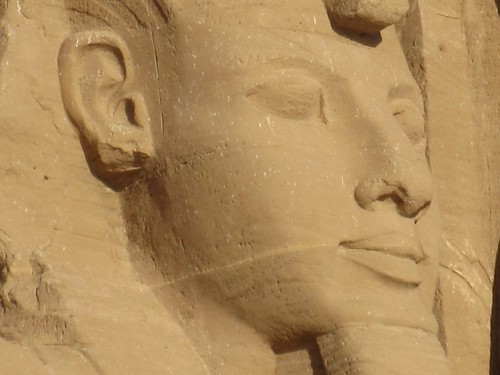
The temple complex is located on the shores of Lake Nasser, which was created after they built the Aswan High Dam in the 1960s, and forms the border between Egypt and Sudan. In fact the original site of the temple is below the current water level. As the water was rising during the construction of the dam, a team of engineers and workers completely disassembled the two temples into more than a thousand pieces and painstakingly reassembled them 65 metres higher up on the hillside. The move took four years and cost about $6,000,000 (funded by UNESCO). There was a nice display in the visitor’s centre that talked about the relocation process, but I would have liked to know more – it really was an incredible feat.
Soon enough, though, we were on our cramped minibus back to Aswan. There was another quick turnaround in the lobby of the hotel and then we were off for the felucca. A felucca, (pronounced to rhyme with Delucca, for any Winnipeggers reading this. For non-Winnipeggers: “fuh LOO kuh”) is a typical Egyptian sailboat. We were scheduled to cruise up the Nile for the afternoon and then anchor at a Nubian village where we’d have dinner at the home of the mayor. Then we’d return to the boat to spend the night under the stars before returning to Aswan by motorboat in the morning.

And this is where I started to lose heart. Maybe it was remembering the frigid temperature overnight at the Bedouin camp in Wadi Rum. Maybe it was the total lack of toilet facilities on the boat. Or maybe, just maybe, it’s that I’m tired and getting less and less enthusiastic about these interesting but uncomfortable side adventures. Whatever the cause, I decided to wimp out, abandon the boat after supper and get a cab back into Aswan where I could enjoy a night off in a hotel room that I’d have all to myself, with a hot shower and wireless internet a warm, comfortable bed.
But first we had a really nice afternoon on board the boat. The big mattress was comfortable and the roof was low enough that you were forced to sit or lay down all the time. The sun was warm, and there really wasn’t much to do but lay about, take photos, drink beer (there was a full cooler!) and nap. We even had a pitstop so a few of us could go for a swim in the Nile. I went in, but not for long because it was COLD. We also had a really nice simple lunch of falafel and cheese and pita and such.

It was excellent. So excellent, in fact, that I started to doubt whether I’d made the right decision about jamming out on the overnight portion. However I hadn’t brought any warm clothes with me from the hotel, and I didn’t have a sleeping bag at all, and by that time I had my heart set on the comfy hotel. Supper was pleasant, but by then I just wanted out. Eventually I was guided back down to the river and got a motorboat ride over to the other side of the Nile from Mohammed, one of the mayor’s sons. He was only about 12 years old, but he piloted the huge boat and waited for me on the other side until my cab came. Mohammed got a bit of baksheesh before I left.
Eventually I got to my hotel, had a hot shower, and installed myself on the bed with the tv remote in one hand and a strong wifi signal happily feeding into my computer, and everything was good. I do feel a bit bad about skipping the night on the felucca, but I got some reports the next morning when I joined the group again, and it sounds like I didn’t miss much. Basically: it got cold, there were no bathrooms, most people slept fitfully. I, on the other hand, slept in, had another hot shower, and lingered in my room getting things done until checkout time. I do worry a bit that the length of time between these little “breaks” from travel is getting shorter and shorter the longer I’m on the road, but I suppose that’s natural. I’m trying not to concern myself about it. I’m just doing what feels right at the time, and damn the consequences.
Down in Upper Egypt
Sunday, January 31, 2010
Of course you remember that Upper Egypt refers to the south of the country, upstream of the Nile, but at the bottom of the map, so we kind of went down to upper Egypt. We made it to Luxor after a long and frigid overnight train journey that you already heard a little about. We arrived at the Tutotel (Get it? Tut… Hotel…), dropped our bags, and turned right around to head for one of the big sights in Luxor – the Temple of Karnak. And instead of simply getting on a bus and driving the 3.5km, we took horse-drawn carriages. There’s a lot of that kind of thing on this tour – horse-drawn carriages, donkey rides, nights in Bedouin camps, nights on board feluccas. This is going to sound terribly bitter and jaded, but sometimes it turns out that these are the kind of things that sound hopelessly romantic and exciting when contemplated in a glossy brochure from the comfort of an easy chair, but are quite another matter entirely after an overnight train ride on Day 11 of a relentless schedule (or, for that matter, Day 227 of a less relentless but still taxing overarching plan). Regardless, into the carriages we went, and arrived at Karnak a short time after.

I was a bit frazzled and resentful that we didn’t have time for a nap or shower or anything before we were back on the job, but it turns out that the Temple of Karnak was great enough to dispel my crankiness (which has been more and more common these days, so you know it must have been pretty great). Part of what made it great was that we had a very good local guide for all our time in Luxor – Mr. Adil was apparently voted the best guide in Luxor at some point in the past, and I can understand why. He was amiable and funny and like to joke around (a bit too much for my tastes, but much more fun than the automaton guide we had in Cairo). However, he was also a serious scholar of Egyptology who had a lot of “common knowledge” kind of information and even shared some of his personal theories about the site, which were really... interesting. Some of them seemed a bit far-fetched, but he also admitted that he gets a lot of his ideas when he’s smoking sheesha, which he does a lot, so that may explain why his theories weren’t really mainstream.

The temple itself is a huge site covering about 2 square kilometres and was built, enlarged and modified over about 1,500 years. It was once the most important place of worship in Egypt and contains, in the words of the LP, a “vast complex of temples, pylons, obelisks, and sanctuaries” and “is quite possibly the most incredible sight in all of Egypt". A strong claim, but Karnak did not disappoint.
Part of what made the site really interesting for me was that its construction was never actually completed. There were the remains of a mud brick ramp that had been used to get large stones up to the top of the main wall, and Adil showed us an area where there was an unfinished column at the end of a row of finished ones. I thought it was really interesting to see.

Undoubtedly, the best part of the Temple of Karnak is the great “Hypostyle Hall” (no idea why it’s called that… I wish I’d asked Adil.) It’s a huge room filled with massive columns – 63 on one side and 63 on the other, with 12 even bigger ones running down the middle corridor. Apparently it was originally roofed with huge slabs of stone, and the few pieces of roof that remain still have the bright painted decorations on them. It’s really impressive, and all the columns are carved with hieroglyphs, some of which Adil translated for us.

I got quite fond of hieroglyphs during my time in Luxor – they really are all over these ancient sites, and it’s fun when you start to be able to recognize some favourite characters, or see the royal names in their cartouches repeated over and over again. There are lots of different birds – an owl, a goose, a quail chick, and representations of feathers and circles and water. One of our favourite characters was a relatively rare one we started calling the “Barack Obama”. You can see why.

Adil was also very fond of pointing out the best places to stand to get good photos of the site, and even showed off a few tricks for getting interesting shots, including shooting through the lens of a pair of amber sunglasses to achieve a sort of interesting poor man’s sepia/sunset effect. And he demonstrated his famous “Obelisk of Queen Hatshepsut Reflected in Sunglasses” shot with me, and I think it’s actually kind of cool.

We were finished at the Temple by around lunch time, and then it became clear that it may actually have been a good idea to get the temple finished with early on. It meant that we could then enjoy that rarest of creatures: a free afternoon. I wandered off with Fabio for a local falafel lunch, visited the “best bookstore in Egypt” (this according to Ahmed, though it really was disappointing, despite the excellent selection of used Danielle Steele paperbacks) and then hit the internet café. Then I had a nice long nap and after that I did something I haven’t done since I left Kampala – I ran. Not hiding away on a treadmill, not on a hash – just me out for a run in public like a normal person. Ahmed assured me that Luxor was very touristy and it would be no problem at all for me to appear in public brazenly displaying my bare knees, so off I went. I did 7km along the banks of the Nile and it was GREAT.
It was another early-ish start the next day for our donkey ride out to the Valley of Kings. Coincidentally it was also my 41st birthday, though the birthday portion of the day turned out to be pretty minor. My donkey, especially, seemed unimpressed by my Birthday Girl status. As for the donkey ride, it was another one of those things I mentioned above – like the horse-drawn carriages – that seems like a good idea, but ends up being fun for 15 minutes, then sort of uncomfortable, then tedious. The ride took over an hour, and a lot of it was on fairly busy streets where we were frequently passed by shiny air-conditioned buses on the way to the Valley.

Once we finally arrived, after only one mishap involving donkey and rider parting company unexpectedly and with minor blood loss (not me), Mr Adil was there again to guide us around the site. No cameras are allowed anywhere in the Valley so I have no photos, but it turned out that the whole thing was just a bit disappointing. There are a total of 63 tombs hidden away in the Valley – from an era rather later than that of the pyramids, when kings started to realize that burying themselves and their treasures underneath massive monuments was a bit like erecting a huge billboard reading “Attention thieves: unimaginable riches contained within. Please Steal.” Everything is underground in the Valley, but of all the tombs known to be there only three are open to the public. Of course the most famous tomb at the site is that of King Tutankhamen, but we didn’t bother to go into that one. It costs an extra £100 (about $20), and we’d seen all the good stuff from inside it in the Egyptian Museum anyways. Even the LP admits that it is “far from the most interesting”.
What we did see were the tombs of three different Ramses (they might have been the 1st, 4th and 9th, but I lost my notes and really, do you care anyways?). The best part about them was the colourful paintings on the walls of the corridors and chambers. The walls were just covered with hieroglyphs and scenes of gods and goddesses, and there were some where the colours were just brilliant. It was hard to believe they’re as vibrant as they are considering their age. Still, it was getting hot, and the site was crowded, so as soon as we'd seen what we'd come to see, we moved on.
After the Valley of Kings we made a short pitstop at the Funerary Temple of Queen Hatshepsut (she of the obelisk-in-the-sunglasses). It’s a really impressive site not far from the Valley. My photos of the Temple are not great because I was taking them with my cell phone camera. What I didn’t mention about the donkey ride is that just as we were setting off my digital camera packed it in. The retracting lens decided to stop retracting and now the camera won’t do anything except try to retract the lens, fail, and then try again. There’s probably a tiny bit of Egypt stuck in the mechanism. I shouldn’t be surprised; that camera has been in constant use for seven months now, and as near as I can tell it took 7968 photos for me on this trip before calling it quits (and that’s not one of those made-up numbers that I stick in here for laughs – that really how many photos I’ve taken). I was gutted about this for a while, but then I realized that it was a good excuse to get a newer, better camera. My current plan is to check out a camera shop in Cairo, and to visit some of the really good electronics shops at the Dubai airport, where I’ve got a four and a half hour layover on Sunday night. Luckily I’m not camera-less. Fabio, the young Swiss guy in the group, and one of those people who has a serious camera, also has a small Canon point-and-shoot camera as a backup. It’s actually much nicer than mine, and he lent it to me for the rest of the tour. I’m enjoying playing with it and contemplating my future new camera, a birthday present for myself.
But back to the Temple of Queen Hatshepsut. It’s a three-level structure faced with columns that used to be fronted by big statues. Most of the statues are gone now, but it’s still striking. (As was Queen Hatshepsut herself – she was the first woman to rule Egypt as a king in her own right, not merely the consort of a king. She wore the famous double crown of Upper and Lower Egypt and was apparently pretty bad-ass until she was succeeded by her son Thutmosis III who defaced a lot of her temples and stuff because he was pissed off that she’d taken over things when he was just a kid.) I thought the whole site looked a bit like a Las Vegas hotel from afar because it actually looks amazingly clean and modern.

After our short stop at Hatshepsut’s place, it was back on the bus and back into Luxor. We had a bit of time to sort out our luggage and then it was on to Aswan and more big sights. However the hour is late and my brain is tired, so I think I will save the story of Uppermost Egypt for another post.


