
 Thoughtful monkey on Emei Mountain
So many Buddhas, so little enlightenment
Thursday, March 18, 2010
(Note: It's a long-ish post today. Normally I might have broken this up into two, but my chances to post before getting on the boat are limited, so today you're getting a bit of an epic.)
(Other note: The internet is sucking today, and I have no time to deal with it - my boat leaves shortly. So this is an email post. I have no idea if the pictures will comes through, and no time to mess with it. Will fix it later.)
It's been a weird few days. The tendency to grumpiness that I mentioned earlier hasn't gone away. In fact, I think it's getting worse. I feel like I'm swinging between contentment, frustration and total despair minute by minute. And the smallest things can set me off. Here's an example: At the local internet café/hostel/restaurant I ordered a beer and a plate of noodles – number 14 and number 62. But it turns out beer is number B14, not number 14. Number 14 is Sechuan pork and vegetables. So I got a big bowl of very oily, very spicy pork and veg AND a plate of noodles. And this just about brought me to tears. The feeling passed, and quickly, but it's alarming how such small things can bring me to the brink of breakdown.
I think I'm annoying the rest of the group too. I'd certainly be annoyed with me – moody, grumpy about the slightest thing, increasingly quiet and sometimes uncommunicative. I don't really fit in with most of them, so I think I'm becoming a bit of a loner. I'm a lot older than the rest of the group, and almost all of them arrived in pairs – three sets of Danes, two couples, and one lone Aussie guy. I think I mentioned it before, but this means I have my own room all the time, which only adds to the loner effect (not that I'm complaining about having my own room, but it does let me retreat more and more into myself). Here's another example of the creepy mood swings – we're about to get on a big riverboat to cruise the Yangzi for three nights and two days. Because the boats are totally booked up, it's likely I'll be paired up in a twin share cabin with a complete stranger – possibly another tourist or possibly a local person. Contemplating this possibility fills me with dread, even though I spent months in hostel dorm rooms sharing with up to 20 strangers. I just feel like I can't face the idea of not having somewhere private to retreat from the world.
Anyways, enough of my psycho drama. Back to China! After leaving the bright lights and big city of Chengdu (pop. 4.1 million), we took a bus to much smaller city of Leshan (pop. 156,000), home of the world's largest Buddha. Built at the junction of the Ming, Dadu and Qingyi rivers, the giant Buddha is carved into a cliffside along the water. The idea was conceived by a Buddhist monk in 713 AD during the Tang Dynasty, and took a mere 19 years to complete. The hope was that the presence of the Buddha would calm the river waters and protect the local boatmen. During construction the surplus rock was used to fill hollows in the riverbed, so in the end the waters did calm down, though it's a matter for debate whether one should thank the Buddha, or the engineers.

It really is massive – 233' high, with shoulders 78' wide… even his eyeballs are 11' across, and his fingernails are bigger than the average person. We approached from a tourist boat on the river, which is definitely the best angle. (Aside: I think the coolest thing about that Buddha is something hidden from view. Even though it's 1,200 years old, it's suffered relatively little erosion because there's a hidden drainage system! Clever monk!) After the Buddha we had a really nice lunch with the local Intrepid operator, Mr. Yang. He's been an English teacher, local tour guide and restaurateur in the area for ages, and he and his wife laid out a huge and excellent banquet for us up in his dining room. I say huge because there was more food than we could eat, but this is actually the norm here. Just like that first meal I had with the hashers at the Great Wall, every time we sit down to eat there seem to be more dishes than it would be possible to finish. I think this is part of the etiquette here – to completely finish every dish would imply to the host that he hadn't provided enough food, so the host eliminates the chance of that happening by serving up more than could possibly be eaten. Regardless, lunch with Mr. Yang was some of the best food we've had since arriving in China, and fortified us for the next leg of the journey.

I was well-fed by Mr. Yang, but no more enlightened by the giant Buddha than when I started. So it was on to more Buddhas, this time at Emei Shan (pronounced "OH-may San"). Emei Shan is one of the four sacred Buddhist mountains in China. (I would list the others, but do you really care?) We stayed in a small town at the base of the mountain called Bauguo, in the Bauguo Monastery. Staying in the monastery was ok, though as you might imagine, the facilities were fairly basic. Our first night was also pretty chilly, though I managed with my long underwear, Hash hoodie and spare blanket.

It rained overnight, and the morning we were to ascend the mountain was clear and cold. Huang said we were exceptionally lucky, since it's normal for the mountain to be shrouded in clouds and fog most of the time. It didn't feel particularly lucky, though, when we got out of the bus at the upper parking lot to be greeted by this sight:

Our ascent actually turned out to be quite easy. Some tourists spend two days hiking up the mountain, and we even saw a monk prostrating his way up the mountain – three large steps, then down on the knees with forehead pressed to the ground, then three more steps. Lacking the devotion for that kind of ascent, we got a bus as far as the upper parking lot, then walked for about half an hour to a cable car and caught that right to the summit. The heavy, wet snow packed down quickly into that sort of slippery pseudo-ice, so walking up the steps might have been a bit treacherous if we each hadn't been equipped with a pair of special grippy devices for the bottom of our shoes. They were like Chinese Yaktraks, and worked remarkably well. Vendors along the path were selling them, but ours were provided by our local Intrepid operator. The vendors were also selling long toe-less socks that were meant to go on the outside of your shoes to provide grip, and a sort of raffia/wicker sandal to tie underneath your shoe for the same purpose.

It was actually a pleasant walk, except for the big globs of snow melting off the branches of trees that occasionally landed on my head. At least the sun was shining, which helped my mood. It seemed like ages since we'd had a sunny day, and I was beginning to feel like the citizens of Chengdu must feel with their 300 overcast days per year. At the top – called The Golden Summit, is the Jinding Temple, topped with another big Buddha, this one golden, and complete with elephants. We got to go inside the temple underneath the big statue, and George, our local guide, explained some things about it.

We had some time to wander around at the summit, and because the day was so clear the views were quite amazing. They claim there are four "wonders of the natural world" at the Golden Summit. We missed three of them – the sunrise (thank God), the Buddhist Divine and the Saints Lights, but we certainly saw the Sea of Clouds.

We walked back down the way we came, though by this time the sun had melted a lot of the snow and the temperature was very pleasant. And because things had warmed up, we got to see the other natural phenomenon of the area – the monkeys! Apparently some people come to Emei Shan just to see them. They are quite brazen, and frequently steal food and water bottles from people who are careless enough to leave such items accessible. We saw a few incidents where stupid people with open shopping bags of food had the bags ripped right out of their hands so the monkey could sit in the middle of the path ransacking whatever was inside. This was normally accompanied by wailing on the part of the victim, much photo-taking on the part of everyone else, and the eventual waving off of the monkey by someone with a stout stick. In fact, along with our metal grippy-things, our local Intrepid man provided each of us with a monkey whacking stick, though none of us was called on to use it in that capacity.

After another trip on the cable car and another bus ride we ended up back at the parking lot where we'd started that morning. By this time it was close to 3:00 pm so we were all ready for lunch, which turned out to be another gut-splitting event. This was not a bad thing, though, because we still had the bulk of the day's activity to come. We were going to hike back up the mountain to our destination for the night – the Hongchun Ping Monastery. It was about a three hour walk. By this time we'd descended far enough and the day had warmed enough that there was no snow in sight.
The walk itself turned out to be different than I expected. I suppose since I'm used to the wild and undeveloped nature of the Canadian woods, I was surprised at how built up the path was. Every step of the way was paved with large stones, and there were railings and stairways, and impossibly picturesque little pagodas and stopping points all the way. It was fantastic, and seemed somehow very Chinese. It was like those typical Chinese watercolour paintings you see on scrolls – a deep river valley covered in trees, a waterfall, an inviting path and a small house perched on the side of the hill. I took many pictures to try and capture the look, but for now here's just one glimpse. Check out Flickr for more.

Well, I say it was great, but that's really only true up to a point, and that point was a lovely covered bridge that marked the last stage of our trip up to the Hongchun Ping Monastery. By the time we got to the bridge we were already quite warm. I'd shed as many layers as possible and I had then stuffed into and strapped onto my daypack in whatever way I could. Still, there was no getting around it, there were over one thousand steps to climb to make it to our home for the night. It was at this point I started to understand the point of view of the people who'd hired a sedan chair to ferry them, Cleopatra-like, up and down the mountainside. Earlier in the day I'd been filled with contempt for these apparently able-bodied people who were literally carried on the back of others – especially since the architecture of the chairs forces you into a sort of lounging postion that just emphasizes the incredibly lazy nature of the thing. But part way up the thousand steps I would have gladly handed over my credit card.

Those damned stairs just kept going. Every time you reached a landing or a turn, you'd be greeted by the sight of another flight of stairs and another turn in what seemed like an endless climb. By the time I made it to the top I was in a perfect state: dripping with sweat, and completely fed up with stairs, monasteries, China, traveling and life in general. It was a grumpy moment writ large. I actually had to stop just before the entrance to the monastery and stand there to try to compose myself. I didn't think the monk should have to deal with me in either of the states I was close to: screaming or weeping. Eventually I regained my composure, and it turned out the monastery was a pretty nice place. The rooms were pleasant, and the beds were equipped with electric blankets and they had hot showers. It's remarkable what a couple of amenities like that can do for one's mood. Soon enough I was clean and happy, tucked into my toasty bed and quietly reading while I waited for supper time.
We didn't eat in the monastery, but went back down a few flights of stairs to a tiny restaurant we'd passed on the way up. The Hard Wok Café (Ha!) was a bit ramshackle, clinging as it was to the side of the mountain, but the food was predictably plentiful and tasty and they had cold beer. The next morning we even had breakfast there, and though the service wasn't fast (by any stretch of the imagination) the banana apple chocolate honey pancakes were worth the wait. Then next time you're nine tenths of the way up the stairs to the Hongchun Ping monastery, I'd recommend a pitstop with Betty at the Hard Wok.

We had a fairly leisurely start that morning – late enough that I woke before the alarm and had another hot shower and the time to wander the monastery a bit, soaking in a bit of much-needed calm, and taking a lot of pictures. It was a short time, but it did wonders for my mood.

The walk back down the mountain was easy and pleasant – nothing like the misery of the day before. We retraced our steps to another picturesque pagoda and there divided into two groups – those who would take the easy one hour stroll back to the parking lot, and those hardy souls who would take the scenic and more taxing three hour walk right back to the Baoguo Monastery at the bottom of the mountain. Considering the fragility of my mood these days, I think I was wise to choose the short and easy route. It was a quick walk, and the bus back to the monastery was quick too. This left us with time to explore the local hot springs! They turned out to be a bit of a disappointment – more a warm swimming pool than the steaming, rocky, open-air business we'd been expecting. Still, the locker rooms were nice and there were more hot showers (two in one day!) so you really couldn't complain too much.
That night I decided to forgo the group dinner and went straight to the local internet café where I had the momentarily disastrous ordering experience. I was mostly there for the free wifi, and was immensely relieved when it turned out that China, Flickr, and my computer were all playing well together for a brief, shining moment. I managed to get all my photos uploaded, and stayed long enough to have another B14.
By the time I trudged back up to the monastery my mood was reasonable. I passed through the darkened main courtyard, and stopped for a while in front of the open entrance to the temple. The statue of Buddha was lit up, and the pyramids of Coke were standing on the altar (if they call it an altar), and there were colorful round pillows on the floor for worshippers to kneel on. I stood there for a long time staring at that Buddha, and inside I thought that I might finally be gaining a tiny bit of peace from rubbing up against so many Buddhas in the last few days. Whatever the cause, I went to bed feeling content, and am determined to try and stay that way. At least until some other disaster befalls me, like a cold cup of tea or a hangnail.
Special Bonus Photo: I've started taking pictures of the crazy English translations that appear on signs and menus, and I just have to share. Some of the are funny, but some are almost poetic. This is my favourite in the latter category, seen outside a temple on the Golden Summit. It's practically haiku.

Pandas and puppets
Wednesday, March 17, 2010
Note: You should all count yourselves very very lucky that there are photos in this post. For some reason I have been unable to upload any photos to Flickr since I left Xi'an. Getting these photos uploaded involved some pretty serious digital gymnastics - I had to transfer the photos to my iPhone, then email each individual one to a special super secret Flickr email address, so the resolution may not be great. But like I said... you are lucky.
Moving on...
Chengdu was at the end of the second overnight train of the trip. (There are still two more bloody overnight trains before we hit Hong Kong. I really have to read those Trip Notes more carefully.) This one arrived at the charming hour of 5:30 am, so naturally all the rooms weren’t ready when we finally dragged ourselves into the hotel at about 6:00 am. At least we managed to get into three rooms for long enough to splash water on our faces and change into fresh socks. Then it was breakfast at 7:00 am.
Breakfast was a buffet at the hotel, and because it’s China, it was weird. The orange juice was hot, which wasn’t all bad since it was a bit chilly. Huang told us that Chengdu has 300 overcast or foggy days every year, and you could feel the dampness in the air. (Just a second here. THREE HUNDRED DAYS without sunshine? That’s cloudiness 82% of the time. I wonder what the suicide rate is?). The rest of breakfast was a significant departure from any Western idea of breakfast except for one plate of muffins and some hard boiled eggs. There was fried rice, steamed cabbage, steamed buns, spicy pickles, spicy cold carrots, and very spicy unidentifiable brown something. Then again, we are in the capital of Sichuan province now, and the region is famous for its spicy food. I just didn’t really have the heart for it after a long train ride and a cursory freshening up. Breakfast was included the next morning, but I decided to go it alone in my room with a pot of yogurt, some fruit and a cup of proper tea. It was good.
After breakfast it was still only 8:00 am, though we’d been up for about three and a half hours by that point. We shuffled, zombie-like, onto another bus to see what Chengdu is most famous for – giant pandas! Giant pandas (apparently there are also “lesser pandas”) are found only in China, mostly in Sichuan province. Officially an endangered species, estimates of the number of giant pandas in the wild vary, but a 2003 survey put the number at 1,590. Chengdu is home to the Giant Panda Breeding Research Base, which is just what it sounds like – a place where they study and breed giant pandas. And who wouldn’t want to do that? I mean, look at them!

Pandas are an oddity among bears. So odd that for a long time scientists debated whether they were actually bears at all. In the end they did decide pandas belong on another branch of the bit of the animal kingdom that includes brown bears and polar bears and such. Pandas are actually built to be carnivores, but, famously, 99% of their diet is bamboo. This turns out to be a highly inefficient foodstuff for a large warm-blooded creature – a panda’s digestive system can only process about 20% of the total volume of bamboo it eats into actual nourishment. Therefore, they have to spend a LOT of time eating, and ingest up to 30 or 40 kg of bamboo per day. They’ve even developed a sort of extra thumb (actually a modified sesamoid bone, thanks Wikipedia) that helps them hold and manipulate the masses of bamboo they deal with daily. And because even then they don’t get a lot of nutritive value from their food, most of the rest of their time is spent sleeping. Wikipedia claims that pandas will even avoid sloped territory so they don’t have to walk uphill (which makes me wonder if some people are actually pandas in disguise – bad diet, oversleeping, avoiding exercise… that describes half the population of North America).

Do I have any other interesting panda facts? Well I’m glad you asked! Newborn pandas are incredibly tiny – only about 100 grams and 10 to 15 cm long. They’re pink and hairless and completely helpless, but in an ironic twist of nature, first-time panda moms are totally useless. The birth of a baby panda is a bizarrely quick event. Though the gestation period is 80 – 180 days, the actual labour and birth takes about as long as it takes to eject last night’s copy of “Fight Club” from the DVD player. It seems to take the mamma pandas completely by surprise – we saw a video where the startled mom actually jumped away from the mewling cub and seemed genuinely shocked and baffled by the whole thing. In the wild, of course, this spells death for the underdeveloped and helpless baby. In captivity humans swoop in instantly and nurse the cub along until mom gets on board. Happily, second-time panda moms are perfectly caring and maternal. It’s like they need one dry run before they get the idea.

After the pandas we had a free afternoon. This tour’s schedule seems to be much more generous with the free time than either the Indian/Nepali or Jordanian/Egyptian variety and for that I am profoundly grateful. I considered having a nap and then trying to get to an English bookstore, but instead I opted for the full tourist treatment and went for lunch with some of the gang and then walked with Tony to the People’s Park for a look around. The walk was pleasant enough, though Chengdu was living up to its meteorological reputation because it started spitting rain while we walked.
The park was momentarily diverting, and it was only later that evening, after consulting the LP, that I realized we missed the fantastically named “Monument to the Martyrs of the Railway Protection Movement (1911)” which memorializes an “…uprising of the people against corrupt officers who pocketed cash intended for railway construction.” Damn. All I saw was people, plants, water, fish and boats.

After the park we carried on to the even less inspiring and more rained-on Tianiu Square, which was replete with many odd fountains and one very large statue of Mao. Reasoning that it would be more interesting to walk back to the hotel by a different route, we headed south for the river and had a long and not very interesting stroll back west along a busy street. We passed a weirdly large number of stores selling safes of all sizes, so I surmised that we’d stumbled into the well-known Chengdu Safe District (strangely absent from the LP). Back at the hotel I settled in to bash out another few thousand words for you greedy beggars, had a cup of instant noodles for supper, and dashed out once again for the evening’s activity: Opera.
Yes, Chinese opera! I know what you’re thinking, “That lucky girl! What I wouldn’t give for a long evening of incomprehensible wailing and discordant melodies played on unfamiliar instruments!” Rest assured, dear readers, that Sichuan opera is - and here I am paraphrasing both Huang, the tour leader, and Tina, our local guide – “… way less boring and more fun than Beijing opera”. Well, I’ve never experienced Beijing opera, but I can tell you that the Sichuan opera I went to was totally awesome.
Only two of us chose to go to the opera – the rest of the gang went out for a Tibetan food dinner. I figured I’d already had Nepali yak cheese fondue, and what could top that? So off I went, once again accompanied by Tony (he’d missed the acrobats in Beijing, so figured he’d give the opera a shot). The performance was in a semi outdoor space which seemed to be part theatre, part shopping mall and part tea house. There were no assigned seats, but the padded bamboo chairs had benches in front of them with one teacup, saucer and lid for each seat, and a bowl of peanuts to share. As instructed, we placed the lids from our teacups on our seats to save them, and then wandered a bit to see the rest of the place.
I browsed around one of the shops and actually ended up buying a souvenir! It’s a very plain scroll of Chinese calligraphy – and cost a mere ¥150.00 (about $21.00). I think it will roll up nicely until I can mail it home from Hong Kong. Also in the area surrounding the auditorium was an open-air dressing room area where the audience could watch member of the company putting on their makeup and costumes. It was really interesting, though I couldn’t help but think it was one of those things that would drive an actor crazy (Agent on phone to actor: “I’ve got you a great gig! Sichuan opera in Chengdu!” Actor to agent: “It’s not at that damned place where they make you put on your makeup in front of the tourists is it? The last time I did a show there I got tackled by a big guy in lederhosen who tripped while he was setting up his tripod on my makeup table…”)

We settled into our seats, and they served us tea right there. A boy would come over with a big kettle of boiling water that had a two foot long spout on it – he could pour hot water into your cup from the aisle even if you were four seats in. There was a very tiny amount of English intro to each piece, but the show was basically all in Chinese, and the crowd was mostly Chinese too, which was gratifying. And it was a great show – lots of variety, and you could tell that the company were hugely skilled. There was an overture performed by the band, then a sort of full company dance number with amazing costumes. Then a solo on the Chinese violin, called the ehru.
After that was an incredible display of puppetry. The machinery of the puppet and the skill of the performer were just staggering. The puppeteer held the puppet up with his left hand, and with his right he manipulated both the rods that controlled the arms. And he didn’t just wave the arms around either – he could make the puppets hands grip and release things. It was incredible. He could have the puppet wave a handkerchief around and then toss it away, or pick up a prop, or grab the long springy feathers on the top of its head. And he did this all with one hand. Outstanding.

After the puppets was a bit of acting, and then a guy who did a solo on a sort of Chinese oboe. And then there was a comedic performance of a classic duo – the domineering wife and hen-pecked husband. Though in China he’s not called “hen-pecked” he’s call the “soft-eared man”. I guess he’s had his ear talked off for so long it’s gone soft. Huang told us the general story, which involved the husband coming home from drinking/gambling and having to make it up to the wife for being out all night. The wife requires him to perform three tasks, the first of which is to blow out a lantern that she’s placed on the top of his head. In my opera the husband did a whole series of gymnastic sort of maneuvers with the lit lantern on top of his head. Again, very impressive, even if it did go on a bit, and it was getting cold.
The big finale was a mercifully short and really impressive – featuring the famous face-changing performers. These are performers who wear a series of masks on their face and can change them in a split second. It’s so fast that the changes of really good performers can’t even be seen with high speed cameras. One of the guys in my show even did complete costumes changes in the time it took to wave a large flag in front of him. Oh, and of course there was the fire-breathing…

So all in all, it was another very very full day. Let’s recap – woken at 4:30 am on overnight train. No hotel room. Weird breakfast. Giant pandas. Spicy lunch. Long rainy walk. Blogging. Instant noodles. Sichuan Opera. More blogging. Beer. Bed. I’ve said it before and I’ll say it again. A lot can happen in a day out here.
Another note: My internet access for the next week or so is going to be decidedly spotty. We’re staying up in the mountains in a monastery for a few nights, and after that we go straight to a boat on the Yangzi for three nights, then another overnight train, so brace yourself for a gap in posts and tweets. I’ll be back with you as soon as I can, with tales from the Yangzi.
Pick of Pics: Xi'an
Monday, March 15, 2010

The Xi'an Bell Tower (which is actually in the middle of a giant traffic roundabout) as seen in an arty fashion through a blossoming tree.
(This Pick of Pics was included at Kathryn's suggestion. I wasn't immediately taken with it, but maybe that's because I was disappointed to discover that the blossoms and possibly the whole tree, were fake.)
(This Pick of Pics was included at Kathryn's suggestion. I wasn't immediately taken with it, but maybe that's because I was disappointed to discover that the blossoms and possibly the whole tree, were fake.)
Xi'an and the terracotta army
Sunday, March 14, 2010
The overnight train we took from Beijing to Xi’an was certainly better than the Egyptian variety, but I have to say that “Hard Sleeper” class lives up to its name. The mattresses are, well, let’s just say that to call them mattresses in the first place is charitable. I did manage to sleep, but woke with an aching back feeling a bit grumpy and out-of-sorts. To be honest, my grumpy and out-of-sorts moments have been growing more frequent the longer I travel, and I worry that at some point they’ll simply blur together and become my default state.

Xi’an literally means “Western Peace”, (xi means west; an means peace), and the city was once one of the six ancient capitals of China. It was also the start of the Silk Road to central Asia and Europe, so it was a major trading centre. During the Tang Dynasty (618-907 AD) it was the largest city in the world, but it declined along with the Tangs and didn’t flourish again until the Ming Dynasty (1368-1644 AD), when the impressive city walls were rebuilt. Those Mings were fiends for wall-building – though it was our friend Qin Shi Huang who started the wall, and whose exploits we will revisit later in the post – it was the Ming Dynasty who refurbished and refaced the wall into the form we know today.
The city walls of Xi’an form a neat rectangle with a perimeter of about 14 km, so naturally I thought it would be a great venue for running. Then I reconsidered because the longest run I’ve had since the marathon has been about 9.8 km. Instead I set out with David, Claire and Tony and we rented rickety bikes to make the circuit of the walls. We were lucky enough to be there just after Chinese New Year’s, and a long section of the south wall was taken up with a display of silk lanterns. And I’m not talking about mingy little table-top / patio lantern kinds of things. These were more like parade floats – huge constructions made out of brightly coloured fabric in an array of themes. We passed by Chinese characters, trees and flowers, Russian dolls, Egyptian sphinxes and pyramids, the Sydney Opera House, totem poles, African animals, and giant pandas.

The walls themselves were impressively wide and well-maintained, but the surface was pretty rough, and the bikes were not exactly off-road monsters, so the circuit was a bit rough. Or perhaps I was just feeling my age and general lack of fitness in trying to keep up with the young kids. Either way, it was more of a workout than I expected, and came on top of a session of Natalie’s Killer Hotel Room Workout (first one since Uganda), and the Great Wall walk the day before. Still, we had the chance to peer over the wall into a park that was filled with locals doing all kinds of local things. There was a man playing the Chinese violin with two women performing what I could only assume was excerpts from Chinese opera. And there were knots of old men playing some kind of Chinese card game type thing, though of course Chinese playing cards are very different. Despite that difference, it looked like every other knot of old men I’ve seen gathered in every public square anywhere I’ve been – playing cards, backgammon, dominoes… whatever.

Impressive city walls aside, our real reason for being in Xi’an was to see the famous Terracotta Warriors, east of the city. This is not just a blockbuster site for China, but a UNESCO World Heritage site and one of the most famous archeological finds in the world. (I really should figure out how many of those UNESCO sites I’ve been to on this trip…) The site was discovered in 1974 by three local farmers who were drilling a well and pulled up, instead of another bucket of dirt, the life-sized clay head of an ancient warrior. It turned out they’d drilled their well on top of an enormous underground vault that eventually yielded thousands of the now-famous terracotta statues of warriors.

And here we come back to our friend Qin Shi Huang, because the warriors are actually part of his tomb complex, which covers more than 56 square kilometers and is therefore the largest in the world. Astute GSRED readers will remember that Qin Shi Huang was the emperor who first unified China, and who strung together the Great Wall. His accomplishments are even more impressive than that – he ruled for only 36 years, but in that time he created an efficient centralized government, standardized the systems of measurement, currency and writing, and built more than 6,400 km of new roads (Thanks, LP!). Unfortunately, he managed all these by being a total nutter, enslaving hundreds of thousands and killing about ten percent of the total population of the country at the time (that’s about one million dead). Further evidence of his somewhat unstable nature is his tomb complex – estimates are that more than 7,000 warriors in 60 different vaults guard the Emperor’s final resting place. It took 700,000 workers 39 years to build the whole thing. And x-rays and ultra-sound readings indicate that the actual tomb is surrounded by a river of mercury. Clearly our man was not playing with a full set of mahjong tiles.
In an ironic but entirely appropriate turn of fate, the vaults of warriors were broken into by local farmers only two years after the emperor died. Angry with the brutal methods of the emperor, they burned the wooden roof beams and smashed thousands of the terracotta statues. To date only one intact figure has been recovered, that of a kneeling archer. The figure is unique, and so famous that an American collector reportedly offered $100,000,000 U.S. dollars to buy it; his offer was refused by the Chinese government (and rightly so).

The statues really are impressive, not just because there are so many of them, but because the face of each individual is different. (Just like snowflakes. Awwwww….) The hair styles are different, the armour is different, the facial hair, the expression – it really is amazing. Each statue sits on a square base that bears the name of the maker and the name of the solider on whom it was modeled. It’s nice that they credit the artist, but our guide told us that being able to identify the maker was also to facilitate a system of punishment. If a statue’s hand came off due to shoddy workmanship, they would cut off the maker’s hand. And if a statue’s head came off… well let’s just say that there would be one fewer statue-builder in line for his bowl of noodles that night.

Large sections of the vaults have not been uncovered yet – they’re deliberately being preserved. This is because though we’re used to seeing the terracotta warriors as plain monochromatic brown figures, they were originally painted in bright colours. The Chinese are now working with German scientists to develop technology to preserve the colours of the statues once they’re exposed to air. Until that time, the untouched areas will remain covered.
There are three “pits” open to the public, the most impressive of which is certainly Pit #1, which we saved for last. It’s also still actively being excavated, so while we could see the ranks of restored figures in the front of the building, we also got to see the work in progress. It must be painstaking. You can see a lot of parts of the different pits where the broken statues have been uncovered, but no restoration work has been done yet. They’re just a jumble of arms and legs and bodies and heads. It’s like the world’s biggest jigsaw puzzle. I can’t imagine how long it will take to put everything back together.

The results of all that work are undeniably impressive.

The trip to the Terracotta warriors was good – and I’m glad the tour included it. Not visiting the site would have been like going to India and not seeing the Taj Mahal. Our trip out to the site involved a local city bus, and an intercity bus that took over an hour each way. By the time we got back into Xi’an in the late afternoon I was ready for a nap. Instead, I headed out to the local supermarket to stock up for the next overnight train trip. China is the most challenging food destination of the trip so far by a long, long, long margin. I could probably do a Steve’s Weird Food post every day I’m here and still have plenty left over by the time I reach Hong Kong. Going to the supermarket is just bizarre. There are whole aisles of stuff that’s completely alien. I can’t even identify what category of food it might be, or if it’s food at all. Then there’s the stuff that’s familiar, but done with a Chinese twist.
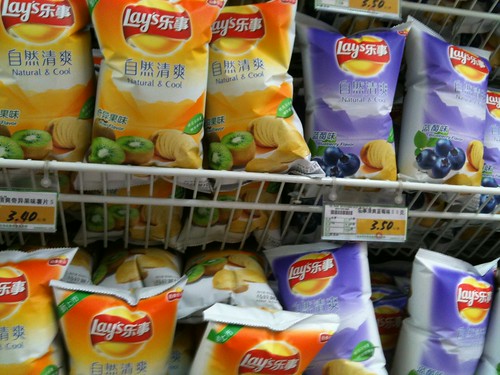
Then there’s the stuff that’s identifiable, but you really wish it wasn’t. Take Tony’s favourite snack – chicken feet. These come vaccuum packed in plastic and the packages hang out like beef jerky, unrefrigerated. And they look like, well, like chicken feet. I actually tried to sample one at lunch and I could barely manage to pick it up, let alone taste it. Sorry, Steve. I’ll give it a shot another time. They’re just so… feety. And there’s really no meat on them at all, you just eat the nasty, leathery skin. Skin is like a whole other food group in China. The famous Beijing duck (which I sampled, naturally, in Beijing) is really mostly about the crispy skin and the layer of fat underneath it. A nice piece of Beijing duck skin is like a mouthful of melty lard with a bit of crispiness. The duck meat itself is kind of secondary.
I am, however, getting reasonably adept with the chopsticks. We each got our own set of them at the start of the tour, in keeping with Intrepid’s enviro-friendly policies. We’re meant to bring them with us to meals to cut down on the number of disposable chopsticks we use, and I’ve actually remembered them every time so far! There are different levels of skill with chopsticks in our group, and I was surprised to learn from Huang that there’s no single way to hold them. Apparently everyone does it slightly differently, in whatever manner is comfortable for them. One of the Danish girls (Nanna! I know their names now!) uses a technique that involves gripping the bottom chopstick with her index finger and thumb and manipulating the top one between her middle and ring finger. It’s baffling to me how she manages to successfully convey food to her mouth in this fashion, but she hasn’t gone hungry yet. (Then again, the Danes did bring a load of Danish “sweets” with them that they may be surviving on. I tried one of them – a salted liquorice fish-shaped thing that tasted like DEATH. No, wait, it tasted like death that has been left out in the sun for a week and then and stomped on with sweaty feet.)
I did enjoy the trip to the supermarket, partly for its cultural value, but mostly, I admit, because it meant I got to buy a few familiar foods. I’ve had fruit and yogurt for breakfast for three days in a row now, and have had many cups of normal black tea. I even found single-serving tubes of Skippy peanut butter, which made me so happy I tweeted about them. They may not be environmentally friendly, but they’re convenient and sooooo good.
And that was Xi’an – walls, lanterns, sore legs, terracotta warriors, chicken feet and peanut butter. Now I'm on another overnight train - a 17 hour long crawl to the city of Chengdu in Sichuan province, home of spicy food and giant pandas, both of which I'll be sampling, though hopefully not in the form of spicy panda hotpot. Then again, that would be an excellent Weird Food...


