Three things the British do well

Tuesday, July 7, 2009

A short post, submitted with great affection:

1. Cream: Apparently if it can't be sliced, it's not actually cream. Clever cows.

2. Queuing: If there's anything Brits do well, it's queuing. ("Standing in line" for those not fluent in the jargon). I feel like any self-respecting Brit would not pass up a chance to queue even if he didn't know what he was queuing for. Of course the flipside to this is that queue-jumping (cutting in line) is a social crime on par with serial murder and should be met with a fitting response, as noted below:

3. Restrained Expressions of Disapproval: Despite the gravity of an offense like queue-jumping (which might be a cause for handgun crime in the US) a serious incident here may elicit a raised eyebrow or, in the most extreme cases, a muttered, "Tut". Only the most flagrant violations will cause the average Brit to move from "miffed" to "peeved", and may even force him to murmur something like "Well that's just not cricket." before shaking his head slowly and exchanging a raised eyebrow with the person next to him.

I really like this country.

Streets and Gates, Gates are Bars, Bars are Pubs...

Sunday, July 5, 2009

As I write this, I'm sitting in a pub, on High Petergate, just inside Bootham Bar. Which is York-ese for "I'm in a bar in High Peter Street just inside Bootham Gate"*. It's like they're deliberately trying to confuse tourists. Then again, York has been around since the Romans were here in about 71 A.D., so I suppose they can be allowed their eccentricities.

York has been quite nice, not least because I splurged (just a bit) on what has turned out to be a very nice, quite modern B&B, with nary a doily insight, but with a double bed, and flat screen tv and en-suite bathroom! Luxury indeed. I've been doing sink laundry every night.

Once again, my faith in local tour guides has been confirmed - on my first morning I did a "Essential York" walk with an engagingly quirky guide named Chris who toured us around the ruined abbey, the city walls, and the winding streets and snickleways of the main tourist area. Chris was particularly colourful, with a talent for florid prose and a hatred of Henry VIII (I believe the phrase he used was "bloated tyrant"). He also warned us against investigating the dry ditch (not a moat) surrounding the city walls, warning that "the people of York empty their dogs there every morning." And he had a proper Yorkshire accent, which is good practice for my ears in these last few days before I hit Scotland.

One of the things I like most about York is the walls - there are still really long sections of them standing, and most of it is built on the foundations of Roman wall from more than a thousand years ago**. On the afternoon I arrived I went for a run that circumnavigated all the sections of wall that are still standing, and it was bloody brilliant. In fact, it was so nice I did a second loop, for a total of about 10km. And then I had an enormous ploughman's lunch with EVEN MORE cheese than on Dartmoor, and two pints. It was a good night.

On my right: the city walls, on my left (not pictured): an Enterprise Rent-a-car and a Just Tyres shop.

Chris toured us around the ruins of St. Mary's Abbey, which in some ways was more interesting than the preserved churches.

The ruins

My favourite part was the rock garden made up of salvaged stones from the abbey. The square-shaped stones were mostly recycled into other walls and buildings, but the decorative stones couldn't be used for that. A bunch of them are here:

Nothing like a few medieval carved stones to dress the place up...

The trip into the tangled streets of the area inside the walls was fun too, especially ducking through the little "snickleways" between streets (I mean "gates"). Though they were only dubbed "snickleways" in the last few years, by an author who wrote about them in a popular guide. They're basically little covered alleyways between buildings that act as short-cuts between bigger streets, and have names like "Little Hornpot Alley" and "Mad Alice Lane" and stuff like that.

A snickleway

And of course we visited "The Shambles", a small lane best known for its astoundinug concentration of camera-wielding Japanese tourists. Ha! I'm kidding, it's best know for its tipsy architecture, with 16th century timber-framed buildings that lean out over the street.

The Shambles

One nice find was a snickleway leading to a little hidden church (15th century), with a nice garden where I sat to eat my lunch two days in a row. On the second day I was joined by a lovely man who was the former keeper of the church (Holy Trinity Church in Goodramgate) who was very chatty, and told me lots about the church, and insisted I go see St. Wilfred's in Harrogate when I'm there, and recommended a B&B in Prague. (I'm not kidding, he wrote the details in my notebook...) It was the longest conversation I've had in days.

The afternoon was a bit of a bust. I followed Rick Steves' normally sound advice and visited the Yorkshire Museum, which was a bit boring and had too many cases of unearthed Roman pottery shards and such. I guess I just wasn't in the mood, so I cut out of there early and went for a long run. I've now come to the conclusion that it's going to be really hard to get long long runs in while I'm traveling. It's not the time that's a problem, it's the distances. It's really hard to find a place where I can run for 10 or 15km before having to turn around. On this run I started on my "usual" wall-circumnavigation route, but deviated when I got to the banks of the river Ouse, because there was a nice paved pathway there. I settled in on the path for a while, hoping it would last for miles. Instead I had to double back twice and eventually took a fancy new pedestrian bridge to the other side of the river and followed a smaller path there. Eventually that path tuned into a dirt track, and finally it ran up against a fence. There were steps leading up and over the fence, so I asked some nearby dog-walkers if it was ok to hop it. They assured me it was fine, and I could run as far as I wanted; God bless the English and their public footpaths.

See? There really were steps, and a little dog-door too!

The path went through several overgrown fields, and got really narrow, and passed under a highway, and then finally popped out on a residential street.

If you look closely at that green signpost, it says "Public Footpath"

There being no apparent continuation of the path, and it being about an hour into the run, I turned around, grateful that I wasn't facing an hour of Dover cliffs to get back to where I'd started. That's when the psychology hit. As I mentioned when I tweeted about the run, the scale of this place is really deceiving. I felt like I'd seen so much and been so far that it was a real shock to get back into York proper in about 15 minutes. I had to do another almost complete circuit of the walls to make it up to 20km, so though the distance wasn't epic, it was hard on the brain.

On Saturday I headed to the York Castle Museum, which gets 3 stars from Rick Steves and has nothing at all to do with castles. It was quite excellent, with a recreated Victorian street scene and lots of well-annotated displays on everyday life in England. It was loads better than the Yorkshire Museum and I ended up being there for hours. I hit the Clifford Tower after that. It wasn't really worth the £3.50 admission, though it did give me a chance to take a picture of myself on the ramparts.

Me, on the ramparts, as I said.

After lunch, I headed to what surely must be the main event for anyone visiting York - York Minster. The minster is a huge cathedral built between 1220 and 1472. Yes, it took 252 years to build, but they did a really nice job, so those of you who haven't even managed to repaint the bathroom can just stop sneering right now.

York Minster (Ok, I did not take this photo - the Minster is way to big for my tiny camera...)

I'm not sure of the numbers, but York Minster certainly feels bigger and taller and brighter than Westminster Abbey, and it's less cluttered too. (Ok, wait a minute, Rick Steves says it's the largest Gothic Cathedral north of the Alps - 540' long and 200' tall). I took the 275 winding steps up to the top of the crossing tower, for a really nice view of York.

The city, viewed from above and behind the two west towers of the minster.

And the Minster, viewed from about half way down.

York Minster also has more medieval stained glass in it than all the glass in all the rest of England put together. Much of it is in the Great East Window - the largest expanse of medieval stained glass in the world. Naturally, it is scaffolded inside and out right now for major restoration work, but that meant that a few of the panels were on display at person-level, which might actually be a better way to view stained glass than from 100 feet away. I liked the Minster, and even stayed for the evensong service so I could hear the choirboys sing, and it was a really nice way to end my visit.

There's a bit more York on tap for tomorrow, then a quick train ride to Harrogate for my last bit of family before the wilds of Scotland!

*And I'm having steak & kidney pudding, which I haven't had in ages! Yum!

** That's a blogger shortcut because honestly I can't be bothered to look it up.

The Eden Project

Saturday, July 4, 2009

As I mentioned in my last post, one of the places I visited in Cornwall was the Eden Project. Cornwall used to have a lot of open-pit mining of white china clay, which left some scars on the landscape. The Eden Project, started in 2001, fills one of these old pits with a one-of-a-kind collection of plant life scattered around outside and, most impressively, in two sets of gigantic "biomes", which look like geodesic soap bubbles clinging to the side of the valley.


The Biomes

Inside the larger set of bubbles they're recreated rain forest conditions from a few different areas of the globe, including some I will visit (like Malaysia). Walking in there was like walking into a wall of water - the temperature wasn't that hot, but the humidity was about 90%, so we weren't half way through before our shirts were sticking to our backs. If all of Asia is like that, I may just elect to come back to England for a bit. (For those in Saskatoon - think of the Mendel Art Gallery Conservatory, multiplied by a thousand.)

Yes, that's a waterfall, inside the bubble.

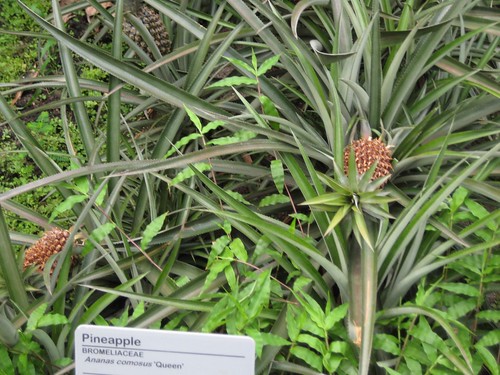
Besides the plants, they also had little vignettes set up that showed how people live in the various areas, with bamboo huts, and emergency shelters and such. And they spend a lot of time trying to educate visitors about environmental issues, food politics and sustainability. For instance, I honestly had no idea this is what pineapples look like when they're growing. ( And don't try and tell me you did...)

It's like they're growing out of little tufts of tall grass. Honestly, if I thought about it at all I thought they grew on trees like coconuts.

The other biome had a much more temperate Mediterranean set-up, so we had a look around there too. We also had a wander around outside, though it was a really odd sensation after being in the biomes. I kept having to remind myself that we actually really were outside, because the biomes are so big and well-designed.

It was also interesting to learn a bit more about the Eden Project, which isn't just about chucking a load of plants into an old clay pit. They're all super enviro-friendly, and community-minded and such. They've got solar power, and rain water recycling, and a little tractor train running on bio-diesel that's used to ferry around the lazy and infirm.

The propaganda that comes in the guide to the place is filled with high-minded talk:

"Eden is about spectacle, education, the application of science and social change... Burning underneath all this is a passion to bring together the batallions of business with the forces of social responsibilty to forge a new social contract capable of harnessing the power and expertise of the former to the needs of the latter."

Err.. what ever. I just has a nice time looking at the plants, and marveling at the engineering of the biomes, and looking pensive at the highly meaningful seed/pinecone/egg sculpture thingy in the middle of one of the newer buildings.

Me, and the seed

And that was my day at the Eden Project. The next time you're in Cornwall, check it out. And have a pasty.

Devon, Cornwall, and the south west

Friday, July 3, 2009

After a few days in Kent, I took a train back up to London, transferred to Paddington Station, and then had 3-hour train trip across the bottom of the island, ending up in Plymouth, with a new batch of family and a new bit of the country to see. It's been a bit strange visiting all this family that I really don't know. In most cases they have been perfect strangers, but in all cases they have been generous, welcoming and lovely. And in every new house I've been in I've had the arresting experience of glancing at a wall and finding an oil painting done by my grandmother, who was a prolific painter in her later years, and whose works are apparently scattered throughout the family. It gave me an oddly comforting sense of connectedness.

Cornwall was a lot of fun, and it was especially nice to be ferried around by my hostess Anne. Driving in Cornwall was a new experience (to clarify: I was not actually driving, I was passengering). There are some wide divided highways (dual carriageways), but we spent a lot of time on smaller roads. And by "smaller roads", I mean, in many cases, "roads barely wide enough for one vehicle, with overgrown stone walls on each side, but maintaining two-way traffic flow". I'm not kidding, those were some skinny cart-tracks; most driveways in Canada are wider. Apparently though, people are just used to it. Driving these roads takes nerves of steel and a lot of skill in backing up to the last wide spot to allow opposing traffic to pass by. It's picturesque though, I'll give it that.

I spent a day in Perranporth, which is a small seaside village with a fairly well-known sandy beach. I even went for a swim in the sea, complete with borrowed wetsuit. Photographic evidence below:

Not exactly "Baywatch"

The next day was a busy one: we drove in to Truro, where we spent a bit of time examining Truro Cathedral, which has some quite nice stained glass. There was also a nice street market where I picked up a genuine Cornish pasty to have for lunch. (I also got a lovely cherry and almond flapjack, which over here have absolutely nothing to do with pancakes, and are more like oat-y granola bars. I may be developing an addiction.)

My pasty just had beef, potato and turnip, or so they claimed...

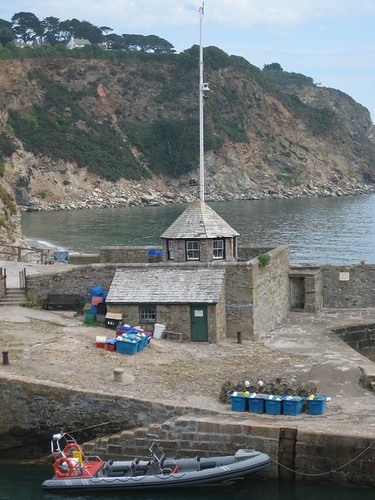
After Truro, we stopped for lunch in a nice fishing town called Charlestown, where we sat by the harbour and I ate my pasty and my flapjack and we watched some young lads diving into to water for no apparent reason other than to climb back out again, and dive in at a different spot. It was awfully mucky water for such an activity, so I can only hope there were some young women somewhere within sight they were trying to impress.

Chalestown Harbour

After lunch, it was on to the Eden Project which was quite brilliant and completely unexpected in the wilds of the Cornish countryside. In fact, it was so different that I've decided it deserves its own post so, you'll just have to wait a bit to hear about that. Instead, here's a picture of another lovely seaside town, Looe, where we stopped for supper. (Or dinner, or "tea" or whatever you call the sustenance ingested between the hours of 4pm and 9pm).

Looe

It was a long day. The next day was shorter, which was a mercy. The main event of the day was a trip up onto Dartmoor, which was quite neat. The moor is a somewhat sparsely vegetated, sort of barren area of high ground that is most famous in my mind for being the setting for "The Hound of the Baskervilles". And indeed, it was a very Sherlock Holmes-y kind of day - all rainy and misty and moor-like. The Cornish seem to be quite proud of the barren and fierce reputation of the moor - there's a famous Victorian-era prison there, so situated because even if a prisoner managed to escape he didn't stand much chance against the elements. In fact, while it was certainly much more sparsely populated and with far fewer trees and things than the surrounding countryside, it was still fairly civilized to my eye. There were loads of sheep all over (all over the road, in fact), and horses and ponies. And there were proper roads, and people and small villages. So while Dartmoor was appropriately evocative and picturesque, I didn't find it particularly threatening. I'm sure if I'd encountered it in a horse-drawn cart in January of 1850 I'd feel differently, but right now I can't help but feel that the average moor-man of today, tough as he may be, would be quite at a loss if he found himself in the middle of a prairie winter.

We did have a really nice lunch at a pub in Princetown, on the Moor. I had the Ploughman's Lunch, which may become another addiction. This is a cold plate that usually comes with bread, pickles, relish, some salad, and a ridiculous amount of cheese. I'm not kidding, the lunch I had yesterday had two enormous wedges of stilton cheese with it, and even I, professed cheese-lover, could not finish it all. (I had a Ploughman's again tonight in York and, impossible though it seemed, it came with MORE CHEESE than the Dartmoor variety. Again, cheese was left uneaten, which is a sad state of affairs.)

We rounded out the day with a quick visit to a National Trust property called Cotehele, which was quite nice, and helped by the fact that we arrived quite late. This meant that we were relieved of the responsibility to linger meaningfully over every tapestry, chamber pot and 15th century butter knife. We did, however, have a nice cup of tea in the restaurant.

And that was my time in the south west (there are more photos over at Flickr). Stay tuned for details on the Eden Project, and for the further adventures of Go See Run Eat Drink in York, Harrogate and on to Edinburgh!


Running the White Cliffs

Wednesday, July 1, 2009

Last week I finally dragged myself out of London and spent a couple of days in the seaside town of Deal, on the Kentish (south-east) coast, just north of Dover. I was there mostly to visit family, and to enjoy a couple of days of luxurious Bed and Breakfast living after ten days at Stalag Russell Square.

(Aside: The B & B was totally brilliant. I had a whole room to myself, with a bed, and sink and mini fridge and tv and a bathroom right outside the door. And the breakfast! As I said in my Twitter: "Full English Breakfast: egg, toast, sausage, bacon, fried potato, fried tomato, fried mushrooms, fried slice. Coronary bypass optional. Yum.")

I treated Deal like a bit of a break after the hectic pace and spartan accomodations in London, and decided it would be a good chance to have a nice long run. Looking at a ridiculously large-scaled map, I realized that it might be quite possible to run all the way from Deal, through St Maragaret's to Dover, a distance of about 14 miles round trip. The day was overcast and threatening rain, so it was good running conditions and I thought it would be really cool to run all the way to a whole other town and back. That's not generally something that's possible to do in North America (Dwayne notwithstanding).

I set off on a nice paved seaside path, and made good time until I got here:

Fair enough, I thought. It doesn't say "Go away", it just says "Stay on the path". And the alternative was this:

So I took the sea-level path, and had a nice view of some old bunker sort of things behind a fence, until I came to a complete dead end. What I hadn't really thought through was that Dover is situated at some fairly well-known White Cliffs, and I was starting in a sea-level town, thus implying that eventually I'd have to deal with a fairly significant elevation gain. So I turned around and braced myself for the trip up the cliff. In fact, there was a public footpath and a stone staircase. (Of course, there was as staircase, because as I've mentioned before, the entire island has been completely inhabited or about a thousand years. Also, the English take their public right-of-ways very seriously. I was a bit surprised there was no escalator.)

Once I got up the stairs, it was clear that the whole run was going too be very very hilly. I walked some of the really hard uphills, and made pretty good time until I ran across a WWI monument and veered off course to have a look. Here's a look at the dedication; the monument itself was a tall spire.

Getting on from there I think I took a wrong turn and ended up wending my way through a bit of a small town, through back roads, across cattle gates and finally managed to get back to the cliffside path. I didn't make it all the way to Dover, but the path seemed to end, and I'd covered a bit more than 10k, so I took a break. I stopped for some pictures, and Twittered, "Running the white cliffs of Dover. Sitting on the edge right now, higher than the gulls, France through the mist. This is what it's about."

See? I was really there!

It was a really nice moment, sitting there thinking, "I'm really doing it. I've got here, I've seen things, I'm running. It's actually happening. I actually made it happen."

And then there was the trip back. I found the return path, so I didn't have to visit the cattle gates and back roads again, and I enjoyed the (mostly) downhill terrain. Here's a look at that monument, on the way back. How's that for a scenic long run?

The run back was tough - I'm really not used to that kind of terrain, and the weather was heavy and humid so I was completely drenched in sweat. Couple that with the dirt and scrapes I picked up from a small tumble on the path and I must have looked like I'd been on maneuvers for a week. I'm sure I was a bit of a sight for the genteel English dog-walkers and seaside strollers back in Deal. So, having no face left to lose, I took off my shoes and socks, and waded in the sea a bit to rinse off. The whole thing ended up being a tough workout, but how can you complain about a run that takes you past two castles along the coast of the English Channel? No complaints here.

P.S. Don't get used to the video business. That 24 second video took about half an hour to upload, and that was on a wired broad-band connection. That ain't gonna happen in many places...