Showing posts with label Egypt. Show all posts

Musings on the Middle East

Monday, February 1, 2010

Thoughts on two weeks traveling the Middle East, in no particular order.

----------

For reasons passing understanding, restaurants in Jordan and Egypt often provide kleenex instead of proper napkins for wiping one’s hands. All over the place – everywhere from the Bedouin camp in Wadi Rum to the posh seafood restaurant where we had supper in Dahab, Egypt, there were boxes of kleenex on the tables. At first I thought they’d been hauled out because the place had run out of proper paper napkins and was improvising, but in fact it seems to be the norm. As you’d expect, it sorta works, but not really.

----------

I'm finally – FINALLY – running again. Not regularly, but I ran twice in Amman on the treadmill in the Magic Hotel. And I hashed in Amman in the torrential rain. And best of all, I got to run outside twice, once along the waterfront in Luxor and once again in Aswan. I was a bit worried that I’d get hassled by the local men, and I did get quite a few comments, but they were all positive. “Good exercise!” and “Very nice!” and “Strong Woman!” and stuff like that. I even got some sporadic applause when I passed by one or two different groups. It was a nice change from the hassle you normally get when walking along touristy spots. Then it’s a constant barrage from touts selling felucca cruises or carriage rides or from taxi drivers or people manning the endless stream of stalls selling tourist tat. It’s exhausting trying to stay pleasant but asserting, for the eight hundredth time, that no, you do not want a taxi, or a felucca or a papyrus print or a scarf or a crystal pyramid with a 3D image of King Tut suspended inside it. When I was running I was immune to all that, maybe because I was moving too fast for them to bother with me.
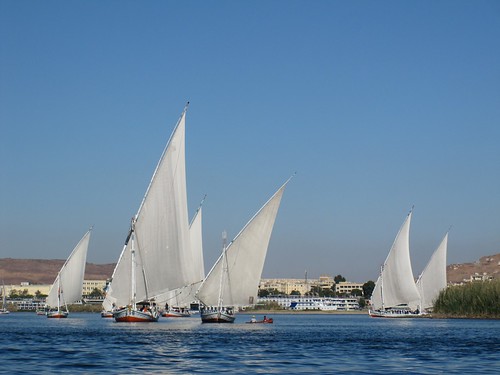
The view along the Nile

And the other nice thing? I’d forgotten how good it feels after a run. It’s been so long since I’ve done regular exercise that I was surprised by the wave of contentment and happiness that washed over me after my run in Aswan. Great.

----------

Tipping – baksheesh – is a way of life in the Middle East. Hotel receptionists, bellmen, housekeeping staff, local guides, camel drivers, station porters, donkey wranglers, dive shop owners, felucca sailors, taxi drivers, guys at checkpoints, police, waiters - basically anyone drawing breath within a 10 metre radius of any activity in which you are involved - will expect a tip of some kind. As the Imaginative Traveller trip notes say:

Throughout the Middle East, tipping is part of the fabric of life. The local word is 'baksheesh', which when translated into English falls somewhere in between 'tip' and 'bribe'. Everyone constantly tips everyone else and foreign travellers are expected to comply with this system. It is part of everyday life and is a form of remuneration for doing something, regardless of the standard of service. This is quite confusing for those used to the western concept of tipping as a way of showing appreciation. Over the years we have found that most of our customers find this constant need for tipping to be both tiresome and embarrassing, especially if you don't have the correct small change.

No kidding – in Jordan this was a nightmare. Imtrav (T.W.T.C.K.C.I*) usually suggests that the group establish a “Tipping Kitty” of about $3.00 USD per day to cover all these sort of tips, handled by the guide. This sounded like a really good idea, but our Jordan guide said that the suggested amount there was 5 JD per day, which is closer to $7.00 USD and seemed quite high to those who’d already been travelling in the area for a while and were familiar with the system. This dissention meant that we didn’t use a group fund in Jordan and therefore were each expected to tip all the appropriate people the correct amount at every turn. This was frankly impossible because you almost never have enough small change, and I, at least, am usually oblivious to when a tip is appropriate anyways. It was extremely frustrating to feel like you were either constantly being hit up for money, or constantly (and unintentionally) offending everyone around you.

In Egypt, with our fabulous guide Ahmed, the Tipping Kitty was back, including documents that showed exactly how much is allocated for each different service in each place. (why didn’t we have this in Jordan?) I simply gave Ahmed my 165 Egyptian Pounds (about $35 CDN) and most circumstances were taken care of for my entire time in Egypt. It may not be in the spirit of the region, but at least it was off my mind.
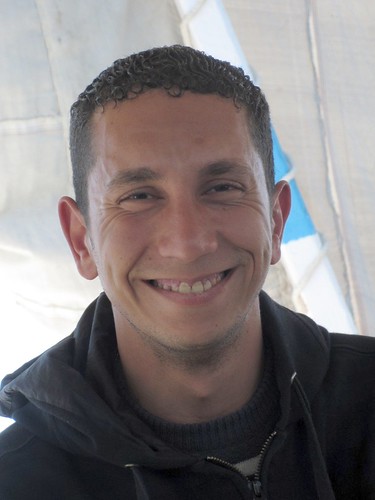
The fabulous Ahmed. He was very creative about distributing baksheesh. Sometimes it was just cash, but sometimes it was a small bottle of cold water given to a guard at a checkstop so that he wouldn’t make us all show our passports or open all our bags. Once he even promised a cell phone top-up. Crafty.

----------

Ok, here’s the most annoying thing about the Middle East – it’s really hard to find a beer! Turkey was 98% Muslim but it’s still a very secular state, and it’s easy to find alcohol wherever you want. In Jordan and Egypt it’s frustratingly rare. Very few hotels we stayed at (including the magical Toledo Hotel in Amman) had alcohol available on any menu. Similarly, restaurants will usually offer soft drinks, smoothies, fresh juice, four kinds of coffee and 98 kinds of tea, but no alcohol. It was a rare event indeed to have a drink with dinner, which was annoying (though it did mean the bill was usually a lot cheaper). There were bars in Aqaba, which was good, and Ahmed told us we could walk down to the corner store for beer and bring them back to the posh seafood place in Dahab, but it would have been nice to see beer show up on a menu with food. And please God, let me never have to endure another bottle of Amstel Zero non alcoholic “beer”. Ugh.

----------

It seems to be a universal truth in the Middle East that no one ever has change. Bank machines spit out £100 and £200 notes, or £50s if you’re lucky. Admittedly, a £200 note is worth about $40, which is a lot of money in this neck of the woods, so I can understand why someone would be reluctant to change it if you were buying a $1 can of pop. But I bought two 10 dinar SD cards for my camera in Aqaba and the shopkeeper only agreed to change my 50 dinar note when I said I’d buy a third card. I think they see it as a game, and whoever ends up with the small bills wins. This is probably because the small notes - £1 and £5 in Egypt – are the ones you need for the endless stream of baksheesh that’s constantly flowing out. Usually this means you have to lie about what’s in your wallet. You hand over a £20 note and the shopkeeper shakes his head sadly. “Oh, have no change. Anything smaller?” You shake your head sadly… no, you have nothing. “Ah, is problem.” You stare, unflinching. It’s £20 or nothing. You are prepared to walk out without making the purchase if no change is available. The trick is in who backs down first. If it’s something you don’t really care about, you can hang on until the shopkeeper relents and sends someone off to find change, or magically produces it from his pocket, and you win. If it’s something you really need, you pull out your wallet again and perform a much more thorough search than before and – remarkably – discover that you do have a smaller note, and the other guy wins. I sometimes wonder if they actually keep score.

Exact change! I lost this round.

----------

We spent a lot of time in small buses and minvans in Egypt, and though it’s a warm part of the world, it’s still January and temperatures are not always comfortable. Nevertheless, the drivers we had almost always kept their window at least partly open, creating a cold draft (or in Cairo, a smelly one) that just added to the discomfort. Once we asked that the window be closed and Ahmed told us that it’s normal for Egyptian drivers to keep the window open, so they don’t fall asleep. Naturally this begs the question: If you’re so tired that you need a cool breeze to keep you from falling asleep while hurtling down the road at 120 km/ph, then should you really be behind the wheel?

----------

It’s weird to me that in a region that produces an infinite variety of sticky, honey-soaked treats, the most common thing we are offered for dessert in a restaurant is… fruit. And I’m not talking about a nice fruit salad. I’m talking about a whole orange, unpeeled, and rolling around on a side plate. It’s terribly disappointing that no one seems to understand that fruit is not dessert. Fruit is… fruit. Dessert is sticky and sweet and should involve licking fingers and aching teeth. Come on Middle East!
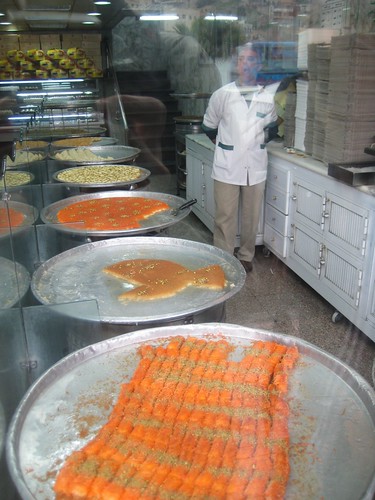
THIS is dessert – at a nice sweet shop in Amman

----------

Ok, I realize this might all sound a bit whiny, so I'm going to close with a couple of my favourite and most recently discovered things in the Middle East. Naturally, they are both edible. First, lemon juice. This is NOT lemonade. I'm not sure what makes it different, but it definitely is. Very. It's got a sort of creamy frothiness that makes it taste a bit like a lemon julep. It's tart and refreshing, and I think there's a bit of the lemon zest in it. And it's always freshly made and served icy cold and it's very very very good.

Second, roasted sweet potatoes. I only found these on my second-last day in Cairo, but I wish they'd been everywhere. There was a street vendor selling them outside our hotel - he had a cart with an oven on it where he was burning some kind of charcoal. And he had a bunch of the roasted potatoes on the top of the oven to keep them warm. When you bought one (or two, if they're small), he'd pluck them off the top slice them open, and serve them on a random scrap of paper. The first one I got was on a glossy KFC menu, the second was presented on what appeared to be a photocopied page from a UK personal income tax form. And they were great. I'm not sure if you're intended to eat the skins, since I think they go straight from the ground into the fire, but the skins had a nice smokey flavour, and I think they're the best part, so I gobbled them down along with the soft, sweet flesh, and probably a thousand thousand thousand germs and gunk. But they were fantastic, and only £1 each - about 20 cents.
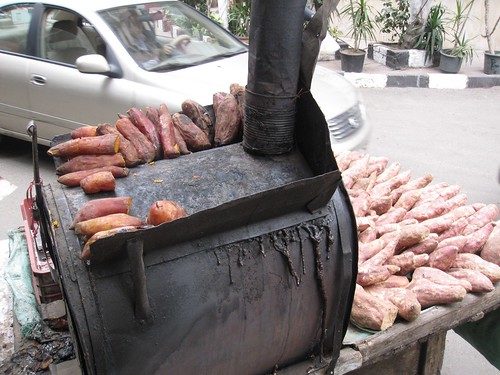
The Potato Man's cart. The Potato Man himself declined to be photographed.

----------

And those are parting thoughts on the Middle East. By the time this is posted I'll be in Delhi starting another 2 week tour of northern India and Nepal, accompanied by my friend Patti. The Middle East was good, and I'm glad I got to tick off all those amazing sights - Petra, the pyramids, and the Valley of Kings. But despite my constant complaints about being tired and moving around too much, I'm ready for something new. On to India!


* That’s What The Cool Kids Call It. (And to Rob H: Yes, the asterisks are back, in moderation. I am making an effort to include my parenthetical statements in the body of the text, but sometimes I just feel the need for an asterisk. Plus Steven G. likes them, and I like Steven G.)

Upper Egypt: the hits just keep on coming

I told you about the Temple of Karnak, the donkey ride, the Valley of Kings and the Temple of Queen Hatshepsut. That was all accomplished in about a day and a half in and around Luxor. Not being ones to linger when there are miles to be driven and antiquities to be viewed, we hightailed it out of Luxor at the first opportunity and drove to Aswan where I had the Weird Food birthday supper you’ve already heard about.

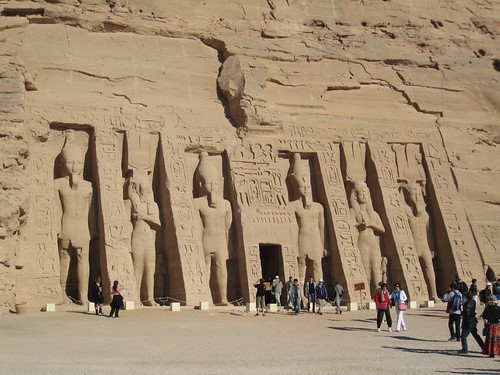
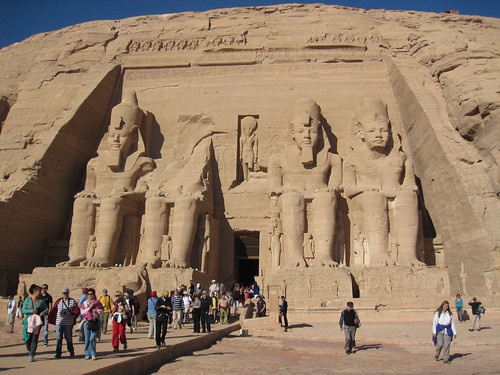
That night we all tried to get to sleep early because there was a very very early start scheduled for the next day. We were going to see the Great Temple of Abu Simbel, built by Ramses II (who was not a guy who did things halfway). It’s a magnificent site, but it’s also located in the far south of Egypt in a very sparsely inhabited area. The 280 km drive from Aswan to Abu Simbel is apparently too dangerous to be undertaken privately, so twice a day (three times during high season) a huge convoy of up to 60 vehicles forms up in Aswan and proceeds to the site with a police escort. And when do these convoys leave? The first one leaves a the punishing hour of 4:00 am. Naturally, we decided to take the second one so we got to leave a the much more comfortable hour of 4:30 am. Yup. The alarm went of at 3:15 am and we were instructed to be in the lobby ready to go at 4:00. Nice. It would be a three hour drive in the convoy to the Temple, where we’d then have about two hours to look around, and then we’d have to report back at 10:00 am to get into the return convoy back to Aswan. Oh, and of course the trip to Abu Simbel was not included in my tour, so I got to pay an additional 80 USD for the whole business. I really hoped this turned out to be worthwhile.

The Temple of Abu Simbel. Those statues in front are close to 66’ tall. And the place is so important and famous that this scene is depicted on the Egyptian £1 note.

I think it was. The logistics of getting to the site are definitely annoying, but when you get there it really is quite magnificent. As with the Valley of Kings, no cameras were allowed inside the temples. I think this is to help preserve the colours of the painted decorations on the walls inside (I run into this a lot – can anyone tell me whether flash photography really degrades paint? Or is this all just an excuse to try and get people to buy the professionally produced photos in the gift shop?). At least Abu Simbel still allowed photography outside – even outdoor photography is now banned in the Valley of the Kings. Merely being in possession of a camera there can net you a fine of £3,000 ($600). Actually being caught using it will cost you £5,000 ($1,000). Ahmed told us this is because too many people were sneaking cameras inside the painted tombs and then bribing the local guards to let them take photos. As usual, the countless jerks of the world have ruined it for everyone.

Here’s the other problem with the convoys – they create a huge glut of people who all arrive at the same place at the same time to see exactly the same thing. The crowds inside the big temple after we got there were awful. And of course everywhere you looked there were people taking photos, even though the local guards were making people put their cameras away. Naturally, it’s also forbidden to touch the walls inside the temple – not only is the original paint still present in some places, but most of the hieroglyphs are actually carved into the rock, not just painted. Nevertheless I saw people touching, and even leaning against the walls. There was one particularly miserable bunch – a Russian family consisting of a mom, dad and two little girls. As ai was standing nearby one of the little girls reached out to touch the carving of a figure in a side chamber of the main temple. I was a bit surprised but figured she was young and didn’t know better and would soon be corrected by a parent. Instead, dad came over and joined in the fun and I watched them trace over the whole carving with their fingers. I had to just leave the room it made me so mad. People are odious.

The facade of the smaller temple, which Ramses built for his wife, Queen Nefertari

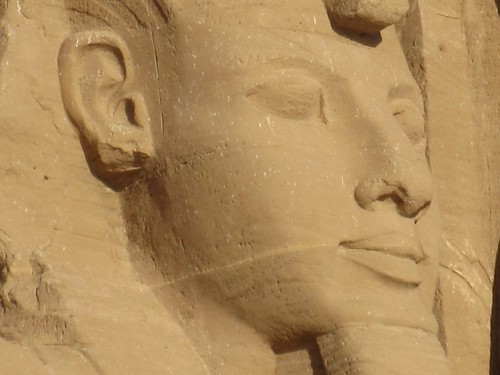
Luckily the crowds thinned out after while, so when I went back to have a second look at the big temple it was much more manageable (though there were even more cameras out, and I even saw one woman blithely recording a video of the whole place as she walked through). The insides of both the temples are covered with carvings and hieroglyphs. There’s even a hunting scene inside the big temple that appears on the Egyptian £20 note. It’s pretty fantastic stuff. I got my fill of the sights and had some fun playing with my borrowed camera, which has much more zoom than my old one, and thus allowed me to take some nice close-up shots.

Staring into the gigantic face of Ramses II

The temple complex is located on the shores of Lake Nasser, which was created after they built the Aswan High Dam in the 1960s, and forms the border between Egypt and Sudan. In fact the original site of the temple is below the current water level. As the water was rising during the construction of the dam, a team of engineers and workers completely disassembled the two temples into more than a thousand pieces and painstakingly reassembled them 65 metres higher up on the hillside. The move took four years and cost about $6,000,000 (funded by UNESCO). There was a nice display in the visitor’s centre that talked about the relocation process, but I would have liked to know more – it really was an incredible feat.

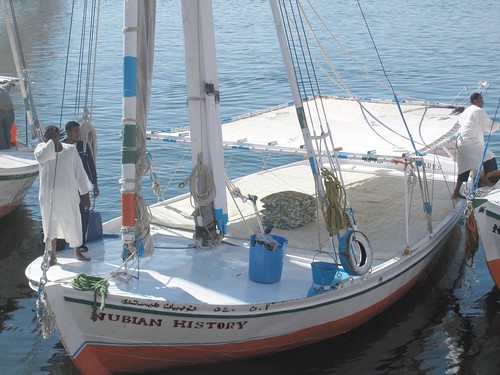
Soon enough, though, we were on our cramped minibus back to Aswan. There was another quick turnaround in the lobby of the hotel and then we were off for the felucca. A felucca, (pronounced to rhyme with Delucca, for any Winnipeggers reading this. For non-Winnipeggers: “fuh LOO kuh”) is a typical Egyptian sailboat. We were scheduled to cruise up the Nile for the afternoon and then anchor at a Nubian village where we’d have dinner at the home of the mayor. Then we’d return to the boat to spend the night under the stars before returning to Aswan by motorboat in the morning.

Our felucca, the whole deck of which was covered by one big comfy mattress

And this is where I started to lose heart. Maybe it was remembering the frigid temperature overnight at the Bedouin camp in Wadi Rum. Maybe it was the total lack of toilet facilities on the boat. Or maybe, just maybe, it’s that I’m tired and getting less and less enthusiastic about these interesting but uncomfortable side adventures. Whatever the cause, I decided to wimp out, abandon the boat after supper and get a cab back into Aswan where I could enjoy a night off in a hotel room that I’d have all to myself, with a hot shower and wireless internet a warm, comfortable bed.

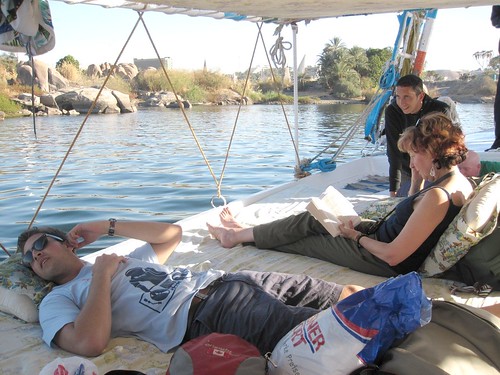
But first we had a really nice afternoon on board the boat. The big mattress was comfortable and the roof was low enough that you were forced to sit or lay down all the time. The sun was warm, and there really wasn’t much to do but lay about, take photos, drink beer (there was a full cooler!) and nap. We even had a pitstop so a few of us could go for a swim in the Nile. I went in, but not for long because it was COLD. We also had a really nice simple lunch of falafel and cheese and pita and such.

Life on the felucca

It was excellent. So excellent, in fact, that I started to doubt whether I’d made the right decision about jamming out on the overnight portion. However I hadn’t brought any warm clothes with me from the hotel, and I didn’t have a sleeping bag at all, and by that time I had my heart set on the comfy hotel. Supper was pleasant, but by then I just wanted out. Eventually I was guided back down to the river and got a motorboat ride over to the other side of the Nile from Mohammed, one of the mayor’s sons. He was only about 12 years old, but he piloted the huge boat and waited for me on the other side until my cab came. Mohammed got a bit of baksheesh before I left.

Eventually I got to my hotel, had a hot shower, and installed myself on the bed with the tv remote in one hand and a strong wifi signal happily feeding into my computer, and everything was good. I do feel a bit bad about skipping the night on the felucca, but I got some reports the next morning when I joined the group again, and it sounds like I didn’t miss much. Basically: it got cold, there were no bathrooms, most people slept fitfully. I, on the other hand, slept in, had another hot shower, and lingered in my room getting things done until checkout time. I do worry a bit that the length of time between these little “breaks” from travel is getting shorter and shorter the longer I’m on the road, but I suppose that’s natural. I’m trying not to concern myself about it. I’m just doing what feels right at the time, and damn the consequences.

Down in Upper Egypt

Sunday, January 31, 2010

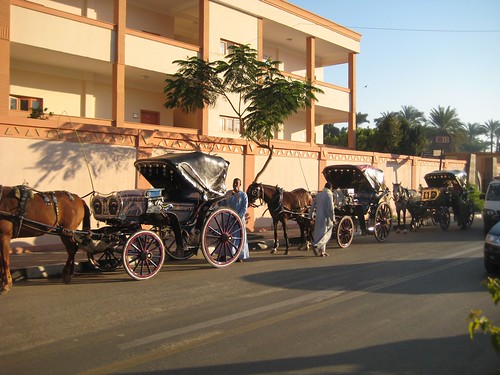
Of course you remember that Upper Egypt refers to the south of the country, upstream of the Nile, but at the bottom of the map, so we kind of went down to upper Egypt. We made it to Luxor after a long and frigid overnight train journey that you already heard a little about. We arrived at the Tutotel (Get it? Tut… Hotel…), dropped our bags, and turned right around to head for one of the big sights in Luxor – the Temple of Karnak. And instead of simply getting on a bus and driving the 3.5km, we took horse-drawn carriages. There’s a lot of that kind of thing on this tour – horse-drawn carriages, donkey rides, nights in Bedouin camps, nights on board feluccas. This is going to sound terribly bitter and jaded, but sometimes it turns out that these are the kind of things that sound hopelessly romantic and exciting when contemplated in a glossy brochure from the comfort of an easy chair, but are quite another matter entirely after an overnight train ride on Day 11 of a relentless schedule (or, for that matter, Day 227 of a less relentless but still taxing overarching plan). Regardless, into the carriages we went, and arrived at Karnak a short time after.

The carriages waiting for us outside the hotel

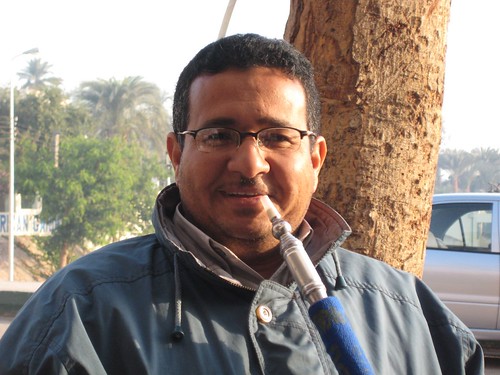
I was a bit frazzled and resentful that we didn’t have time for a nap or shower or anything before we were back on the job, but it turns out that the Temple of Karnak was great enough to dispel my crankiness (which has been more and more common these days, so you know it must have been pretty great). Part of what made it great was that we had a very good local guide for all our time in Luxor – Mr. Adil was apparently voted the best guide in Luxor at some point in the past, and I can understand why. He was amiable and funny and like to joke around (a bit too much for my tastes, but much more fun than the automaton guide we had in Cairo). However, he was also a serious scholar of Egyptology who had a lot of “common knowledge” kind of information and even shared some of his personal theories about the site, which were really... interesting. Some of them seemed a bit far-fetched, but he also admitted that he gets a lot of his ideas when he’s smoking sheesha, which he does a lot, so that may explain why his theories weren’t really mainstream.

Mr. Adil, with his beloved sheesha

The temple itself is a huge site covering about 2 square kilometres and was built, enlarged and modified over about 1,500 years. It was once the most important place of worship in Egypt and contains, in the words of the LP, a “vast complex of temples, pylons, obelisks, and sanctuaries” and “is quite possibly the most incredible sight in all of Egypt". A strong claim, but Karnak did not disappoint.

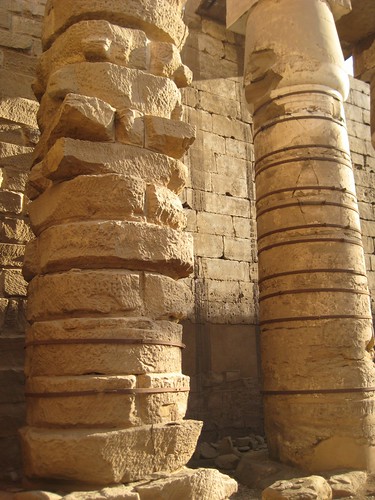
Part of what made the site really interesting for me was that its construction was never actually completed. There were the remains of a mud brick ramp that had been used to get large stones up to the top of the main wall, and Adil showed us an area where there was an unfinished column at the end of a row of finished ones. I thought it was really interesting to see.

The unfinished column

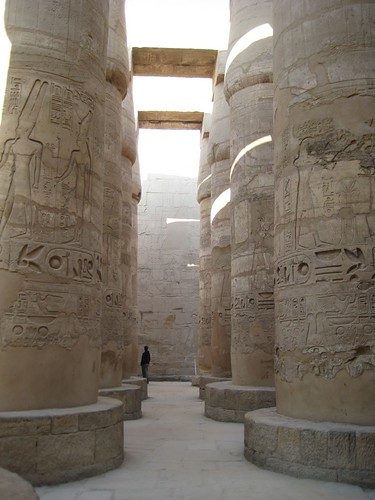
Undoubtedly, the best part of the Temple of Karnak is the great “Hypostyle Hall” (no idea why it’s called that… I wish I’d asked Adil.) It’s a huge room filled with massive columns – 63 on one side and 63 on the other, with 12 even bigger ones running down the middle corridor. Apparently it was originally roofed with huge slabs of stone, and the few pieces of roof that remain still have the bright painted decorations on them. It’s really impressive, and all the columns are carved with hieroglyphs, some of which Adil translated for us.

A view down one small section of the Hypostyle Hall, showing the huge columns.

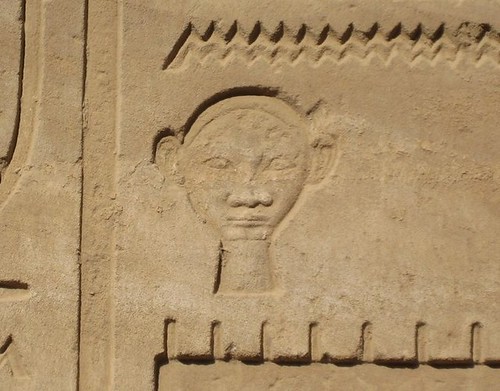
I got quite fond of hieroglyphs during my time in Luxor – they really are all over these ancient sites, and it’s fun when you start to be able to recognize some favourite characters, or see the royal names in their cartouches repeated over and over again. There are lots of different birds – an owl, a goose, a quail chick, and representations of feathers and circles and water. One of our favourite characters was a relatively rare one we started calling the “Barack Obama”. You can see why.

See what I mean?

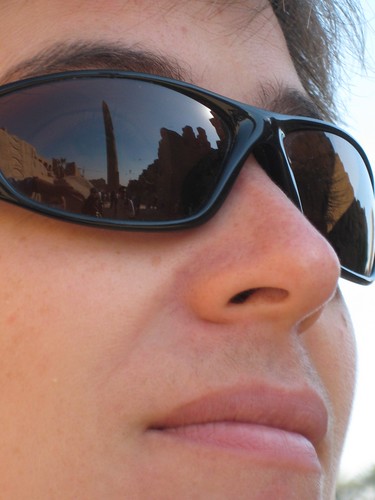
Adil was also very fond of pointing out the best places to stand to get good photos of the site, and even showed off a few tricks for getting interesting shots, including shooting through the lens of a pair of amber sunglasses to achieve a sort of interesting poor man’s sepia/sunset effect. And he demonstrated his famous “Obelisk of Queen Hatshepsut Reflected in Sunglasses” shot with me, and I think it’s actually kind of cool.

The Obelisk of Queen Hatshepsut (pronounced like “HAT Ship Suit”) reflected in my sunglasses

We were finished at the Temple by around lunch time, and then it became clear that it may actually have been a good idea to get the temple finished with early on. It meant that we could then enjoy that rarest of creatures: a free afternoon. I wandered off with Fabio for a local falafel lunch, visited the “best bookstore in Egypt” (this according to Ahmed, though it really was disappointing, despite the excellent selection of used Danielle Steele paperbacks) and then hit the internet cafĂ©. Then I had a nice long nap and after that I did something I haven’t done since I left Kampala – I ran. Not hiding away on a treadmill, not on a hash – just me out for a run in public like a normal person. Ahmed assured me that Luxor was very touristy and it would be no problem at all for me to appear in public brazenly displaying my bare knees, so off I went. I did 7km along the banks of the Nile and it was GREAT.

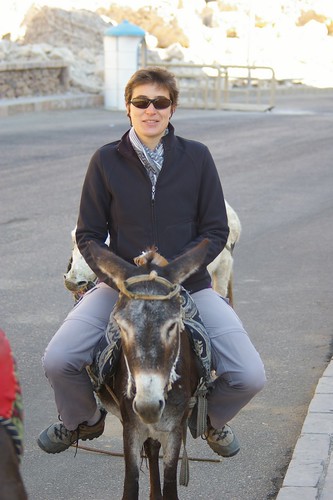
It was another early-ish start the next day for our donkey ride out to the Valley of Kings. Coincidentally it was also my 41st birthday, though the birthday portion of the day turned out to be pretty minor. My donkey, especially, seemed unimpressed by my Birthday Girl status. As for the donkey ride, it was another one of those things I mentioned above – like the horse-drawn carriages – that seems like a good idea, but ends up being fun for 15 minutes, then sort of uncomfortable, then tedious. The ride took over an hour, and a lot of it was on fairly busy streets where we were frequently passed by shiny air-conditioned buses on the way to the Valley.

Yes, the donkey was small. They were all that size. I promise you, Kathryn, that my size relative to that of the donkey was not at all unusual.

Once we finally arrived, after only one mishap involving donkey and rider parting company unexpectedly and with minor blood loss (not me), Mr Adil was there again to guide us around the site. No cameras are allowed anywhere in the Valley so I have no photos, but it turned out that the whole thing was just a bit disappointing. There are a total of 63 tombs hidden away in the Valley – from an era rather later than that of the pyramids, when kings started to realize that burying themselves and their treasures underneath massive monuments was a bit like erecting a huge billboard reading “Attention thieves: unimaginable riches contained within. Please Steal.” Everything is underground in the Valley, but of all the tombs known to be there only three are open to the public. Of course the most famous tomb at the site is that of King Tutankhamen, but we didn’t bother to go into that one. It costs an extra £100 (about $20), and we’d seen all the good stuff from inside it in the Egyptian Museum anyways. Even the LP admits that it is “far from the most interesting”.

What we did see were the tombs of three different Ramses (they might have been the 1st, 4th and 9th, but I lost my notes and really, do you care anyways?). The best part about them was the colourful paintings on the walls of the corridors and chambers. The walls were just covered with hieroglyphs and scenes of gods and goddesses, and there were some where the colours were just brilliant. It was hard to believe they’re as vibrant as they are considering their age. Still, it was getting hot, and the site was crowded, so as soon as we'd seen what we'd come to see, we moved on.

After the Valley of Kings we made a short pitstop at the Funerary Temple of Queen Hatshepsut (she of the obelisk-in-the-sunglasses). It’s a really impressive site not far from the Valley. My photos of the Temple are not great because I was taking them with my cell phone camera. What I didn’t mention about the donkey ride is that just as we were setting off my digital camera packed it in. The retracting lens decided to stop retracting and now the camera won’t do anything except try to retract the lens, fail, and then try again. There’s probably a tiny bit of Egypt stuck in the mechanism. I shouldn’t be surprised; that camera has been in constant use for seven months now, and as near as I can tell it took 7968 photos for me on this trip before calling it quits (and that’s not one of those made-up numbers that I stick in here for laughs – that really how many photos I’ve taken). I was gutted about this for a while, but then I realized that it was a good excuse to get a newer, better camera. My current plan is to check out a camera shop in Cairo, and to visit some of the really good electronics shops at the Dubai airport, where I’ve got a four and a half hour layover on Sunday night. Luckily I’m not camera-less. Fabio, the young Swiss guy in the group, and one of those people who has a serious camera, also has a small Canon point-and-shoot camera as a backup. It’s actually much nicer than mine, and he lent it to me for the rest of the tour. I’m enjoying playing with it and contemplating my future new camera, a birthday present for myself.

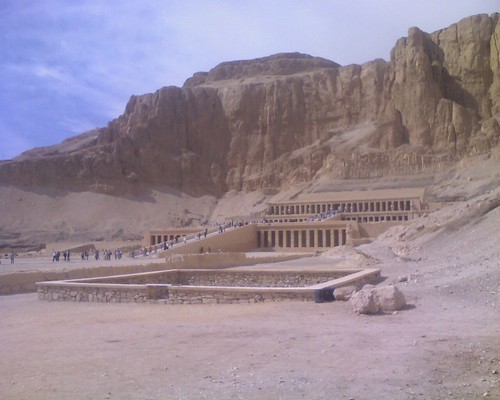
But back to the Temple of Queen Hatshepsut. It’s a three-level structure faced with columns that used to be fronted by big statues. Most of the statues are gone now, but it’s still striking. (As was Queen Hatshepsut herself – she was the first woman to rule Egypt as a king in her own right, not merely the consort of a king. She wore the famous double crown of Upper and Lower Egypt and was apparently pretty bad-ass until she was succeeded by her son Thutmosis III who defaced a lot of her temples and stuff because he was pissed off that she’d taken over things when he was just a kid.) I thought the whole site looked a bit like a Las Vegas hotel from afar because it actually looks amazingly clean and modern.

The temple, viewed from afar. I can just picture a giant restaurant terrace with an all-you-can-eat buffet of shrimp cocktail on that lower level, and banks of slot machines on levels two and three. Perhaps I've been at this too long...

After our short stop at Hatshepsut’s place, it was back on the bus and back into Luxor. We had a bit of time to sort out our luggage and then it was on to Aswan and more big sights. However the hour is late and my brain is tired, so I think I will save the story of Uppermost Egypt for another post.

Steve's Weird Food for the Middle East: Three for One!

Saturday, January 30, 2010

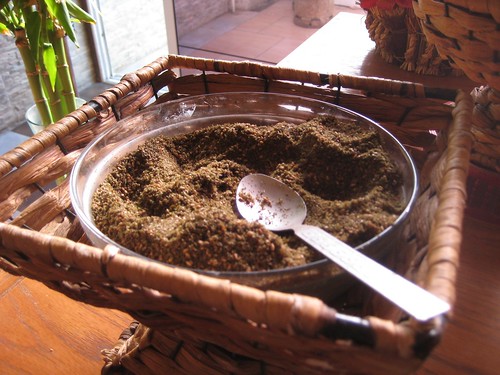
Steve’s Weird Food for Jordan: There hasn’t been a lot of weird food in the Middle East, but there’s one thing that I think should qualify for Jordan: zaatar. It’s “a fragrant mix of sun-dried thyme and sesame seeds” (LP) that shows up on buffet tables. I gave it a try on our last morning in Jordan, and it was quite inoffensive.

A dish of zaatar at the breakfast buffet

It’s generally served sprinkled on pita bread, with olive oil drizzled over the top, and that’s how I had it. It was a bit crunchy, and not nearly as strong-tasting as you’d expect. In fact, zaatar was a bit of a non-event and hence merits no more effort on my part, or yours.

----------

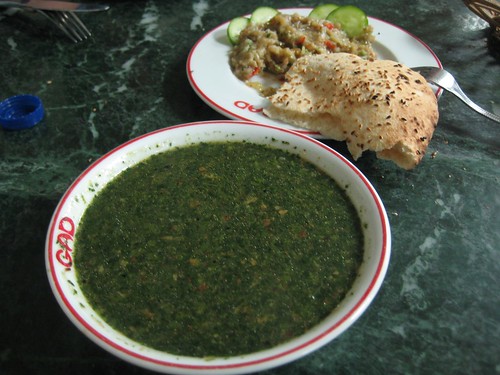
Steve’s Weird Food for Egypt: When I asked Ahmed our guide about what I should eat as my weird food for Egypt, both he and Anna - the half-Egyptian woman in our group - instantly had the same answer: Molokhiyya (pronounced sort of like "Moll – uh – KHAY – uh” where the KHAY is that throat-clearing guttural sound like in the Scottish pronunciation of “Loch”). The LP describes molokhiyya like this: “...a slimy but surprisingly sexy green leafy vegetable known in the West as mallow. In Egypt it’s made into an earthy garlic-flavoured soup that has a glutinous texture and inspires an almost religious devotion among the locals.”

Molikhayya

I tried it in a fast-foodish place that Ahmed took us to in Cairo, and found it exactly as described. It’s very green, and a bit earthy, and decidedly slimy. It was certainly edible, but the texture left a lot to be desired and the overall experience was a bit like eating a bowl full of stewed grass clippings suspended in snot. Molokhiyya probably will not make it onto my “Try Again” list.

----------

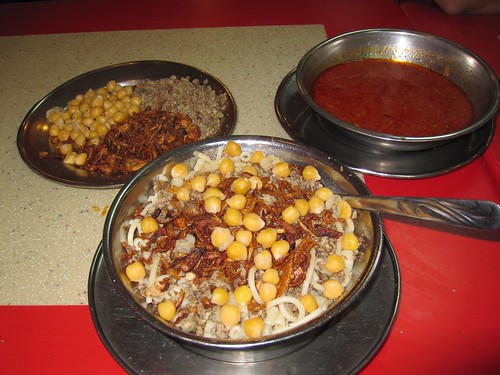
Bonus Weird Food for Egypt (The Birthday Supper Edition): It wasn’t exactly what I had in mind for a birthday supper, but I long ago stopped thinking I’d get what I want when I want it on this trip, so it was all fine. We’d arrived in Aswan after a long day of sight-seeing and driving and Ahmed took us out to a local place to try a specialty called koshery. It’s a vegetarian mish-mash served in a bowl and consists of: rice, three different kinds of pasta (spaghetti, tubetti – like short macaroni, and something like those tiny noodles that come in Lipton chicken noodle soup), chick peas (of course), crispy fried onions, black lentils, and tomato sauce.

The koshery as served, with the tomato sauce on the side and extra chick peas, lentils and onions available too.

It was tasty, especially those crispy fired onions. In fact, it had the feel of something that someone made up out of a fridge full of leftovers. I liked it a lot, though it was a big bowl of food to get through, especially with all that pasta. I think it would be the kind of thing you’d really crave late at night in a less-than-sober state.

As we were finishing supper Ahmed and a guy in our group, Ron, went off so Ron could "help fix the computer" of the guy who ran the restaurant. This seemed a bit weird, but Ahmed is one of those guys who knows everyone and so no one questioned it. It turns out, though, that it was all a ruse and they came back with a big tray of birthday treats for me!

Yum! And there was a piece of cake too! I may not have got a beer on my birthday, but this definitely made up for it, and was a really nice gesture. There was even a big piece of chocolate cake that I ate all by myself!

Ahmed and Ron, the Birthday Rescuers - thanks guys!

Blockbuster sights of lower Egypt

Thursday, January 28, 2010

Lower Egypt really is positively crammed with blockbuster tourist attractions – Cairo alone boasts the pyramids at Giza, the Sphinx, and the Egyptian Museum, which features the treasures from King Tut’s tomb. (Confusingly, “Lower Egypt” refers to the north of the country, because though it’s at the upper part of the map, it’s downstream relative to the Nile, and in Egypt, it’s all about the Nile). Anyway, it’s impossible not to be impressed on one hand, and simply overwhelmed on the other. I tended towards the overwhelmed end of the scale, but this may be because the tour I’m on now is setting a punishing pace, and I’m simply getting frayed. We’re moving around every day, staying in a different hotel every night, and we’ve got almost no free time. It is nice not to have to worry about finding accommodations or getting to the different sights, or even finding breakfast, but this convenience comes with a price, and these days that price feels too high.

For instance all the sights I mentioned above – the pyramids, the Sphinx and the entire Museum – were packed into one day, before we hopped back to the hotel, had a group dinner, and then got on a perfectly miserable overnight train. (The train itself was reasonable, if grimy, with large seats and lots of leg room. The problem was that the temperature on board dropped steadily from fresh to chilly to arctic during the night. This made it difficult to sleep for anyone not accustomed to dossing on a chair in a meat locker. I’d actually bought a couple of blankets in Cairo in preparation for spending the night on a felucca on the Nile in a few days, which should have helped the situation a lot. The blankets on display in the shop were a bit small, but I bought two. When I opened them up on the train it turned out that the blankets on the display and the blankets I bought (stacked directly underneath the ones on display) were two different things. I was, in fact, the proud owner of two postage stamp-sized baby blankets, which did little to keep me warm on the train and will be perfectly useless on the felucca. I abandoned them in the hotel in Luxor with bitter disappointment. No decision yet on whether I will brave the felucca with whatever fetid and ancient blankets might be available, or whether I give in to my better judgment and skip the whole thing in favour of an upgrade to a hotel. Odds-makers would favour the hotel, especially since I really feel like I’ve done my time sleeping al fresco and deserve every upgrade available at this point.)

One of the offending blankets. £66 down the drain (about $12.00).

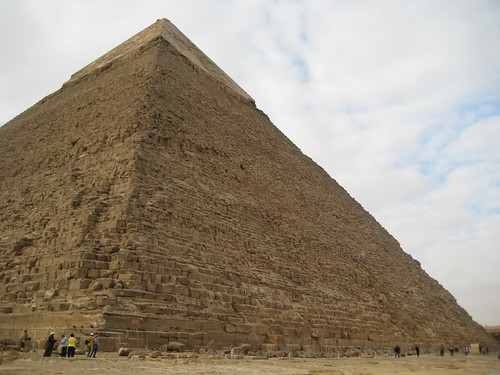
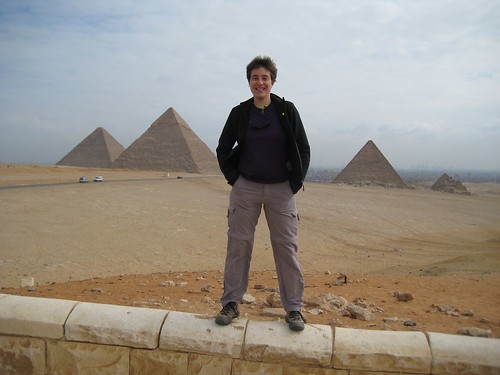
Ok whining over for now, back to Cairo. The pyramids were impressive, but I hope I don’t sound too jaded and horrible if I say they were actually smaller than I expected. And though every guide book on the planet mentions it, it was still startling to see them rise up out of the modern suburb of Giza. They really are in the middle of the city! The most impressive thing about the pyramids is really their beautiful geometric perfection relative to their age. About 5,000 years old, they were built without the use of the wheel, the block and tackle, or any iron tools. Impressive.

Pyramid pic. Ok, maybe they are pretty big.

In fact, the best part of the sight was the trip inside the pyramid of Khafre (a bit smaller than the Great Pyramid of Cheops, but also only £30 to enter, instead of £100. We were reliably informed that there was little difference between the two from the inside.) Going inside involved a trip down a long sloping corridor that required an uncomfortable stooping posture. (GSRED Traveler Tip: Try going down the tunnel backwards, like going down a ladder. This way the natural shape of your posture matches the slope of the corridor.). After descending there was a short level passage and then a corridor sloping up to the burial chamber. The chamber itself was surprisingly plain – no decoration, no paintings, no adornments of any kind. The stone sarcophagus was placed at one end of the room, lid open, and empty. Otherwise, the room – about 15’ x 30’, was completely empty. In fact, the only thing on the walls was a comically large and arrogant painted inscription from the Italian archeologist who discovered the tomb in the 19th century. That was at least 12’ long, with letters about a foot high. Cheeky. I lingered with a couple of people in my group, enjoying having the place to ourselves and soaking up the ambience. Unfortunately we stayed a minute too long and got stuck waiting in the level spot for a group of 9,746 Japanese tourists to descend before we could get out.

See? I was really there!

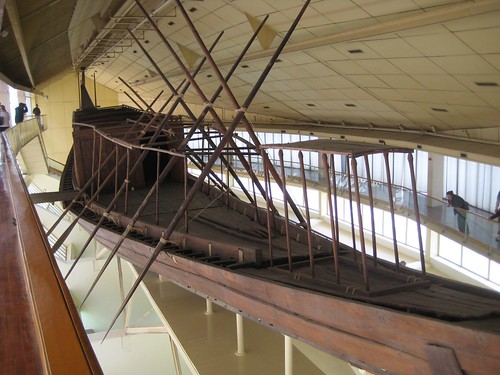
After the pyramids, we had a quick look at what purports to be the oldest boat ever discovered. It’s a pharonic funerary barque and was discovered in 1954 and susbsequently reassembled. It was impressive too, and I especially liked seeing how they planks that made up the hull were held together with ropes instead of joinery.

The Boat

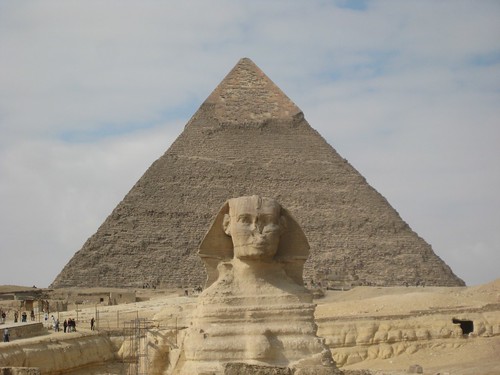
Then we all trooped obediently back to the bus for the short hop to the Sphinx. In fact, they’re as close together as you think they are, but getting between them on foot isn’t really practical. And once again I have to apologize, but it was smaller than I expected. There’s not a lot to see at the sight once you’ve taken in the Sphinx, but Fabio and I enjoyed watching the other tourists striking amusing poses for photographs. The most popular pose was the “blowing a kiss to the Sphinx”, followed closely by the “Appearing to hold up the Sphinx by cleverly placing the outstretched hand in the frame”. (Look over at Flickr to see one photo of mine that includes four, count ‘em FOUR separate Russian tourists all in a line, posing for photos. And yes, there are a couple of me posing too, with the pyramids. But no kisses.)

Obligatory shot of the Sphinx and a pyramid

After the Sphinx we made a quick pitstop for lunch at a popular take away place. Of course I had falafel, because it’s mandatory in the Middle East to consume your bodyweight in pita bread and chickpeas of some form every day. At least it’s cheap – my lunch was one small pita with falafel and one small pita with fried eggplant and cost a total of £3 (about 67 cents).

The Egyptian Museum, where we went after lunch, was large and dusty and hard to handle. I’ve been in a lot of museums by now, and this one definitely falls into the “well-intentioned but underfunded” category, which is a real shame given the unbelievable and unique treasures on display. The cases were old-fashioned and sparsely documented, and the number of exhibits was simply overwhelming. It felt like I’d stepped into a time machine and emerged in the 1950s – it was a lot like the museum at the Citadel in Amman, but one hundred times bigger. Then again, I did see the sarcophagus of Amenhotep and all the treasures from King Tut’s tombs. And there are LOTS of those. I think most of the second floor of the museum was King Tut stuff. It was undeniably cool to see the actual contents of the tomb – the many layers of shrines that surrounded the many layers of sarcophagi that surrounded the many layers of coffins that finally surrounded the actual mummy. And there was the furniture and jewelry and statues and such that were piled haphazardly inside the burial chambers. In fact, the most evocative things on display were the black and white photos depicting the tomb when it was first discovered by Howard Carter in 1922. Having been inside a tomb that morning, it was chilling to think about going in there and seeing the vast collection for the first time. And of course I saw the famous golden mask, which was brilliant.

But I was also tired, and the museum was chilly and not long after arriving I realized I’d simply had enough. I waited out the time after that, having a look at some “lesser” sarcophagi, and a few papyrus scrolls, and I admit I also spent a bit of time texting, and I thought about going for a coffee. In the end I had a bit of time back at the hotel to get online and blog and upload some photos. Then it was dinner and the overnight train, and the too-small blankets and all those things I’ve already mentioned. We return to Cairo later in the trip, and I hope to have a bit of time to explore the city then. It may have brilliant sites dating back 4,000 years, but it’s also a busy, dirty, heaving modern city, and I’d like to see some of that too.

This time next year - December 9

Tuesday, December 9, 2008

POP QUIZ: Can you guess today's "This Time Next Year" location from this audio clue?:


If you guessed the Lost City of Petra, you're correct! (And you know me well.) To quote Wikipedia:
Petra is an extraordinary archaeological site in southwestern Jordan, lying on the slope of Mount Hor in a basin among the mountains which form the eastern flank of Arabah (Wadi Araba), the large valley running from the Dead Sea to the Gulf of Aqaba. The site was designated as a UNESCO World Heritage Site in 1985 when it was described as "one of the most precious cultural properties of man's cultural heritage".
To quote me: "Petra is dead cool!"


The best known site at Petra is the iconic Al Khazneh, or Treasury Building, but the whole site has a lot more to see. I'll admit that when I thought of Petra, I really just thought of that one building, but it turns out that Petra is not just the Treasury, a souvenir stand, and a guy selling falafel from a cart... its a whole CITY, and they think most of it hasn't even been uncovered yet. There's the remains of the fantastic Ad-Deir monastery, along with "rock-cut tombs, obelisks, temples, sacrificial altars and colonnaded streets". One website claims you need 4 or 5 days to really explore the whole city so I'm a little worried that my proposed itinerary will rush me through Petra too quickly. (Of course if I wanted to do it really quickly, I should run the first ever Petra Marathon on September 26th, 2009.)


I'm actually planning on seeing Petra as part of a package tour (more on the whole idea of package tours is probably coming in a later post). The particular tour I've got my eye on is called the "Jordan and Egypt Adventure", and just reading the itinerary makes me positively buzz with excitement:

This tour combines our ‘Petra to the Pyramids’ and ‘Nubian Sailtrek’ tours to give you the highlights of both Jordan and Egypt. We’ll see the hidden city of Petra, take a camel ride amidst the weird rock formations of Wadi Rum, sail along the Nile on a felucca and explore the Pharaonic treasures left by the Ancient Egyptians.

  • Camel ride in Wadi Rum
  • Overnight in Bedouin camp
  • Full day guided exploration of Petra
  • Sunrise on Mt Sinai
  • Pyramids & Sphinx at Giza
  • 1 day felucca cruise
  • Horse-drawn carriage ride to Karnak Temple
  • Donkey ride to the Valley of the Kings
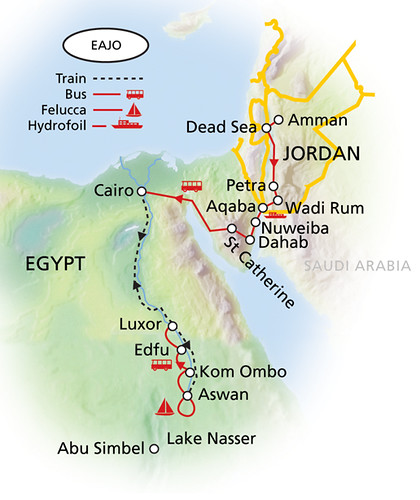
Seriously? A camel ride? A bedouin camp? A felucca cruise? Pyramids? It's like the Greatest Hits of the Ancient World. How is it that YOU have not already signed on to come with me on this? I mean look at this map:

The Jordan and Egypt Adventure, December 7-22, 2009. You know you want to.