Showing posts with label Laos. Show all posts

The Gibbon Experience

Sunday, April 25, 2010

Two things right off the bat:

  1. I did NOT see any gibbons while I was on the Gibbon Experience.
  2. It was still pretty cool anyways.
I wasn’t at all sure about the Gibbon Experience. It definitely sounded cool – live for two nights in a tree house, navigate around the jungle canopy on a series of zip-lines, and see gibbons. How could you NOT want to go after reading this in the LP?:
“The Gibbon Experience is essentially a series of navigable ‘zip-lines’ criss-crossing the canopy of some of Laos’ most pristine forest…. Guests stay in fantastical tree houses perched 200 ft up in the triple canopy. The communal lodges, admitting a maximum of eight, are complete with cooking facilities and running rainwater showers! In between spotting wildlife, the zipping is life affirming. Your safety harness with a wheel on the end of a cable is attached to a zip-line; all you need is a little faith and an adventurous spirit. It’s a heart-stopping, superhero experience.”

And you don’t just get to zip around the jungle and sleep in a tree house like you’re living out a Boy’s Own fantasy. You get to do all that, and contribute to the preservation of the forest at the same time. So you can be a carefree kid and a responsible grown-up at the same time. I’ll let their own website explain:

The Gibbon Experience works closely with the local people in Bokeo Nature Reserve, to transform their economy from one based on slash-and-burn farming, logging and poaching, to one based on long term, conservation focused activity.

The Gibbon Experience currently employs 40 full time workers from the Lao Loom, Lao Theung and Lao Soung… The funds received are reinvested to protect the forest…Villagers can make a non-destructive living from their unique environment, by protecting the forest and farming the lower altitude flat lands.

All the funds from the participant fees (€180 for three days/two nights) go to continue the project, employ local people, and steward the forest. The Bokeo Nature Reserve receives no money from the Lao government, but now makes enough to fund the employment of enough rangers to patrol about 25% of the Reserve. It’s really a win-win-win thing. Tourists get to experience an exciting environment in a unique way, local people get sustainable employment, and the forest and its inhabitants get some protection.

Getting to the Gibbon Experience is no easy thing. First you have to get to the tiny border town of Huay Xai. Huay Xai doesn’t have much to offer beyond a strip of hotels and guesthouses, interspersed with restaurants, small shops, internet cafés, and one used bookstore with a fantastically crappy selection. It was not a great place to spend three nights, but I think I made the right choice to delay my departure until I was healthier. On my third morning in Huay Xai I packed a few essentials into my day pack and trudged to the Gibbon office down the street where I could leave my main bag in storage.

There were eleven other people in the office waiting to depart. We watched a short safety video about how to use the ziplines, and then piled into two tuk tuks for the long ride to the village where our trek would start. The tuk tuk was not bad – at least it had a canopy to keep off the sun, but it was a bit cramped, and the ride was long. Well, at least it seemed long until we came to a stop because we could go no further. The intense rain the night before had toppled a large tree, which fell right across the road, blocking it completely. This would have been bad, except that there was already a group of people there and there was a chainsaw, and so it seemed like it would all be taken care of in no time.

No way through

Ha! That might be true in some western country, but in Laos things take time. Especially when the chainsaw won’t start properly. Or at all. There was a lot of fiddling around with the chainsaw, but to no avail. Then, alarmingly, the whole thing was disassembled and the motor went west in a black truck, while the blade and chain went east on a motorcycle. We settled in for a long long wait. Luckily, the people in the group were all interesting and friendly, so the conversation was good. And naturally I had my book of crossword puzzles, so it wasn’t too bad.

Eventually the various bits of the chainsaw returned and were reassembled into a functioning device, and we were back on our way. We arrived in a very tiny village not too much later, and started walking from there. The documentation about the Gibbon Experience said we’d have about an hour and a half of walking before we got to the tree houses. The walking was not too bad at first, but there was a lot of uphill and the temperature and humidity so it got very sweaty very fast.
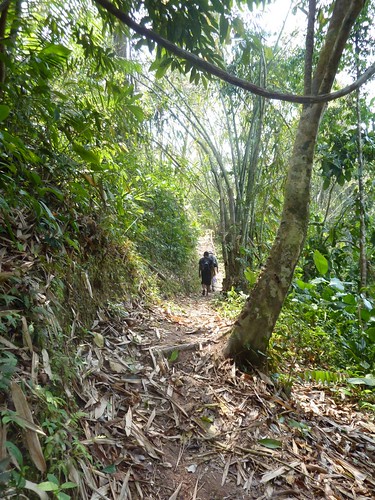
The walk from the village

After about forty minutes we made it to a sort of “base camp” where the volunteers and staff of the project live. Here we were fitted up into harnesses and divided into three groups, to live in three different treehouses. Treehouse 1 was reported to have better access to zip-lines, but Treehouse 7 was supposed to be the nicest of the lot. I ended up in Treehouse 7, with five others – Todd, an American; Christina and Cecilia, more Danes!; Kat, German; and Steve, British. We also had two local guides who were with our group the whole time. What we didn’t really understand was that Treehouse 7 might be pretty, but it was also the most remote of the houses, so we had a lot more trekking to do before we’d make it to our home. A LOT.

Luckily, first we got onto some ziplines! The zipping was really great. You’d come to a zipline where a heavy wire rope had been wrapped around a tree and you’d clip on your safety line and roller, sit down and let go. The lines were all slightly angled down so gravity carried you the whole way, and the rollers had a rudimentary brake to help you slow down if you needed to, in case you were going to crash into the platform at the other end.
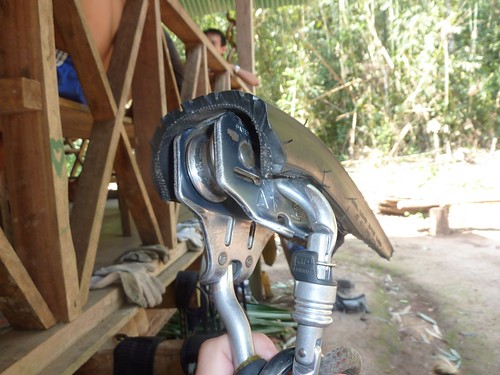
The roller device. The chunk of bicycle tire on top is the “brake”. Squeeze that with your hand and it clamps down on the cable, slowing you down.

It was INCREDIBLY FUN. Some lines went from one side of a valley to another, and some went from ground level to a tree house or a platform, where you’d connect right to another zip-line. In fact, the only way in our out of the tree houses was by the zip-lines. We had four or five zips to do on the way to Tree House 7, and it was fantastic the whole time.
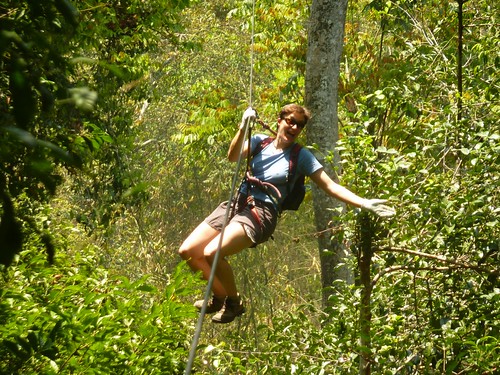
Here’s me, on the zip-line. F.U.N.

The walk to the tree house was long, and involved at least one long long hill, so by the time we got there we were all exhausted. Luckily, the place was great.
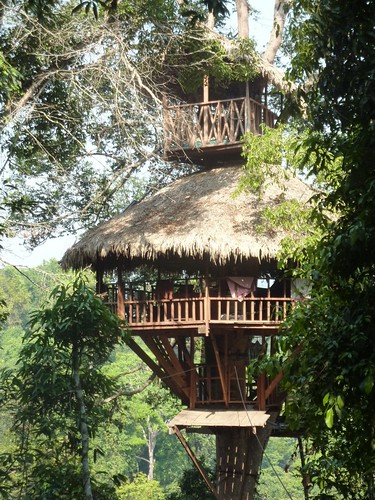
Tree House 7, home sweet home

There were three different levels. The lowest level had the platform you’d zip into or out of. (There were two different lines – one angled slightly down from the house, for exiting, and one angled slightly up, for entering). That level also had the bathroom, including the best shower EVER.

Video! And talking! I’ve figured out a better method for getting video onto the blog, so this post is video-mania!

The main level had folding chairs and a table and sleeping mats and a kitchen, including a sink with potable water, a burner for making coffee and tea, and… a refrigerator! That’s the big advantage of Tree House 7 – the fridge. No other tree house had one. And though it was not the most enthusiastic fridge I’ve encountered (run on solar power with a battery that died every night it didn’t have much chance to achieve optimum coldness) but it was total bliss in the middle of the jungle to be able to pull a cold bottle of water out of the fridge after a long day of trekking.
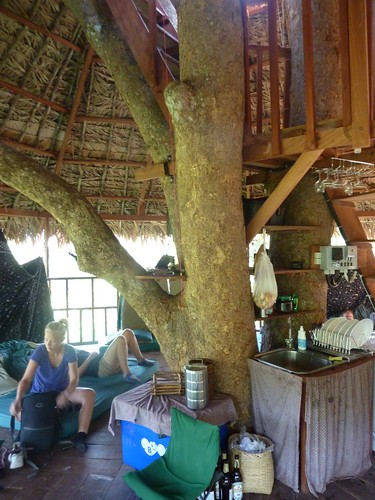
A view of a bit of the tree house main level

The upper level of the tree house was small, and had just enough room for a hammock and two sleeping mats. All in all, the tree house was perfectly excellent. The view was amazing, there was lots of room to spread out, and, you know, it was a TREE HOUSE. It was like living the fantasy you have when you’re a kid, all “Swiss Family Robinson” and stuff. Great.

And the food was pretty good too. There was a separate kitchen on land, not far from where the tree house zip-lines ended. At every meal a couple of Lao women would cook us up a big vat of sticky rice and four different hot dishes, which they packed up into one of those stacking towers. Then they’d hook onto the zip-line and deliver our meal. Later, they’d come back, pick up the dishes, straighten things up and zip away again. I admit I got a bit sick of sticky rice by the middle of day two, but others in the group couldn’t get enough.

The sleeping arrangements in the tree house were basic – big mats that were meant to sleep two or three people. The mats each had a large tent-like canopy over them to keep out the mosquitoes. We just shared the sleeping space, and it seemed to work out fine.

On our first morning in the the tree house our guide, Tjia Lee (pronounced sort of like “Charlie”) zipped over early to wake us up so we could hear the gibbons singing. It was about 6:00 am, and very misty, so there wasn’t much to see. But there was definitely something to hear. The gibbons sounded like… I don’t know… they started out softly, but then the sound grew into a real chorus of weird, almost alien sounds. Luckily, I have video! There’s not much to see here, but turn up your speakers and have a listen.

The gibbons singing

After the singing, and a nice hot breakfast (including more sticky rice…) we set off for a day of zipping. It’s a really agreeable way to start the day – zip-lining. If everyone got to commute to work by zip-line instead of stuck in a car in traffic, or jammed into a crowded metro car, we’d probably all be a lot happier. We trekked back up the damned hill and then got into some serious zipping, including a trip on the longest line – about 400m. And yes, I have MORE video!

The long zipline. The video ends before the zip-line did, because this was one of the lines where I didn’t quite make it to the end and had to pull myself, hand over hand, to get to the platform.

It was a good morning. We visited a few of the other tree houses and confirmed that, in fact, Tree House 7 is the nicest of the lot. We also did a lot of walking. This is something that I wish I’d been more prepared for. The information you get going into the Gibbon Experience is scant. I was expecting a very different ratio between walking and zipping (more zipping, less walking) so there were times when I got a bit cranky about how much sweaty trudging there was to be done. To be fair, if we’d been in Tree House 1 things would have been different, but that’s just another example of the lack of information available. It also would have been really nice to see some kind of map of the area so we knew where each tree house was, and where the paths and zip-lines were between them all.

The other thing I wasn’t prepared for was the lack of beer. When we first arrived at TH7 I asked Tjia Lee if there was beer and when he said no I thought he was kidding. I mean they could charge triple the market rate for a bottle of cold Beerlao in a tree house and no one would bat an eye. It turned out they used to stock beer in the houses, but of course some jerks abused it, got pissed up, got on the zip-lines, and got hurt (Note: no one fell to his/her death or anything, but I heard that there was a broken leg, probably from slamming into an arrival platform without lifting up the legs). So no more beer is provided. However, that did not stop the intrepid residents of TH7, because on the afternoon of day two, after a nice lunch and a suitable interval of napping in hammocks, we went on a beer run. Our guides couldn’t quite believe we were really going to do it, but they came along to show us the way anyways.

It was insanity. The guides told us it would be 40 minutes to the village, and 40 minutes back, which didn’t seem to tally with what we’d experienced on the trek in, but they were the guides… so off we went – me, Todd, Steve and Christina. Well of course you know what happened. It was a hot and sweaty 40 minutes just to get to the volunteer base, then another 35 minutes to get to the village. By this time we arrived we were all exhausted, but had little choice but to load up on vaguely chilled bottles of Beerlao and turn right around for the trek back. Three hours and fifteen minutes after we set out, we finally made it back to the tree house. Sweaty, stumbling, and almost delirious, it was certainly the most demanding beer run I’m ever done. Then again, there was the world’s best shower as a reward, not to mention a few bottles of Beerlao to make it all better. Tjia Lee told us that sometimes people in Tree House 1 will walk to the village for beer, but no one from Tree House 7 had ever done it before. So yay for us!

The next morning we had the option of getting up at 5:00 am, trekking back up the hill and heading to a spot where we might see gibbons. However by this time I was so sick of walking that even if I had been promised that the gibbons would perform excerpts from “Hamlet” I could not have been convinced to join in. Steve went, and he did end up seeing some gibbons very far in the distance. And people in the other tree houses reported seeing gibbons too, often quite close. I simply had to content myself with hearing them sing, zip-ling a lot, and being part of the only team of idiots ever to make a beer run from Tree House 7.

So, if I were to make a few suggestions to anyone planning to go on the Gibbon Experience, it would be these:

  1. Try to get into Tree House 1, unless lack of refrigeration is intolerable for you. TH7 may have been picturesque and well-equipped, but the trek in and out was daunting.
  2. If you’re going to Tree House 7, take beer with you when you leave the village.

And that was the Gibbon Experience. Despite the lack of gibbons, I had a great time, mostly because I was with a wonderful group of people. I’ve come to realize that the odds are that anyone you meet who’s out traveling the more far-flung corners of the world and who signs up for something like the Gibbon Experience (or white water rafting, or cruising Halong Bay or blah blah blah) is almost certainly going to be interesting, easy-going and fun to be with. It’s just really hard to be fussy and stuck-up in a tuk tuk or a tree house. So thank you to the gang of TH7, and to the rest of the group. It was great gibboning with you.
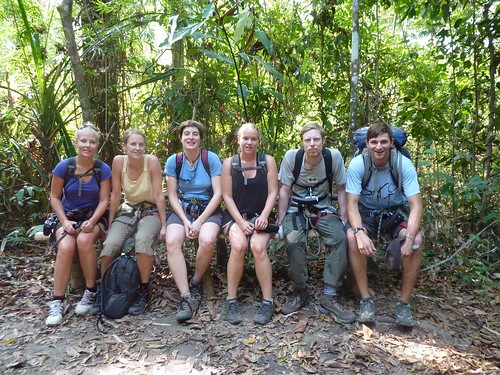
Christina, Kat, me, Cecelia, Steve and Todd, after the last sweaty trudge up the hill from TH7

Pick of Pics: Luang Prabang

Tuesday, April 20, 2010

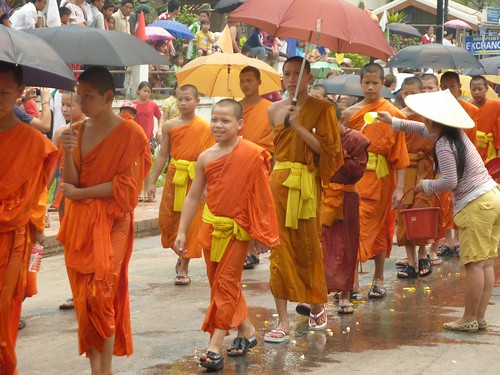
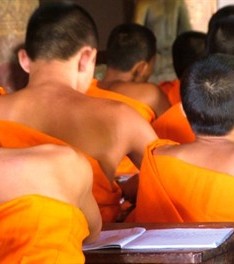
Well you KNEW it was going to be monks, didn't you? These are some more young men watching the Pi Mai celebrations in the streets of Luang Prabang.

The Town of Luang Prabang

Sunday, April 18, 2010

That’s how UNESCO lists this place in its roster of World Heritage Sites: “Town of Luang Prabang”. Most places on the list are things like “The Great Wall, China” or “Canterbury Cathedral”, so you’d think they might have singled out one or another of the lovely spots in the town: “That Chomsi, Luang Prabang” or “Wat Xieng Thong, Luang Prabang”. But nope, its just the town. The whole town. And I can understand why, it’s really a gem. The sad thing is that you can tell that the tourism that is the town’s livelihood is also part of what’s causing the death of the things that make the place so lovely. There’s no McDonald’s on Sisavangvong Street yet, but you get the sense that Starbucks may not be far off. And I’m painfully aware that my visit contributed to the problem, but what’s the alternative?

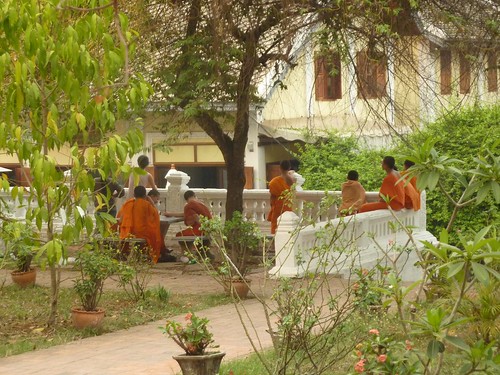
These young monks were watching the Pi Mai water fight in the street below, not without a bit of envy, I think.

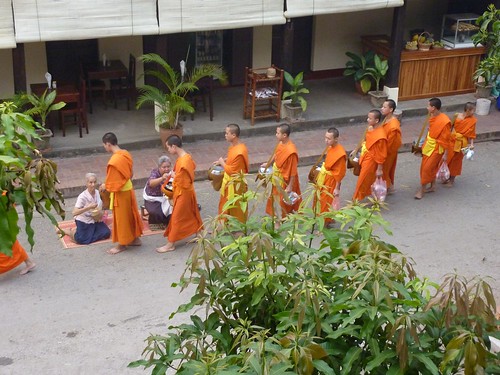
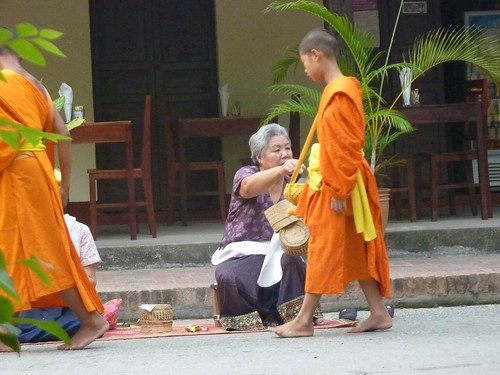
One of the most evocative things to see in Luang Prabang is the morning procession of the Buddhist monks through the town. Every day, starting at about 6:00 am, all the monks from the different wats walk through the town collecting alms from the local people. They walk in single file, robed in the various shades of orange that make them so photogenic, each with a large vessel slung over their shoulder. The local people sit at the side of the road and give each monk that passes a small ball of sticky rice from a container they’ve prepared. My understanding is that the food the monks collect each day is all they have to eat – they are completely dependant on the local people.

Some of the monks, collecting their alms. The procession passed right in front of my hotel. And it looked like some local people were being extra generous for Pi Mai, because some monks were carrying plastic bags with other kinds of food and drink in them.

There were little notices up around the town asking tourists to please be respectful of the monks during their walk. It’s a real, living thing this daily event, not a show for the tourists, and there are rules to be followed. Chief among these rules is that you must position yourself lower than the monks, as a sign of respect. You must not talk – the ritual is a silent one. You are also discouraged from buying rice to give the monks from street vendors, because the quality is often poor. And of course if you want to take photos you must not get in the way of the monks or the local people. It was all kind of common sense, so it was a bit sad to see that it had to be spelled out. (Then again, I suppose I was technically breaking the rules by being up on the balcony of the hotel to take photos, that being much higher than the monks. But I think there must be a range beyond which the rules do not apply, and I was being quiet and respectful.)

It’s hard to believe how young some of the monks are. Apparently many are sent to the monasteries because it’s prestigious to have a monk in the family, and while there the boy gets an education and is fed and clothed, so it’s a popular option for a family that might be struggling.

After watching the monks on my first morning in Luang Prabang it was still only about 7:30 am, so I had a leisurely breakfast and then trooped off to see Wat Xieng Thong, what the LP claimed was Luang Prabang’s most magnificent temple. By this time in my trip I’m definitely suffering from Temple Fatigue, but I did have a nice wander around and ended up chatting a bit with a French tourist who was trying to talk to one of the monks in French, with little success. I actually ended up speaking more French in Luang Prabang than I have anywhere outside of France, though it was all to other tourists.

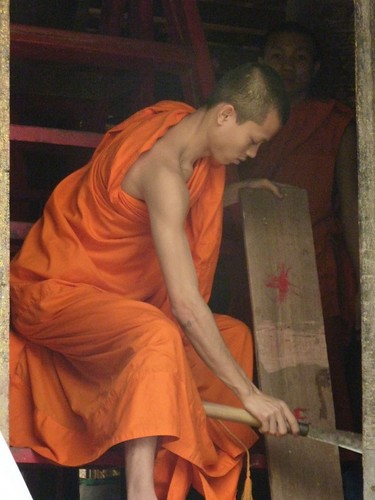
A monk, working on the restoration of some part of the “sim” at Wat Xieng Thong.

It was a nice enough temple, and pleasingly full of photogenic monks in their orange robes. I wandered around the various buildings for as long as I could stand, but it was still only about 10:00 am when I left and started walking through the town some more. It was hot, and though there were many more wats I could have visited, I started to get the sense that an entire day of wat-hopping in the tropical heat might make me insane. On a whim I ducked into an LP-recommended travel agency on the main street and a few minutes later I walked out having booked a half-day trip to see the Kuang Si waterfall. Leaving at 1:30 pm in an air-conditioned minivan, we’d drive about an hour to see the famous waterfall, go for a dip, and then drive back. It seemed a nice way to spend a steamy afternoon, and for 50,000 Kip ($6.00) it was a bargain, too.

And it turned out to be a very lucky decision because in that mini van were Rob and Linda, a very fun and friendly Dutch couple that I ended up hanging out with all afternoon and evening. Being Dutch, they spoke flawless English. “Why do the Dutch speak such good English?” I asked. Their answer? “Because nobody else speaks Dutch.” Fair enough. It’s also because English television is shown in the Netherlands with the original English sound track and Dutch subtitles. And many companies do business in English. And Rob told me that anyone doing post-graduate work will write his or her thesis in English. So yeah, the Dutch speak good English.

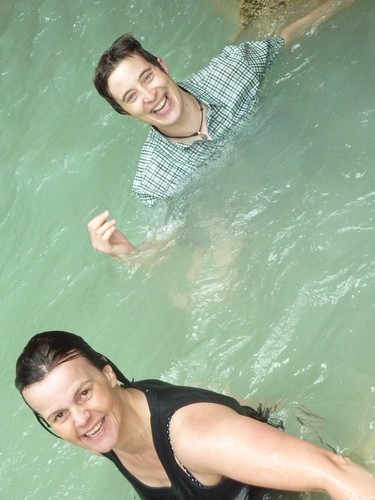
The waterfall itself turned out to be fairly small and unimpressive, but we all went in the water anyways, wearing all our clothes. That seemed to be the done thing – all the locals were hanging around soaking wet, in jeans and t-shirts. Even though I’d brought clothes to swim in, there was really no where to change into them, so I just dove in with my shorts and shirt on.

Linda and me, in an artfully off-kilter shot by Rob

It was incredibly refreshing, and sitting around in wet clothes is a really good way to keep cool in hot weather. The water evaporating off the clothing actually has a cooling effect, so I was happy and comfortable for the first time in days.

After the drive back into town I stuck with Rob and Linda to go see the sand stupas and the beach party you’ve already heard about, and then we decamped to one of the many many many bars along the main street to have a beer and watch the Pi Mai mayhem. Even though we were right alongside the action, there seemed to be an unwritten rule that anyone who was actually sitting at at bar or restaurant was safe from the water fight, though I did notice that the restaurant had taken the precaution of covering the seat cushions in plastic.

While we were sitting we struck up a conversation with the couple at the table next to us. It turns out they were Thai, though both spoke really excellent English. That’s how we met them – Linda heard them speaking English and said something back. They said they always tried to make an effort to speak English for the sake of their small son, who was also with them. They wanted him to learn it from as young an age as possible. We talked with Nil and Rachel and played with baby Keith for quite a while, and learned about all kinds of things. Nil even gave us some interesting opinions on the current unrest in Bangkok. But the most interesting part of the conversation for me was when he talked about the Buddhist monks.

It turns out that being a Buddhist monk is not an all-or-nothing thing. Many young men will try it out for a short time – as little as two or three weeks. Sometimes, as I mentioned before, families will send young boys to live in a monastery so they can get an education or so that they can be fed and clothed if the family is in trouble. And all men are encouraged to do a stint in a monastery some time before they marry. Nil told us he’d gone to be a monk for two weeks and found it really helpful. He’d had to shave his head and eyebrows, and wear the saffron-coloured robes, and live off alms and everything. Apparently there are 300 rules a Buddhist monk must follow (though the very young ones are required to adhere to fewer than that). The oddest rule that Nil mentioned? Buddhist monks are not allowed to pee standing up. This has something to do with modesty, and peeing in rice paddies where if you stood up you would be noticed, but if you squatted you would not. It was a really interesting conversation. As I was sitting there with Rob and Linda, chatting away with this couple from Thailand I couldn’t help but think, “This is what the trip is about. It’s not the things you see, it’s the people you meet and the connections you make.” It was a great night. (And no, Rob H, I do not have any good photos or Rob and Linda or Nil and Rachel and baby Keith, so just get over it.)

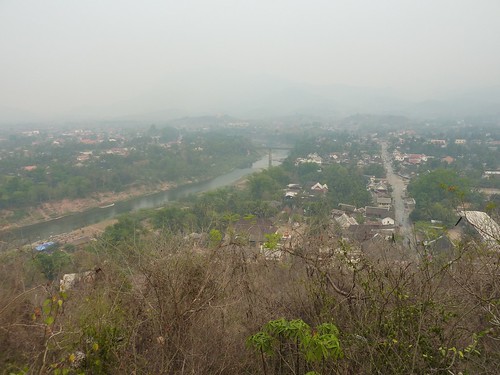
The next day was the day of the first big parade, which you’ve heard about. What you didn’t hear about is that I actually ran into Rob and Linda again, after the parade was over and I was good and wet. That afternoon the three of us walked up the 100m high hill in the centre of Luang Prabang, Phu Si, to check out the temple and wat at the top. The climb was nothing for one who had scaled the lofty peaks of Emei San, but in the afternoon heat we all thought it would be much nicer to get sprayed with water at the top of the hill than at the bottom. The view was pleasant enough, though the air was hazy from smoke and dust. Linda had heard that the next big rain would clear the air nicely and let us see the mountains in the distance, but it was the end of the dry season, so all we got was haze.

A view of Luang Prabang, looking sort of east. You can’t see it in this picture, but from the top of the hill we could spot the areas where the Pi Mai celebrations were most festive because the streets were all wet.

The other fun and unavoidable thing to do in Luang Prabang is to wander in the market. It springs up on the sidewalks of the main street during the day and expands to fill the whole road, which gets closed to traffic, at night. It was mostly touristy stuff like Beerlao t-shirts and local handicrafts. I was particularly taken with the patchwork stuffed toys on offer – my favourite was a crocodile; I think I liked it so much because it reminded me of Alligator Al from Mr. Dressup. If they’d been a bit smaller, and my suitcase had been a bit less overstuffed, I might have bought one.

Of course there were also food stalls set up at the market. A lot of them sold baguette sandwiches with meat and veggies, though they also had ones with peanut butter (!) and Nutella (!!) and I even saw one being made with a good helping of sweetened condensed milk (!!!). Looking back on this, I wonder how I could possibly NOT have tried a peanut butter, Nutella and sweetened condensed milk sandwich. And for a mere 15,000 Kip ($1.75)? What was I thinking?

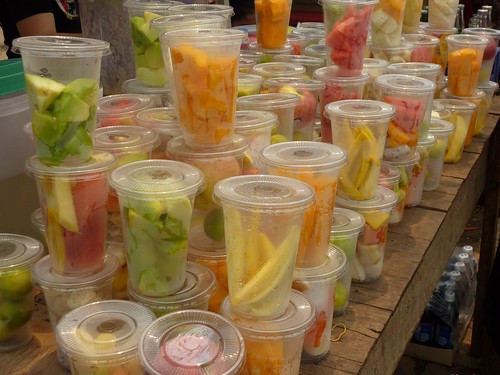
I guess I was probably thinking that I wanted to save room for another fruit shake. The vendors for these were everywhere. They’d display plastic cups full of various local fruits and you’d just pick the one you liked the looks of and it would get blended up with ice, sugar syrup and coconut milk. They were fantastic. I’m sure I had at least one a day while I was in Luang Prabang. Mango and pineapple, apple and lime, mango and watermelon… yum. And only 5,000 Kip ($0.60). Fruit shakes and sandwiches made out of Nutella… why did I ever leave?

The many flavours of fruit shake. Choose from the ones on display or request your own special combo.

On my last night in Luang Prabang the rains finally came. I was happily relaxing in my hotel room when the skies grew dark and the winds picked up and we had a positively biblical downpour. It put a stop to the Pi Mai festivities pretty quickly, and not too much later it also put a stop to the power supply in much of the town, including my hotel. I’d been planning a return trip to the Night Market because I had my eye on an Alligator Al and a Beerlao t-shirt, but it really didn’t seem to be the kind of weather one went out in. Instead I made it to the end of the block where there was an excellent French restaurant with a generator, and where I was seated at a table with a couple of other “orphan” diners. One was a young American guy who left after a short time, and one was a Frenchman who I ended up chatting with for the rest of the evening. I sensed that his English was better than my French, but he seemed happy to listen to me blunder along, so blunder I did. It was a nice last night in Luang Prabang, except that near the end of the evening I started to feel the unmistakable signs of a nasty head cold coming on: a pounding headache and an increasingly sore throat.

My plan was to fly to Houay Xai (“Hway Sigh”) the next day and then take off for “The Gibbon Experience” the following morning. But by time I made it to the guesthouse in Houay Xai after a rough night, two delayed flights and short tuk tuk ride, I felt like I’d been run over by an elephant. I checked in with the incredibly friendly woman at the gibbon office and she said it would be no problem for me to postpone for a couple of days, and even went next door to the pharmacy to help me buy some cold meds. (They look exactly like yellow M&Ms without the Ms, and seem to be about as effective.)

And that’s how I come to be sitting in the boring little border town of Houay Xai, relaxing, napping a lot, watching Dr. Who videos and getting over whatever dreaded lurgy befell me in Luang Prabang. It’s a shame to lose two days out of the schedule, but I think I made the right choice. The gibbon thingy is supposed to be an incredible experience, but it involves trekking and other strenuous activities, and I think I wouldn’t have enjoyed it if I’d been sniffling and snoozing the whole time. So having lost a bit of time in the schedule, something has to go, and it’s going to be Bangkok. I just figure there are a lot of places I can go in this part of the world where there aren’t people being killed in the streets. Yes, I know the areas where the trouble is are isolated, and it’s unlikely that anything would happen to me, but I need to skip something so Bangkok is it.

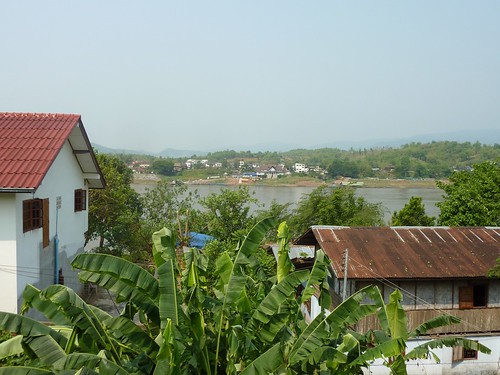
The view from the balcony at the guest house in Houay Xai. That’s Thailand across the river!

I’ll be offline for a few days while I live in the treetops with the gibbons. After that I’m off to Chiang Mai, where I hope to hash and see the sights before proceeding to Phnom Pen, Siem Riep, Angkor Wat, Kuala Lumpur, Singapore and Japan. It hardly seems believable that there are only six weeks left in my fifty week adventure. But at the same time I’m starting to think about going home more and more, so maybe it’s time.

Sabidee Pi Mai Lao!

Saturday, April 17, 2010

Happy Lao New Year! May you and yours enjoy a safe and prosperous 2553! Confused? I was too. It turns out that my arrival in Luang Prabang (“Loo ONG Prah BONG”), a place I’ve been looking forward to for about a year, coincided exactly with the busiest part of Lao New Year, called Pi Mai (or Pimai, or Pii Mai or Pee Mai… and pronounced “Pee My”). I did not plan it this way, but when I look back on earlier posts about Laos, I realize that I did know that New Year was celebrated in April, but that knowledge must have slipped out of my mind long, long ago. (Aside – my TTNY blog for Laos was posted on April 14, 2009. And my first full day in Luang Prabang? April 14, 2010. How’s that for some pretty slick planning/traveling?)

I’ve been a bit whiny about how places like Hanoi and Vientiane haven’t quite lived up to their write-ups in the LP, so I’m happy to report that Luang Prabang is actually all it’s cracked up to be. Quiet, leafy streets, charming architecture, Buddhist monasteries (called “wats”) everywhere you turn, and orange-robed monks all over the place. It’s no wonder UNESCO declared the whole town a World Heritage site.

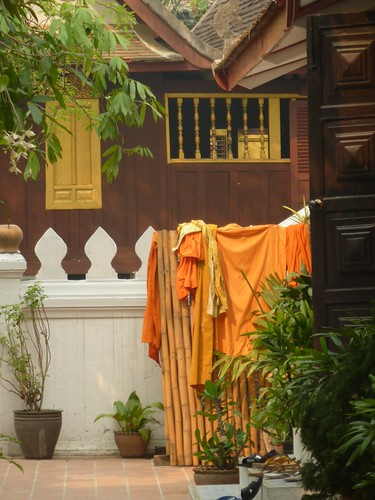
For some reason I find monks’ laundry very picturesque

Unlike western New Year’s celebrations, Pi Mai goes on for days. Technically the holiday lasts three days, but in popular spots like Luang Prabang the festivities can stretch to a week or so.

“The first day, known as Maha Songkran, is considered the last day of the old year. Lao will clean their houses and villages on this day, and prepare water, perfume, and flowers for the days ahead. The second day, the "day of no day", is neither part of the old year nor of the new year. The third day, known as Wan Thaloeng Sok is the official start of the Lao New Year.” (from goseasia.com)

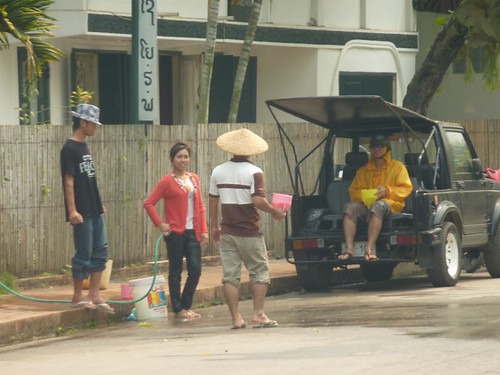
I spent my first afternoon in Luang Prabang just wandering around the streets of the oldest part of town, but before I went out, I had to do a bit of preparation. I wrapped everything important in individual ziploc bags – wallet, books, iPhone, camera – because one of the main ways that Pi Mai is celebrated is by throwing water on people passing by in the street. The later it gets in the day, the more gangs you see on the sidewalk with hoses, big pans of water, pitchers, scoops, buckets and water pistols. When you walk by you get doused, and there’s really nothing you can do to stop it.

This is a small group, on a side street, early in the Festival

It was kind of fun, but could also get a bit tiresome. In the right frame of mind it’s a huge party, and a lot of the people on the main street are clearly backpacker types who’ve come here mostly for the water fight. They invest in a super-soaker water gun and a lot of Beerlao, and have a great time. I’m not really in that category so sometimes, especially when I was hot and tired and had just had to wrap or unwrap my wallet or phone or camera or map for the 947th time I just wanted to shout, “Would you all just please go home so I can see this town properly?!” Then again there were the times when it was so hot and humid that it was really refreshing to get hosed down, and the party atmosphere was infectious.

Here’s what it looked like late in the afternoon on Day Two. Total, drippy, drunken chaos. So much water was used on Day One that when I got back to my hotel late in the evening I was told I couldn’t have a shower because there was no water left in the whole town.

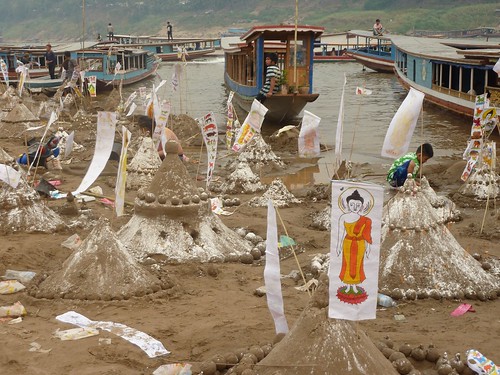
On the first day of Pi Mai I got out of chaos for the afternoon on a short day trip I’ll tell you about in another post. When I got back I took a little riverboat canoe across the Mekong with Rob and Linda, a couple of friends I’d met on my day trip, to check out another local Pi Mai tradition. On a sandy spit of land that juts into the Mekong river the local people had set up a huge beach party and spent the afternoon making sand stupas along the shore. (Quick reminder: a "stupa” is a mound-like structure, normally very big, containing Buddhist relics). We were expecting these sand stupas to be huge, but it turned out they were just like sandcastles at home – about two or three feet across for the most part. They were decorated with flour and painted banners, and there were hundreds of them.

The sand stupas

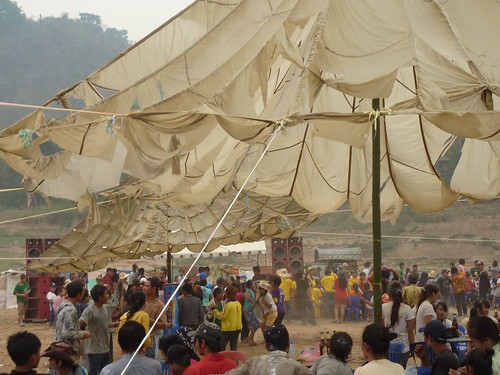
By the time we got there, though, the stupas were mostly forgotten and people were busily engaged in eating, drinking lots and lots of Beerlao, listening to loud music and dancing. Rob’s trenchant observation was that teenagers are the same everywhere – they just want to hang out with friends, listen to loud music and get drunk. We could have been anywhere in the world, except for the fact that most of the people were still drenched and many were covered in flour. (The later it gets in the festival, the crazier it gets. By Day Two it’s not just water getting thrown around, there are also people walking around with bags of flour who merrily fling handfuls of the stuff on you. And then there are the gangs of people who put coloured dye in the water. The gutters were running bright green at one point, I swear.)

A small part of the party on the beach, under a couple of decidedly down-at-heel parachute canopies

On Day Two of Pi Mai, “the day of no day”, I did not leave town. How could I? I had to stick around for the big parade! At 1:00 pm (or thereabouts, this is Laos afterall) there was going to be a parade down the main street in town. The woman who had been crowned Miss Laos a few days earlier would proceed from the south end of town to the oldest temple in Luang Prabang, Wat Xieng Thong, at the tip of the peninsula formed by the fork between the Mekong and Nam Khan Rivers (and conveniently close to my guest house). Of course she would be accompanied by loads of other people, including lots of monks and local people in traditional dress and people banging on drums and wearing masks and such.

And even though it was a parade it seemed that everyone was fair game when it came to the water fight. I’ve read that it’s considered respectful to gently pour water onto your elders and monks, but you’re free to douse anyone else with impunity. This rule seemed to be applied somewhat haphazardly, though I did notice that the monks in the parade got fairly respectful treatment, at least until they got into the real war zone areas of the street where no one was safe (or dry).

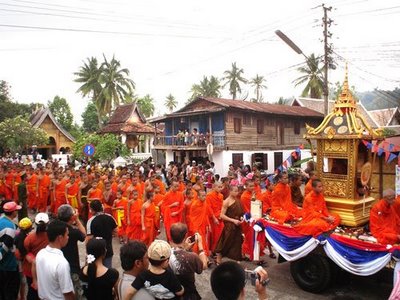
Some of the parade of monks, one being watered down quite calmly by a local woman.

Eventually Miss Lao passed by, reclining on a large papier maché horse. She was facing the other way, though, so I didn’t really get any good photos. Once the parade was over I was hot and tired and sweaty, so I walked straight down the middle of the craziest part of the street. It didn’t take long before I was drenched to the skin, mostly thanks to a guy wielding a pressurized hose, who was clearly upping the ante on the whole water fight business. If this kind of escalation keeps up we can expect to see fire hoses and water bombers in Luang Prabang for Pi Mai 2554.

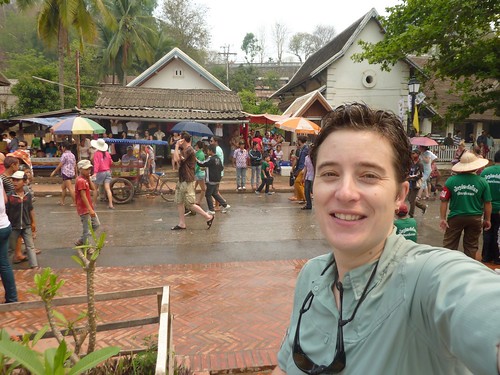
Me, wet, refreshed, and in the swing of things for Pi Mai

On Day Three of the festivities there was, you guessed it, another parade! Naturally they could not leave Miss Laos stranded up at the Wat Xieng Thong, so on the day after the south-to-north parade everyone saddled up again for the trip north to south. I decided to skip the second parade because by that time I was suffering from a bit of Pi Mai fatigue and starting to grow moss between my toes from being wet all the time.

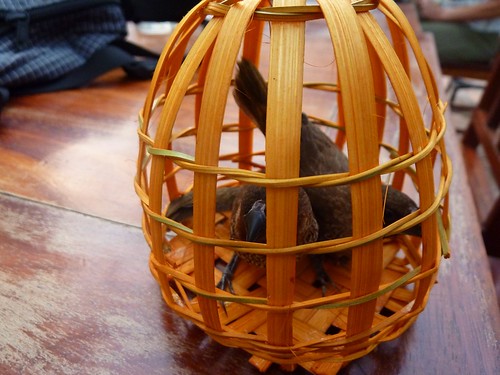
There was another Pi Mai tradition that caught my attention – I noticed women wandering around with bundles of tiny wicker cages. Inside each cage was a pair of live birds! It turns out that the birds are for sale, the intention being that you gain spiritual merit by releasing them from their captivity. (Nevermind that it would seem that greater spiritual merit might come from not imprisoning the birds in the first place…). On my first morning while I was having breakfast, I got approached by one of these vendors, so I went ahead and paid my 20,000 Kip ($2.40) for a pair of birds.

My birds. I have no idea how they get the birds into the cages. There were no doors - you just had to pull the sides apart far enough that the birds could find their way out.

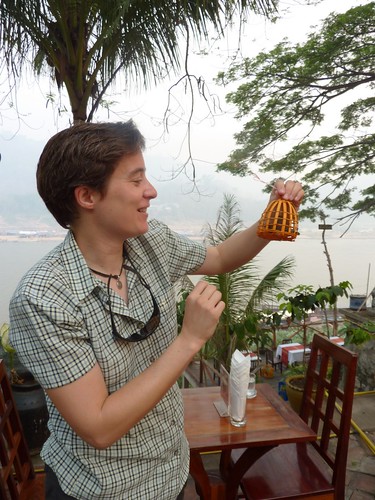
I think that local people take their birds to a temple to release them, but I didn’t bother with that. I just let mine go right away, making sure to get a few photos from some friendly Alaskan tourists who were sitting at the next breakfast table (with an empty bird cage next to them, so clearly they knew the drill).

Me getting ready to release my little birdies (and my hair even looks ok!)

Later on I saw little boys who had gathered up the abandoned, empty cages, so I suspect there’s some recycling going on there. I think the birds may actually be recycled too – someone told me they’re trained to come back, probably because they get food from their handlers. Some of the people selling the birds were also selling fingerling-sized fish swimming around in little bags of water (of course they were in bags!). I assume you were meant to release the fish into the river. The whole thing was really interesting.

Of course Pi Mai is about more than just dousing passers-by. And of course there's actually a reason for the water-play. My understanding is that it’s about cleansing yourself and others for the New Year. When I got watered down by Lao locals in the side streets (as opposed to the crazy gangs on the main drag) you could tell they were doing it with a sense of playfulness, but also with respect and genuine good wishes. I was told that they also wash the Buddhas in the temples at this time every year and on Day Two of the festival I discovered a quiet temple just off the main street and saw evidence of this very thing. The monks had set up a long serpent-shaped downspout arrangement, and were using it to pour water over a Buddha at ground level. I’d seen these serpent thingies in other temples and always wondered what they were for, so it was very cool to see one in use.

The little guy at the bottom was collecting the run-off water in a plastic bottle. I assume the water that has washed a Buddha on Pi Mai is very special indeed.

Pi Mai in Luang Prabang was definitely an experience, but there’s still a lot more to say about my visit to this beautiful, ancient town. Look for another post soon where I’ll report on all the touristy stuff I did that wasn’t part of the crazy Pi Mai celebrations, because despite the week long party, I still managed to get some proper sightseeing done and meet some interesting people that you’ll want to hear about. Stick around.

Steve’s Weird Food Laos Buffet

Thursday, April 15, 2010

It seems like the weird food is everywhere here in Laos, so here are a bunch of weird food related thoughts.

----------

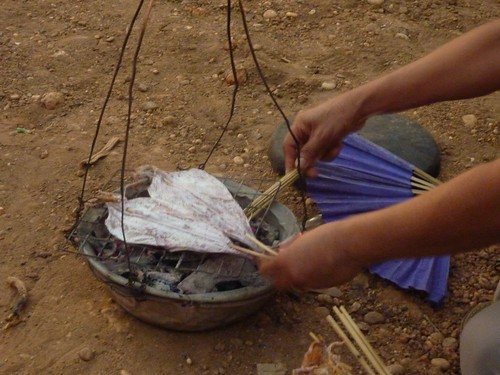
I think the first thing that would qualify as Weird Food (capitalized, therefore referring to Steve’s Weird Food, and not just some random, undocumented weird food) is the dried squid I had with Jim on the banks of the Mekong. These were small whole squids that were flatter than a pancake, hard, and chalky looking. Women were wandering along the riverbank selling them from baskets. They came in several sizes, and when you ordered them the vendor would pop them onto a little brazier she carried on her other shoulder to warm them through. It was a perfectly self-contained operation. Squid in the basket, hot coals in a pan, tongs to handle the product, and baggies to package it up. The smell of warm, dried squid is not one that’s going to take the Paris parfumiers my storm, but the taste was not bad. Well, when I say “not bad” what I really mean is stringy, fishy and chewy, but acceptable with a cold bottle of Beerlao alongside.

The squid on the portable BBQ, warming up for maximum smelliness

----------

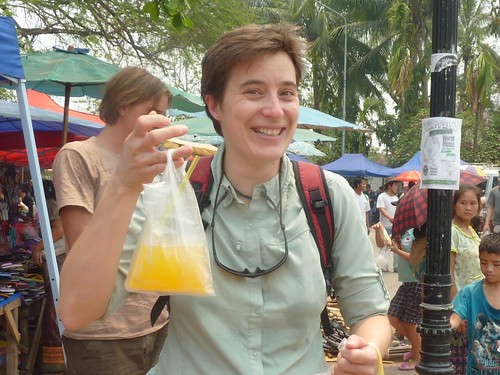
I’ve also noticed something in the Weird Beverages department. I’ve seen a lot of vendors selling different drinks that are made up of scoops of… stuff… from different jars. I have no idea what most of the different ingredients are. Some of them look like seaweed, and some like mud, and some like normal stuff – coconut and lime and such. The really weird bit comes when you order one - the guy selling them will pick up a small, heavy plastic bag and pour in ice and seemingly random scoops of this or that noxious-looking liquid. Then that bag goes into another plastic bag, this one with handles, like a mini grocery bag (a.k.a. carrier bag for our two U.K. readers: Anne and PT). Then they pop in a straw and hand it over. Drink-in-a-bag! It’s a bit odd. I tried it myself, though I got a very tame orange drink, and it turns out to be a pretty good system. There usually so much ice that you can actually set the bag down, contrary to what you’d assume, because the ice gives it some structure. And the large amount of ice means your drink stays really cold. And as an added bonus, you can hold the bag up against your forehead like a cold compress, which feels really really good.

Drink-in-a-bag!

Edited to add: The liquid-comestibles-in-a-bag phenomenon is not restricted to drinks. I've had spring rolls from street vendors who package the accompanying fish sauce in a small plastic bag held shut with a rubber band. And I've seen other places with noodles or other soupy stuff for sale that gets ladled into bags. You could have a whole meal in bags - starters, mains, drinks...

----------

More Weird Food you say? Well how about that old favourite – organ meat? After gnawing on

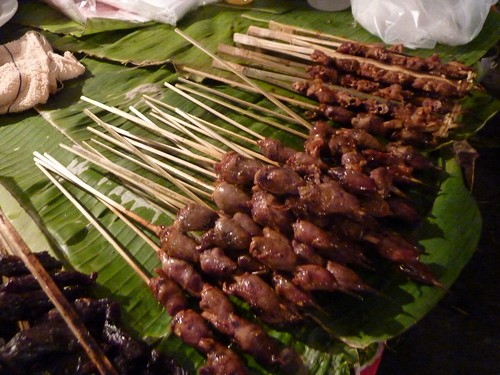
dried squid for a while, I went up to Vientiane’s night market. Night markets are always a good spot for finding weird food, and this one was no exception. There were stalls lining either side of a short stretch of street, and most of them were selling meat on bamboo skewers. There were whole fish, and lots of unidentifiable bits. I spotted a likely candidate and asked the woman selling what it was. “Chicken” she said, though it was clear this was nothing you were going to get at KFC. I had my suspicions, so I put my fist up to my chest and made little pumping actions with it. She nodded. And that’s how I came to order a skewer of chicken hearts.

Chicken heart kebabs, next to a pile of something else that was also described as chicken, along with a finger pointing to the neck…

All of these kinds of things are normally cooked beforehand and then put back on the grill to re-heat through thoroughly once you order them. So I waited around for my skewer and paid the woman the grand sum of 1,000 Kip. That’s about 13 cents, so I think that the chicken heart kebab has the distinction of being the cheapest weird food so far. And it was also one of the tastiest. They were sort of chewy (I suppose any muscle that works as hard as a heart is bound to get a bit tough), but the flavour was great. So great that I almost went back for another one, except that I was still quite full of dried squid and chicken lap and papaya salad and, of course, Beerlao. So I contented myself with the one small skewer and wandered back to the hotel, secure in the knowledge that another weird food was in the books.

----------

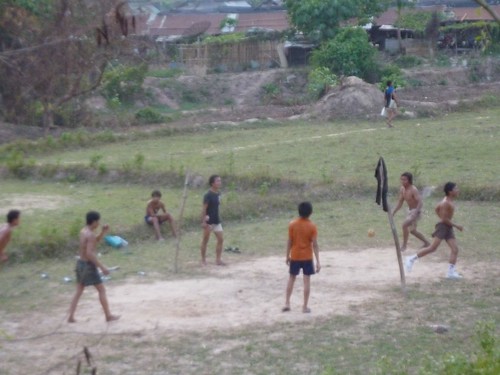
In brief bit of non-Weird Food related news, how about a little local Lao sport? During the Vientiane Bush Hash we ended near a small village, and ran right past a group of guys playing… something. I think it would best be described as “hacky sack volley ball”.

Volleyball Hacky sack, out of focus, but you get the idea

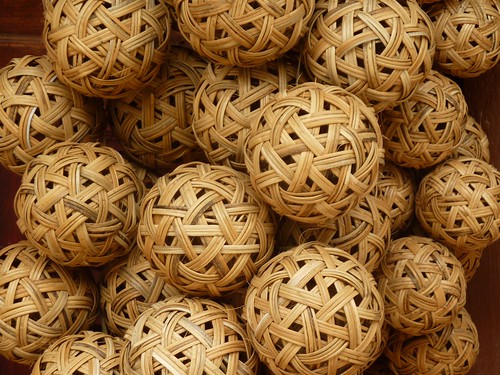
There were two teams on either side of a net, and they were kicking a large wicker ball back and forth. I say it was a wicker ball, but I think it was probably woven rattan or bamboo. It looked like the kind of thing that would be purchased for an outrageous sum at Pier One Imports and then artfully arranged in a pyramid formation with many of its fellows on a large square white dish. The dish would then, of course, be displayed in the middle of a glass coffee table by Martha Stewart.

Apparently not actually intended to be an item of home decor.

----------

Another odd things about dining in southeast Asia. Remember how there were very few proper paper napkins in the Middle East, where they used boxes of kleenex instead? Well here that practice is taken one step further. Instead of a box of kleenex on restaurant tables, you get a roll of toilet paper in a little dispenser. The more posh the place, the fancier the dispenser.

----------

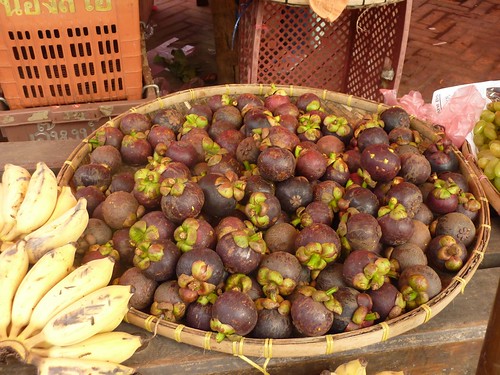
Finally, it’s time for a Weird Food fruit course. It’s pretty much guaranteed that whenever I wander through a market in Asia there will be at least one fruit or vegetable that’s completely unrecognizable. In Luang Prabang, it was this:

Hands up if you know what these are. Ok, everyone with their hand up can just keep their mouth and stop feeling so smug.

Lately I’ve been getting a bit more adventurous in asking about these things, which is how I ended up with some nice little red plums in Hanoi. In Luang Prabang when I asked about the item in question the woman at the fruit stall just grabbed one, cracked it open with her fingers, and offered me the flesh inside. It was fantastic!

The inside of mangosteen

All you hands-up people are probably now saying, “Yeah, it’s a mangosteen you idiot. They’re common as dirt,” which may be true. In fact, when I mentioned my discovery to a Cambodian couple the next day they laughed at me. I suppose this would be like someone walking into the produce department at Safeway and gazing in wonder at the magical and exotic… Mackintosh apples.

Regardless, I’m a total fan of the mangosteen, which actually does taste a bit like mango, and is juicy and refreshing. Tip: they’re easiest to get into if you run a knife around the whole circumference and pop the top right off. And beware that thick purple rind – it stains.

----------

That’s about all there is to say about Weird Food for now, except to tell you about the One That Got Away. On the way to the Kuang Si Waterfall (which you’ll hear about later) I ran into a vendor selling eggs. Not so weird? Well these were eggs on a stick! They were the most unlikely things. The eggs had a hole in the top and bottom of the shell and were threaded onto skewers, three per stick. Honestly, eggs on a stick! It was bizarre. I asked around a bit and it turns out the raw eggs are carefully drained through the holes in the shell and then cooked up with other things, and then the mixture is stuffed back into the shells and they’re put on the skewers. I really wish I’d at least taken a photo because, well, EGGS ON A STICK! Need I say more? I’m on the lookout for them in Luang Prabang, but no luck so far.

----------

Dried squid, organ meat, drinks in a bag, eggs on a stick… Laos is Weird Food paradise.

Slooooooow down. It's Laos.

Tuesday, April 13, 2010

First things first. Right now I’m in Laos, country number 27. That’s Laos, pronounced “Lau”. It has just one syllable, and the “S” is silent. It rhymes with every word in the sentence: “How now brown cow?”. Not “Lay-ose”. Not “Lah-ose”. Say it with me: “Laos”. And who are the people who live in Laos? They are the Lao. It’s pronounced exactly the same way (I have not heard a single person hear use the word “Laotian”). The Lao. In Laos. I’m also on currency number 23, the whimsically named “Kip”. It’s another one of those millionaire currencies – one dollar is worth about 8,500 KIP.

Now that we’ve got that straight, let’s move on.

Vientiane, (pronounced sort of like “Vee-en-CHANG”) the capital city of Laos, is perhaps the sleepiest capital city I’ve visited, and was a definite change after the hustle of Hanoi. But more than anything the defining difference between Vietnam and Laos has been the heat. When I stepped off the plane at Vientiane it was like stepping into a sauna. It was laughably, ridiculously hot and humid, and I went back and forth between horror and giggles. I later found out it was “only” about 36 degrees at that point, but having come from a pleasant 25 degrees in Hanoi, it was a serious shock to the system. In fairness, the guidebook did say that April is the hottest month in Laos, and we’re right at the end of the dry season so it’s especially baking.

My hotel was a little ways from the centre of town, but not nearly as far as I thought. In a shocking lapse of accuracy the LP showed the Beau Rivage Mekong about 3 km south of the city centre, whereas it was, in fact, about 1 km north of the city. Ridiculous. When I asked at the front desk about how long it would take to get to town, and gestured in the direction I thought I needed to go, they said “Is that the Lonely Planet map?” and proceeded to set me straight. (Honestly, LP, your maps are crap enough to begin with, could you not at least manage to place things in the right general vicinity, amid your usual maze of unlabelled streets?)

My lovely hotel room at the Beau Rivage Mekong, where I got to unpack EVERYTHING for five whole nights. It’s part of my new plan to NOT cheap out on accommodations in the coming months. $36 USD/night. Brilliant.

Since it turned out I was closer than I thought, on my first morning in Vientiane I walked to the centre of town, and was drenched in sweat within about 3 minutes of leaving the hotel. Like with Hanoi, I kind of expected Vientiane to be a bit French and all, I dunno, charming somehow. What was I to think when the LP uses phrases like “the whiff of fresh-baked baguettes” and “the romantic shuttered villas refusing to drop.” Charmingness, right? Well it was ok, but it’s not like I was slapped in the face with quaint vignettes at every turn.

The centre of town is universally acknowledged to be Nam Phu – a fountain in a central square. When I visited the fountain was dry, and the square was a large expanse of sun-blasted paving stones, with some trees, benches and gardens, but not a soul in sight. I retreated quickly to the Scandanavian Bakery where they had cold drinks and icy air conditioning. There I was lucky enough to overhear a conversation at the next table that turned out to be occupied by two local hashers! This was a really lucky break because I hadn’t received any response to any of my emails directed at the Vientiane hash, so to meet a couple of local hashers in the flesh and get the reassurance I needed about the upcoming runs was fantastic.

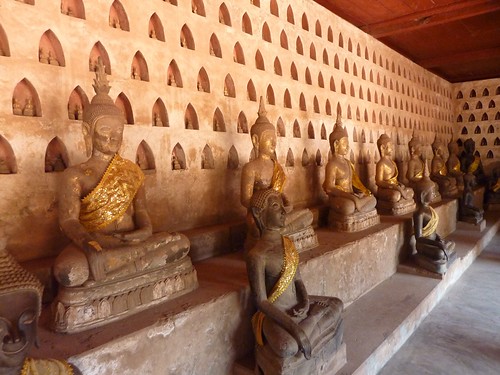
After lunch I figured I should really do some proper touristy stuff, so I walked over to Wat Si Saket, another Buddhist temple, but one with a bit of a difference that makes it worth a visit even if you’re sick to death of Buddhist temples. The main temple building is surrounded by shady cloisters whose walls are lined with tiny niches, each holding one or two small Buddhas, with more bigger statues sitting in front. Really interesting, and blessedly shady.

The many Buddhas of Wat Si Saket

After that I made it out the the Talat Sao morning market, but it wasn’t much to look at and my enthusiasm had melted away by that point. I really just needed a rest. This quickly became a pattern for me – get out in the morning for an hour or two until the brain began to fry, and then retreat to the hotel for a few hours during the height of the afternoon heat. I cooled off and relaxed for a little while and then struck out once again for the day’s big event – a run with the Vientiane Bush Hash! It’s a small city – the population is just 300,000 – but Vientiane has two different hashes: the Bush Hash, that runs on Saturday afternoons at locations outside the city, and the Monday Night Hash that runs (not surprisingly) on Monday nights, in more urban locations. Thanks to my impeccable timing, I was going to be able to attend both.

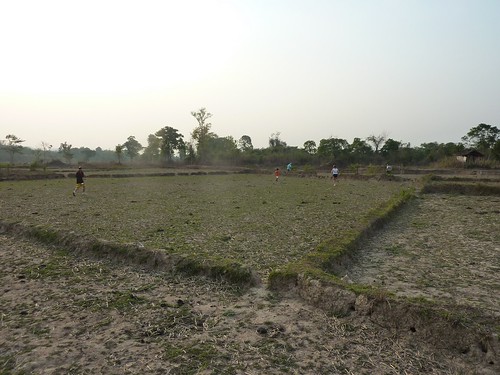
So off I went to meet up at Nam Phu and wait in the blazing sun for the group to gather. Soon enough we were off in a convoy of vehicles to the run site, which took at least half an hour to get to. The area was mostly farmland and small villages with lots of areas of bush as well. And the temperature was really not ideal for running. It was ideal for poaching eggs, or steaming fresh vegetable to tender-crisp perfection. But running? Not so much. Still, off we went, following a trail of shredded paper, which turns out to show up very well in rough terrain.


Hashing across dried up rice paddies with the VBH3

The run was a bit too long for comfort, and I really regretted not taking a bottle of water with me. But it was a really good way to see some of the countryside surrounding Vientiane, an area I’d never have got to as a civilian tourist.

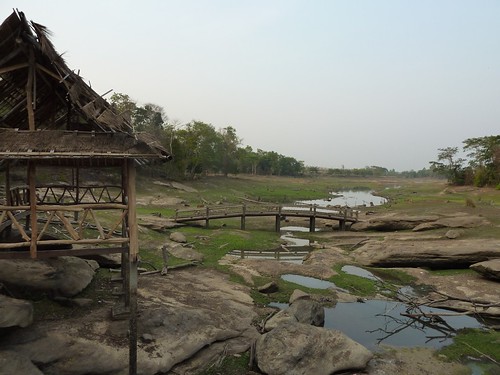
A picturesque bit of dried up lake on the trail. I’m told that in the wet season the water comes within inches of the platform of that building. I don’t know what happens to the little bridge.

The run ended up being an exhausting 8.6 km that took about an hour and fifteen minutes to complete. But there was plenty of cold beer at the end, and we held circle out on the side road from which we’d started, and then we went for more beers at a bar on the way back to town. I finally started the short walk from Nam Phu back to my hotel pretty late, and wandered along the banks of the Mekong river, where there are always lots of small food stalls set up. I picked up a skewer of pork meatballs flavoured with some kind of tangy flavouring, and a ball of sticky rice and egg for just 9,000 KIP (about a dollar). It had been a good, full day.

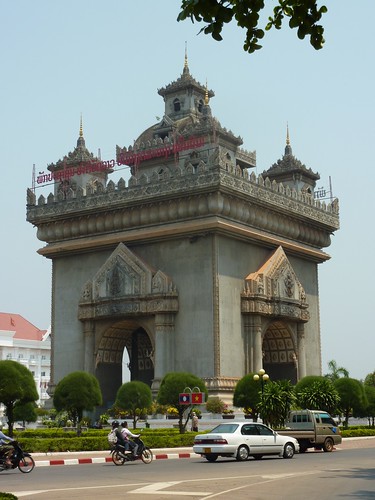
The next morning I started off by renting a bicycle – 10,000 Kip/day – and that instantly gave me a real sense of freedom. Also, when riding a bike you create your own wind so it was a much more comfortable way of getting around in the sauna. I visited an excellent used bookstore and then cycled off to my appointed Proper Tourist Site of the day, the Patuxai – Vientiane’s answer to the Arc de Triomphe. Built in 1969, but never really completed, it commemorates the Lao who died in pre-revolutionary wars

The Patuxai

It was a pleasant diversion, and I paid my 3,000 Kip to climb to the top for the views of Vientiane. Then I climbed back down again and had a nice bowl of noodles from a vendor set up in the shady (relative) comfort under the arch. I also tried a can of coconut juice that was disappointingly not cold enough and much too sweet. Thus fortified, I cycled off to find a series of other Buddhist temples but soon enough I got a bit lost among the unlabelled streets of the LP map. Temperatures were climbing into the “parboil” region, my water bottle was empty, and my enthusiasm was flagging. Clearly it was time for a tactical retreat. I made a quick pitstop to pick up a large bottle of gin, several cans of tonic, and some solid food and retreated to my hotel room With the blinds drawn and the air conditioning working overtime I fired up the computer for a marathon session with the new Dr. Who series. It was perfect.

That evening (when the temperature dropped back down to merely sizzling) I met up with a local hasher for a cold beer and some more street food from the restaurant/stalls set up along the Mekong riverbank. Apparently these used to be much more built up, with decks extending out towards the water. But they are in the process of tearing up and rebuilding the whole riverbank area, so all of these restaurants were bulldozed and have been rebuilt in very temporary fashion while work of land reclamation and heavy machinery continues alongside.

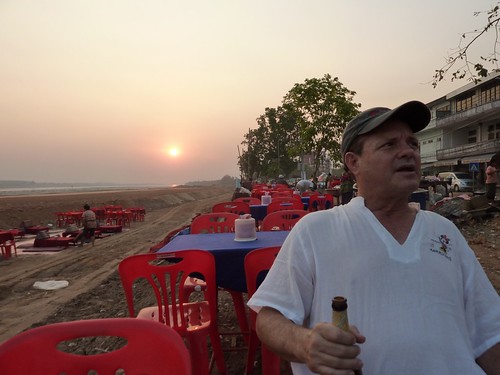
Jim, with the mandatory Beerlao, alongside the Mekong roadworks. That’s Thailand on the other side of the river.

It was a nice evening. We had some traditional Lao food, including green papaya salad (spicy!) and chicken lap, probably the most typical Lao dish, a mixture of finely chopped chicken (or fish, or pork, or whatever) with chilies and green beans and other stuff. It was really good. As was the Beerlao, the only beer and self-respecting Lao would drink. There was also some genuine Weird Food that night, but I think that’s best left for another post.

On my last morning in Vientiane I splurged on a private taxi to take me out the the Buddha Park. It’s an odd sight, located about 25km outside the city, and it sounded like it was worth a visit. The LP said there was a public bus to get there for a mere 8,000 Kip, but I didn’t fancy an hour long ride in a crowded, un-air conditioned bus, so I spent the 220,000 Kip on the private car. It was extravagant, but it’s all part of my new “don’t cheap out” policy for southeast Asia. (This meant that my average daily expenses are in the $80 range, which is frankly astronomical for this area but I simply don’t care.) Off I went in my highly air conditioned taxi, with my driver who would wait for me while I wandered around and then whisk me directly back to the hotel when I wanted.

Buddha Park, known more properly as Xieng Khuan - “Spirit City” - is, as the name suggests, a park full of Buddhas and other Buddhist and Hindu sculptures. It is, in the words of the LP, “a tribute to one eccentric man’s bizarre ambition.” The man was Luang Pu, a “yogi-priest-shaman who merged Hindu and Buddhist philosophy, mythology and iconography into a cryptic whole” (LP) and who supervised the casting of all the sculptures in the park by unskilled workers. They’re all built of concrete, and though some of them look quite old, the whole place was only built in 1958. The area is small, but it is absolutely crammed with odd statues of all sizes, including one gigantic reclining Buddha, and an odd pumpkin-shaped thingy that you can climb inside of, and a small temple sort of structure you can climb to the top of.


The reclining Buddha, and many of his brethren. (As usual, there are a zillion more photos of the park at Flickr, or there will be at some point if the Flickr uploader behaves itself.)

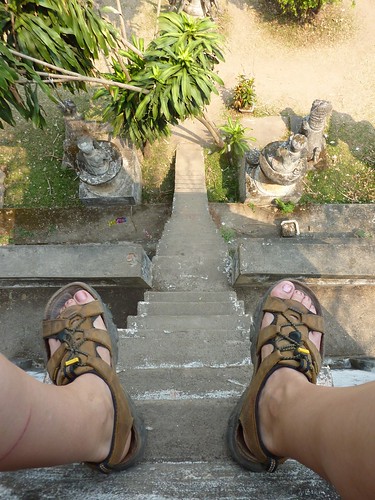
It seemed like the kind of place you could only manage to spend about 15 minutes, but I was determined to get my money’s worth out of that taxi, and ended up having an enjoyable hour there. There weren’t a lot of people around because it was still fairly early in the day, but I did meet a few Lao, some of whom even asked for pictures with me. For the longest time I was the only foreigner there. So enough, I exhausted the sightseeing potential of Buddha Park, but not before I climbed a ridiculously steep set of steps and took the mandatory photo of my feet.

It was really steep, and the higher it got, the steeper the steps were. At the very top they went up about 18” but were only about 3 inches deep. Definitely not up to code.

Back in town I had another nice lunch in a frigidly air conditioned café, and spent a bunch of time trying to sort out my plans for the next week. I also had a half an hour in a print shop, because I’ve implemented a new guide book system for southeast Asia. Instead of buying a paper copy of the Lonely Planet for the region, I downloaded the chapters I wanted from the LP website. They’re stored on my computer and on my iPhone, so I can look at them when I want. This worked reasonably well for Hanoi, though I did make sure to print out the maps because I reasoned that viewing the already-dodgey LP maps on a 2 inch screen would lead to… well I don’t know, but it wouldn’t be good.

When I got to Vientiane I decided to try printing out just the pages about the city, and managed to squeeze 4 LP pages onto one A4 sheet without them becoming too eye-crossingly tiny. These quarter-pages turn into a tidy little notebook that sits in my side pocket and is much quicker to consult than the PDF file. So I’m kind of half electronic and half paper, but I’m still carrying much much much less paper than I would be with a physical guide book. I’ll continue this system throughout southeast Asia, and if I like it, it may be the end of the big blue books forever.

My last big activity in Vientiane was the Monday Night Hash. It was a less taxing run than Saturday, but still had a good amount of rickety bridges, dried up rice paddies, goats and generally Lao kind of scenery. And the hare provided beer, soft drinks and red and white wine after the run, along with a nice spread of western friendly Lao food. It was a great way to end my time in Vientiane, and the local hashers were as friendly a group as I’ve yet encountered.

Yum!

I’m sure there was more to Vientiane than that, but perhaps not. It’s really a place that encourages you to slow down and not bother too much about things. One sight a day was enough, and having lots of time for unpacking, air conditioning and gin & tonic turns out to be a very agreeable way to spend four days. Now it’s on to Luang Prabang, where I’ll arrive right during the busiest part of Pii Mai – Lao New Year. It’s a weird festival, so make sure you don’t miss that post, whenever I get around to writing it, that is.

Volun-tourism, Part Four

Friday, May 22, 2009

We've had house-building, dolphin-counting and farm-tending. The (probably) last volunteering option that I've given some thought to is based in the town of Luang Prabang, in Laos. It's another program run by Global Vision International (they're the dolphin people), here's the rundown:

Enjoy the amazing culture and traditions of Laos, the “Land of a Million Elephants”, teaching novice Buddhist monks and community members in the Royal City of Luang Prabang, a city of silent saffron robed monks and ancient monasteries on the mighty Mekong River.

In Laos, many rural boys move to urban areas to ordain as Buddhist monks for low-cost living and for the opportunity of an education. As a GVI volunteer, you will teach English – the most popular subject – to the monks at Wat Siphoutthabat School in Luang Prabang, helping the school’s few staff to provide their students with an excellent education. Volunteers will have time off at weekends to explore the local area and can take a boat trip up the Mekong to the Pak Ou Caves, swim in the Khuang Si Waterfalls, watch the sunset from the top of Mount Phu Si, take a tour of the night market, raft, trek or even take an elephant tour
When I first started investigating volunteer opportunities, it seemed like every other one was something to do with teaching English abroad. That must be the most popular activity for people who want to work overseas. Magazines like Verge have tons of ads for different agencies promising opportunities to "teach and travel", and frequently run articles on topics like "Choosing a TESL* Course". Despite the plethora of opportunities, I wasn't wild about this idea - I was much more interested in a hands-on project like the house-building or farming.

However, this particular program caught my attention. I find the location very appealing; as I mentioned in my TTNY post about Laos, I'm keen on the whole country, and on Luang Prabang in particular. The opportunity to go there for an extended period and really become part of the community sounds great.

Also, my travel itinerary right now has me in Laos in April, which is the hot season (yuck), but also when the Laos New Year's Festival is held, and I think it would be very cool to be in Luang Prabang at that time, especially if I were there as something more than just a tourist.

The nitty gritty details also sound good. Instead of camping on a beach, or living with a local family, volunteers are provided with a private room in a guesthouse (it even has electricity, so take that Dolphin Camp!). And 2 weeks of the program costs $1,190USD, which is cheaper than the electrically-challenged dolphins or the curried worms. 4 weeks in Luang Prabang would be a bargain at $1,590 USD.

Other bonuses? Lunch break is from 11:15m to 1:30 pm! That's enough time to eat, blog and nap!

What are the down sides? You may have noticed that all of the "pluses" I listed above don't have anything to do with the actual volunteer work. That's because I think I'd rather help build a school for the novice monks than teach in one. I also don't have any experience teaching English, though they say that's not required, and that native English speakers are in desperate need.
TEFL qualifications or experience are helpful (as is any previous experience of English teaching), but not necessarily essential as you will be provided with basic training and support during your stay.
Still, I can't help but feel this may not be playing to my strengths. Those of you who know me, please chime in with your opinion on this. I first bookmarked this project quite a while ago, and at the time I remember being really keen about it. Now that I've revisited it to write this post, I have some doubts. I'd love to hear what others think.


* TESL stands for Teaching English as a Second Language, which normally refers to teaching non-English speakers in an English-speaking environment (like Canada). This is distinct from TEFL, Teaching English as a Foreign Language, which would be teaching non-English speakers in a non-English-speaking environment. Both these would fall under the umbrella of TESOL, Teaching English to Speakers of Other Languages. **

** Not that you cared.

This time next year - April 14

Tuesday, April 14, 2009

I'm playing fast-and-loose with the TTNY schedule these days because at this point it's really all just speculation. My itinerary is now in version 3462937.1 or so, but what the heck, let's forge ahead! Maybe I should start calling these posts STNY (Some Time Next Year)...

Laos is a small, mountainous, land-locked country in southeast Asia, sandwiched between China, Vietnam, Thailand and Burma (or as it is referred to in news reports: "alsoknownasMyanmar"). The population is just over 6 million and the currency is the engagingly named "Kip", though apparently there are not nearly enough Kip for all those 6 million people, because Laos is one of the poorest countries in the area. With its proximity to backpacker favourites like the beaches of Thailand, the temples of Cambodia, and the phở of Vietnam, Laos is southeast Asia's forgotten destination. That's exactly why I'm looking forward to visiting, and may even forgo some of those hotspots to spend a bit more time in Laos. Laos was also featured in the Fall 2008 issue of Verge, so I'm all keen on it now.

The official language of Laos is Lao, whose written alphabet is quite beautiful. Here's the Lao national motto ("Peace, Independence, Democracy, Unity and Prosperity") written in script:

Isn't that great?

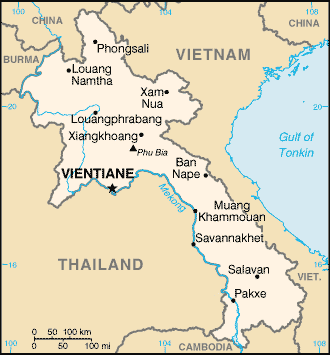
Luang Prabang is the former capital of Laos, and is now a UNESCO World Heritage Site (noted as "Louangphrabang" on the map above). It's got 66 temples, half of which are still in use, lots of traditional Lao wooden houses, and bits of European architecture from when Laos was a French colony. Also, the whole place is positively crawling with Buddhist monks, many of whom are young novices (or whatever a trainee Buddhist monk is called). To give you an idea of the pace of life in Luang Prabang, one of the big tourist activities is to line the streets to give alms to the monks who walk silently through the town at 6 am, with alms bowls around their necks. (In fact it's the Buddhist villagers the monks really rely on, the tourist are just there, well, being tourists). I'm going to direct you once again to Jake at "around the world", his post on Luang Prabang makes me want to go there. Now. Probably you should skip reading the rest of this post and go read Jake's stuff because he was actually there, and I'm just cribbing from Wikipedia. And here's a photo from that same post:


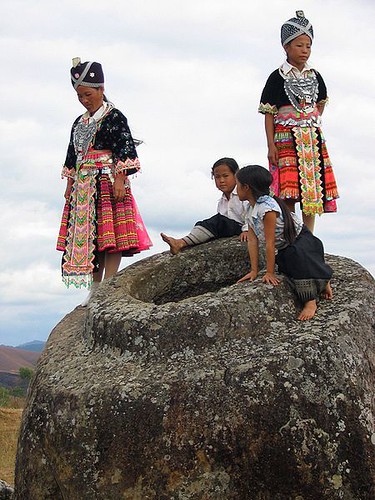
Moving out of the city, let's talk about another site in Laos that seems just fantastic. In fact, it's actually many sites, know collectively as the Plain of Jars. And that's just what it is - more than 400 sites of gigantic carved rock jars, ranging in height from three to ten feet, and weighing up to 13 metric tonnes. Archeologists are not really sure why they're there; some think they were funerary urns for cremated human remains, and some speculate they were for collecting rainwater for passing travelers, since many of the jars lie along a possible trade route. I like the Lao legend that a race of giants once lived in the area. There's also a story that an ancient king, prevailing in a long fought battle over his enemies, used the jars to brew enormous batches of rice wine to celebrate his victory.

Unfortunately most of the clusters of jars are not open to tourists, or anyone else, because they're surrounded by thousands of unexploded bombs. Apparently, the Laotian Civil War in the sixties and seventies "included significant participation by the North Vietnamese Army, American, and South Vietnamese military forces" and they left a lot of stuff behind after massive bombardments. Jar sites one, two and three are open to visitors, but it seems the funding to clear any other sites has run out. This means that Laotian efforts to have the Plain of Jars declared a UNESCO World Heritage Site are stalled, and makes it difficult to conduct any more scientific analysis of the area.


How is it that I can be a reasonably well-educated person and never even have heard of this whole Plain of Jars thing before I opened up the Wikipedia article about Laos? Seriously - an entire area of gigantic stone monoliths of unknown origin and purpose? It seems like the Plain of Jars should be up there with Stonehenge. How many other fantastic and unknown-to-me things will I stumble on while I'm out there? The mind boggles.