Sing Sing

Thursday, May 13, 2010

Singapore was another whistle stop on the Southeast Asia Express. It had sights, weird food and a hash, but it also had one big difference. In Singapore I did not stay in another nameless hotel room. Instead I was generously hosted by friends-of-friends (well, I suppose they were actually family-of-friends) who found out I was coming and immediately offered their spare room. It was great. Jasmine and Scott, their two little kids Thalia and Luke and their live-in helper Khun Nisa were friendly, helpful, and incredibly generous. They gave me a bed and the password for their wifi, included me in their family activities, did my laundry, loaned me maps, suggested things to see and do, took me for dinner, and even gave me a ride to the airport. Like I said, it was great. I’m surprised I left.
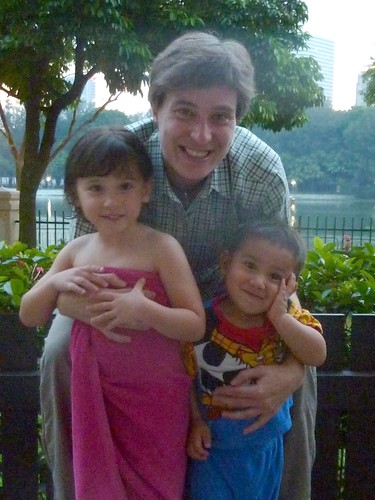
Me, Thalia and Lukey, on the patio

Singapore has a reputation for being a straight-laced police state. And it’s true that you can’t buy chewing gum there, and stiff fines are assessed for all kinds of seemingly innocent things like spitting, jaywalking, or taking a durian on the metro.
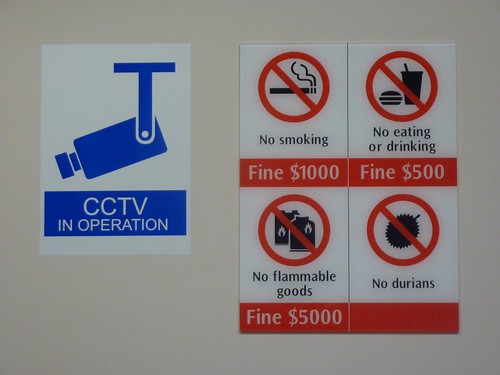
Apparently durian-related offenses are so serious the fines need to be considered on a case-by-case basis.

Well I am here to tell you that Singaporeans are not the cowed and submissive automatons they’re made out to be. For instance, I personally saw genuine Singapore residents jaywalking several times, and even witnessed spitting. And several times I saw people sit in the seats on the metro reserved for the elderly and infirm. So don’t let anyone tell you that a Singaporean could not hold his own in a bar fight or something, because clearly these are not a people to be trifled with.

Despite its population of hardened criminals, desperados and queue-jumpers, Singapore is a lovely, efficient and well-run place. For instance, the escalators in the recently opened Stadium metro station run at a very very low speed until someone actually gets on them, when they ramp up to full speed for as long as it takes to complete the trip and then slow down again to a power-conserving crawl. And that metro system has proper ticket machines and allows you to move from line to line indiscriminately (Are you listening, Kuala Lumpur?). Singapore is also adept at separating its population from their money. Automatic gantries levies a congestion fee on each car that enters the downtown area, via a card reader installed on the car’s dashboard. Singapore has very low taxes (around 17%), so a lot of revenue has to come for user-pay fees like this. However they make their money, though, they seem to spend it creating a place that’s clean, safe and pleasant. I think that if they just upped the taxes by a percentage or two they could afford to build a dome over the whole island and air condition the entire country. Then I’d be lining up at the immigration counter for sure.

Because I got to be an honorary auntie for a few days, I went with Jasmine, Khun Nisa and the kids to the Singapore Zoo on the afternoon I arrived. It’s a nice enough zoo – not too big, and with enclosures that seem relatively natural and don’t instantly make you feel awful for the animals as soon as you see them. Again, it was hot. In fact unless I say otherwise just assume that everything I did in Southeast Asia was done wearing a shirt that I’d sweated through hours before, and with my hair plastered to the back of my neck. Nonetheless, I gamely wandered around the zoo for a while until I finally gave up and joined the rest of the gang at what was undoubtedly the zoo’s best feature – the splash park! I don’t have pictures of the splash park because it was, you know, splashy, and it started raining not long after I got there. But it was GREAT, like a really creative play structure with the added fun of water. Water pooled around the base, water spraying from jets, even water dumping tsunami-like from a huge bucket that refilled and then overturned every five or ten minutes. It was the perfect antidote to a hot sticky afternoon.
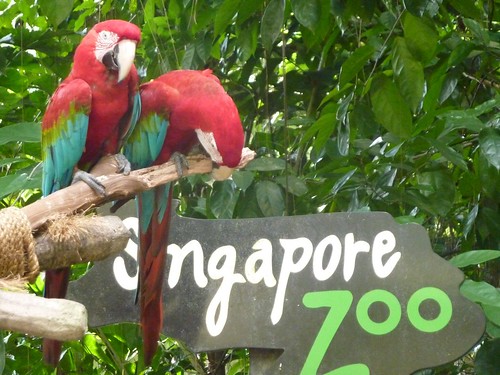
Red parrots (well, red birds anyways) at the entrance to the zoo

Everyone else went home for supper at end of the afternoon, but I stuck around to see a zoo with a difference. The Night Safari purports to be the only zoo in the world specifically designed to showcase nocturnal animals during the hours they’re most active – at night. It’s home to 115 different species and covers 40 hectares of forest and doesn’t even open until 7:00 pm when the sun sets (Singapore is almost exactly on the equator, so the sun rises and sets at the same time every day, all year). It’s a very different experience from the regular zoo. Clearly aimed at an older crowd, the entry area boasted several restaurants and bars and when I wandered over the crowds were much bigger than I’d expected. It was, if you’ll pardon the pun, a zoo. (Heh. It had to be done.)

There was a short and slightly lame show performed hourly in which various trained animals performed or didn’t perform small tricks taught by their handlers. The show was preceded by a desperate, pleading appeal repeated over and over again by the show’s effervescent host - “Please please please turn off the flash on your camera”. It was a simple request, and it made a lot of sense. These were animals that live most of their lives in the dark, so camera flashes aren’t just disturbing to them, they can actually damage the animals’ eyes and in extreme cases can cause blindness. It seemed simple, but of course you know what happened. As soon as an animal appeared, flashes when off all over the auditorium. I can not understand this. Is it because people are to stupid to know how to turn off the flash or to tell whether it’s on or off? Or are they unaware that the flash from a camera seated in the back row will do everything to illuminate the back the head of the person sitting in front of them, and nothing to illuminate the animal fifty feet away? Or do they think the rules apply to everyone except them? Or do they simply not care? Whatever the cause, it was just maddening to watch it happen over and over and over again. Really, just smarten up, people.
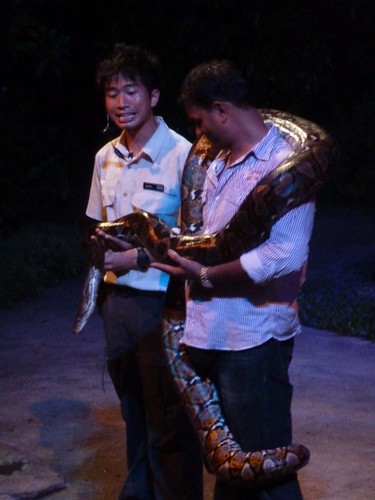
The only remotely presentable picture I have from the show. Because, you know, I didn’t use my flash. (Ian: I know this one! Reticulated python!)

After the show I set out into the park. There was a system of golf-cart-like tram trains that would take you on a big loop around all the whole area, but it cost extra and the lineups were long, and I had no desire to be cooped up with more flash-wielding cretins. I took the walking paths, and it was fantastic. They wound through the dark past the dimly lit enclosures where you could make out the animals going about their business. It was kind of magic, because there was a sort of quiet calmness that came with the darkness that made you just want to be still and watch.

The best part was the bat cage – fully-enclosed area where two different species of bat flew free among the trees. I walked along the pathway inside the cage, and it was easy to spot the large flying squirrels hanging upside down. Smaller bats flapped around, landing on small clusters of fruit hanging in the trees. It was a bit alarming when they flew over my head, but watching them do their thing was fascinating. I stayed at the Night Safari much longer than I’d expected and got home thoroughly satisfied and, of course, ready for a shower.

Singapore’s Weird Food was a twist on an old favourite, the noble durian. This time though, it was in a more palatable (sort of) form: durian ice cream! Thanks once again to the Lonely Planet, I knew exactly where to find this local treat at one of the few mobile street hawkers left in Singapore who sell ice cream sandwiches on Orchard Road, outside one of the city’s many many many high end shopping malls. And when I say ice cream sandwich, I mean exactly that – it was a piece of multi-coloured pink and green bread folded around a block of ice cream.
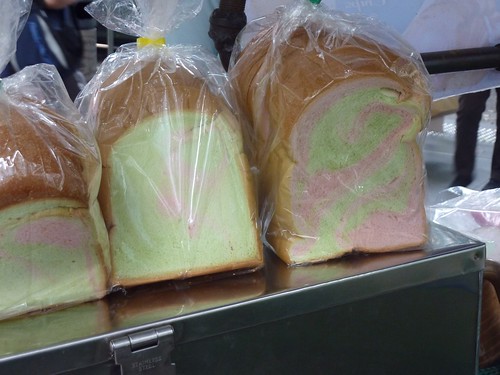
Festive sandwich bread

The ice cream came in lots of normal, probably very tasty flavours like mint chocolate chip, raspberry ripple and mango. And it came in a few wacky flavours: red bean, sweet corn (!) and, of course, durian. I debated whether I should try the sweet corn, but in the end I thought that nothing could top durian, so I handed over my $1.00 ($1 Singapore dollar is about $0.75 CDN).
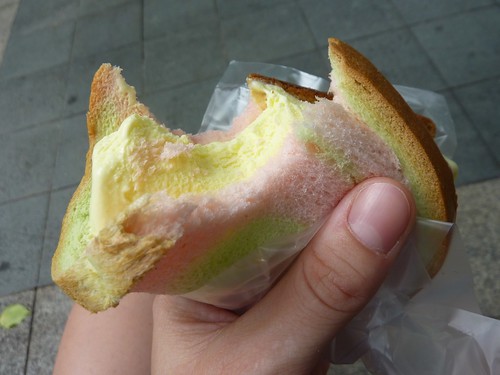
Proof that I actually took a bite

The smell was similar to fresh durian – hints of onion and strong cheese entirely at odds with the whole ice cream thing. And the flavour was similar too, right down to the growing numbness to the horror of it all. The first bite kind of tasted like cold and creamy onion-flavoured death wrapped in sweet bread. The second had more creamy fruitiness and less death, and by the end I could almost have convinced myself it was ok. Well, not really. What I was convinced of was that I should have tried the sweet corn flavour instead. Even in its cloaked and sweetened ice cream form, the flavour of durian lingers in the back of the throat for hours in that way that makes a stray burp particularly unpleasant.

I had a few much nicer food experiences in Singapore – the first thanks to Jasmine and Scott, who took me out to try the island’s specialty – chili crab. We went to an enormous seafood restaurant with tables that went right out near the water and ordered two chili crabs, steamed buns and beer. Being experience chili crab eaters, Jasmine and Scott came armed with packets of tissues and a large container of wet wipes which was my first clue that this would not be a tidy dining experience. The chili crab arrived chopped into large chunks and swimming in thick, spicy sauce. It was really tasty, but also a lot of work. Crab seems to resist consumption as if it’s still fighting for life from beyond the grave. I did my best, but I think I ended up with chili crab up to my elbows, on my shirt, under my fingernails and possibly in my hair. It was worth it.

My other classic Singapore food experience was one that simply had to be ticked off: drinking a Singapore Sling in the very bar where the cocktail was invented. Raffles Hotel is a colonial Singapore institution that first opened its doors in 1887 and is still one of the more exclusive hotels in the city. Rooms start around $750 a night, so I was happy that all I had to do was put on my cleanest dirty shirt and try to look respectable enough to be allowed entry to the Long Bar, home of the Singapore Sling.

Raffles Hotel

And I suppose, considering the price of a room, that I shouldn’t have been surprised that a single Singapore Sling clocked in at a wallet-lightening $29.45 SIG (about $22.00 CDN). Still, it had to be done. At least it came with a generous measure of ice, and was served in a room with air conditioning.
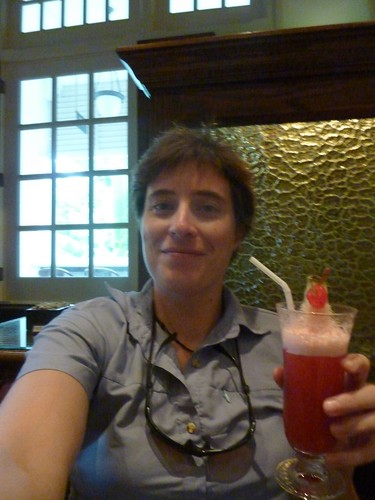
Here’s a crummy shot of me and my $22 drink. I made sure to eat LOTS of the free peanuts.

Still on the theme of food and drink, I also tried a traditional Singaporean breakfast – coffee and kaya toast. The coffee comes strong and black in Singapore, with a dollop of thick sweetened condensed milk on the bottom of the cup. It’s a perfect accompaniment to kaya toast. Kaya is described as “coconut jam” but it seemed more like a smooth, rich spread to me. Caramel brown in colour, it looked like peanut butter and tasted a bit like butterscotch. It was served on a light sweet roll that had been split and toasted. Each half was slathered with kaya, and a pat of butter was added before the halves were stuck back together and served. Needless to say, the combination of coffee, caramel-iness, butter, sweet bread and crunchy toastiness was an instant hit, and compared to the Singapore Sling it was a big bargain at $3.10 SIG in total.

What’s not to like?

If it seems like a spent a lot of time eating and drinking in Singapore, well, that’s kind of what you do there. That, and shop. And since I’m not a big shopper, I had to fill the time somehow. I did do some proper sightseeing – I wandered Little India and Chinatown, I hopped on and off a double-decker tour bus, and I cruised on the river. And of course I went to a hash. The Singapore Sunday Hash was the perfect foil for my extreme hashing experience in KL. The start of the trail was easy to get to, the run was fun, interesting and possible to complete without bloodshed, and the group was small and friendly and sang lots of familiar songs. It was the most homey hash I’ve been to in a while, and it was great.

Too soon though, my time in Singapore was over. I was sad to say good bye to Jasmine, Scott, Thalia, Luke and Khun Nisa, but incredibly excited to be moving on to the almost-last stop of the trip – Japan! And when Jasmine dropped me at the airport and I made the last dash through the steamy Southeast Asian night into the air conditioned airport, I breathed a sigh of relief and bid a fond farewell to a part of the world that showed me some amazing sights, introduced me to some great people, and caused me to lose my bodyweight in sweat every two hours.
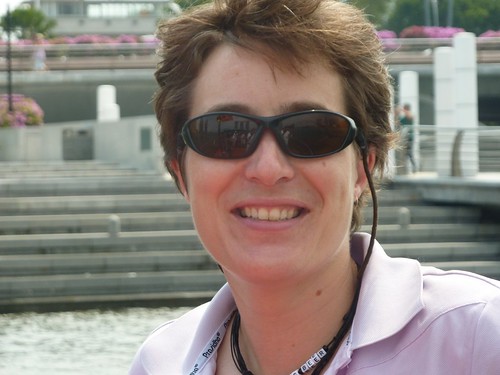
Me on the river cruise. There’s really nothing really “Singapore” about this shot, but it’s the best photo of me I’ve had in a while. Enjoy.

KL

Tuesday, May 11, 2010

That’s what the cool kids call it: “KL”, not Kuala Lumpur. This is probably because everyone in Malaysia pretty much always has their mouth full, so they don’t want to have to pronounce extraneous syllables. It seems that eating is the national sport in Malaysia. That, and shopping.

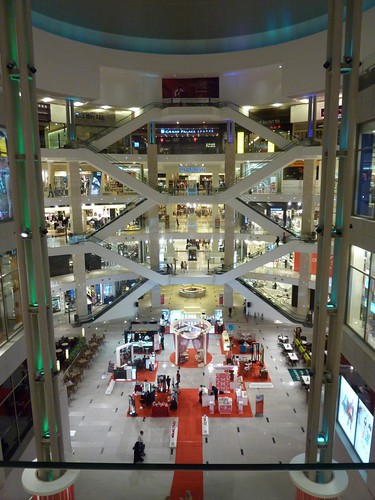
Inside one of the seven gajillion malls within a ten minute walk of my guesthouse.

I’m in a bit of a “whistle stop” phase of the trip right now where it feels like I just fly in to a city, see the big sight, attend a hash, eat something weird and move on. Tick, tick, tick the boxes and off I go. I suppose it’s my own fault – I could have chosen to visit fewer places and stay longer in each place, but as my travel time winds down I feel like I need to cram in what I can. Whatever the reason, I only had about two and a half days in KL, so I tried to make the most of them.

KL is the first big, properly “Western” city I’ve been in since Hong Kong, so it was nice to see old friends like 7-11 and Starbucks, and have access to a mass transit system. On paper the transit system in Kuala Lumpur looks like a pretty good set-up. They’ve got a fast train from the airport, underground metro trains, even a monorail (sing it with me, “Simpsons” fans!). The transit map is properly spidery with many multi-coloured lines flinging themselves across the city, such that you think it’ll be no trouble at all getting around the place. Ha! The problem is that each of those different lines is owned and operated by one of five different companies that do not play well with each other. This means that when you get off the monorail and on a metro train you have to pay a new fare. And the interchange stations definitely stretch the definition. In particular, the change from the metro to the monorail at KL Sentral involves leaving the building, walking two blocks, and entering a whole new station, and paying another fare. It’s hardly the friendly, efficient system I left in Hong Kong. I managed to get around, but it was frustrating, sweaty work.

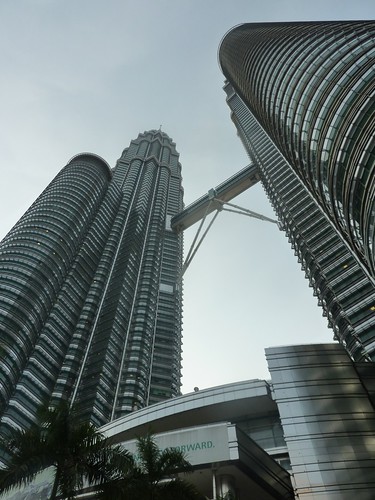
My “must do” activity for KL was to see the Petronas Twin Towers. Once the tallest buildings in the world (surpassed by Tai Pei 100 and then the Burj Dubai, the current record holder), the towers are an icon of KL. At 88 stories and 451.0 metres high, the top floors offer an unparalleled view of the city.

The Petronas Twin Towers

Yes, that would be a sight to see. Unfortunately, the highest part of the towers that tourists can see is the “Skybridge” the catwalk that links the two towers on the 41st and 42nd floors, about 170 metres up. Tickets to visit the Skybridge are free so they’re very popular, and only 1200 are issued every day. As a consequence you have to line up early because the tickets are usually gone by about 10:00 am. I got up at 6:30 am and walked to the basement ticket office, a thirty minute trip. On the way I stopped at one of many food hawkers set up on the sidewalk selling food to people on their way to work. There were simple folding tables covered in food – trays of sweets, tupperware containers filled with fried eggs and curries and noodles and other unidentifiable stuff, and big vats of rice. I picked out a few interesting skewers and some donut-like things, and for the grand sum of 1.75 RM (Malaysian Ringgit, about $0.55) I had breakfast on the hoof.

Breakfast!

I got to the towers by 8:00 am and the lineup for tickets had already snaked back on itself countless times. I stood in line until 9:25 am and snagged the last ticket for the 1:00 pm visit to the skybridge. By this time, frankly, I was ready for a nap so I hiked the 30 minutes back to the hotel and slept until it was time to walk back to the towers AGAIN. It seemed hard to believe that the whole business would be worth the effort.

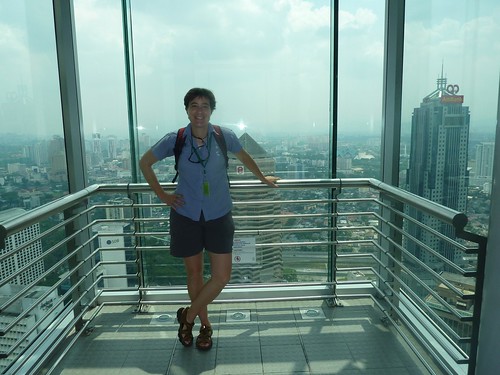
And it wasn’t. Yes, the skybridge is interesting, but it’s less than half way up the towers and we were allowed a grand total of ten minutes to look around and take pictures. So let’s do the math: 30 minutes to walk there, 90 minutes waiting in line, 30 minutes walking back to the hotel, and 30 minutes walking back to the towers. That’s 3 hours of “prep” for ten minutes of activity. I think I could have spent my time better. Then again, it was a pretty good view.

Here’s me, pretending it was worth it.

One off-beat thing I did in KL was to visit the Royal Selangor Pewter Factory – something that was recommended by one of the people I met on my cruise of Halong Bay in Vietnam. The factory offers free tours of their facility, but real drawing card was an associated activity they called the “School of Hard Knocks” where you get to bang out your own small pewter bowl, which sounded like a lot of fun (though that bit wasn’t free). The tour itself was a bit odd – I called ahead to get the details and they actually asked me to pick a specific time to visit so they could assign someone to show me around. Sure enough, when I arrived at the appointed hour Michael was there to give me a short guided tour of the pewter displays they had and of the factory itself. It was kind of cool having a personal guide, but also a bit weird.

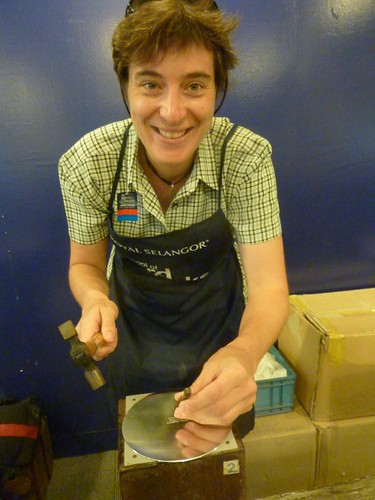
Weirder still was the “School of Hard Knocks”. It took place in a large, purpose-built room that could accommodate up to a hundred pewter-banging tourists. I had the whole room to myself, and a whole other personal guide/instructor to help me through the bowl-shaping process, though I got the distinct impression that she was not entirely consumed with a passion to teach me how to pound my little pewter disc into a bowl. In fact, the whole business felt quite rushed, which is too bad. I was expecting there would be other people participating, which would have been a lot more fun. Still, I did manage to create a reasonable little dish which I’m now carting around Asia with me.

Here’s me, punching my name into the bottom of my bowl blank

While the School of Hard Knocks (you really have to give them props for coming up with that name) was a real rush job, they certainly encouraged you to take your time when viewing the gift shop. I really didn’t want to buy anything, but I was dogged by such a persistent sales person that I finally relented and bought a tiny hand-hammered picture frame fridge magnet. I hate it when they do that.

My next stop that day was unplanned. When I hailed a cab on leaving the Pewter Factory I planned to go back to the hotel and get some lunch, but the cab driver misunderstood me. He thought I wanted to go to the monorail, and suggested I just get out at the closest station – Chow Kit. I looked a the map and the LP and figured that Chow Kit was as likely a place as any to have some lunch, so I agreed. And here’s one for the Improbable Coincidences File: When I told the cab driver I’d come from Winnipeg he told me his wife had left hat morning to fly to Winnipeg and visit their daughter, who lives there. So off all the cabbies in KL, I got the one with a daughter in Winnipeg. Wild.

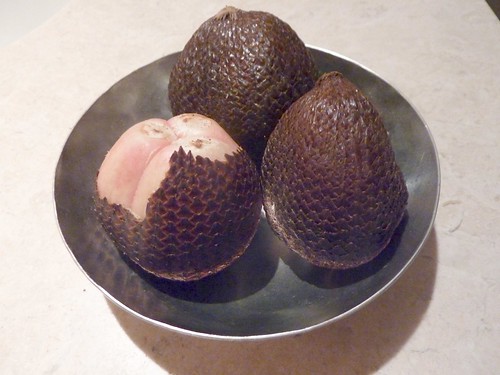
Chow Kit turned out to be cool too. There was a big market with the requisite dead beasts and weird veggies and there were lots of hawker stands selling prepared food. I had some Indian style fritters and a really good folded omelet kind of thing with chicken in it. And I got some sweets and some really weird fruit. In fact, I think that fruit - buah salak - deserves to be KL’s Weird Food, mostly because it looks like a cross between a mutant strawberry and a snake. The shape of each fruit is like a big upside-down strawberry, but the whole thing is covered in a dark brown scaly skin that looks decidedly reptilian. (And no, Ian, I don’t know what species… Malaysian Brown Fruit Viper or something.)

Here’s a partially peeled salak, along with some untouched others, displayed in my hand-hammered pewter bowl.

The white flesh inside was in very firm sections that clung to a large pit in the middle so you had to gnaw at it with your front teeth. The texture was quite nice - juicy and a bit crispy, sort of like an apple. The flavour, on the other hand, was not so nice. It was green and harsh like an unripe banana, and left that funny puckery feeling on my tongue. Sadly, I think buah salak will languish forever (along with black jelly) in the pantheon of foods that will never be “the next big thing”.

Besides the towers and the weird food, the other box I simply had to tick off in KL was the one marked “Hash”. The Hash House Harriers were formed at the Royal Selangor Club in Kuala Lumpur 1938, and that original group – the Mother Hash - still runs every Monday night at 6:00 pm, and has done so since 1938. I actually went to visit the Royal Selangor Club while I was in KL, but let’s just say that, like the Skybridge, it wasn’t worth the trouble. And I couldn’t run with the Mother Hash because it’s a men-only group (don’t get me started….) Instead I got in touch with one of the 37 (no really, thirty-seven) other hash groups in the greater KL area. I chose the Batu Hash House Harriers because they were running the night I was there, and they answered my email.

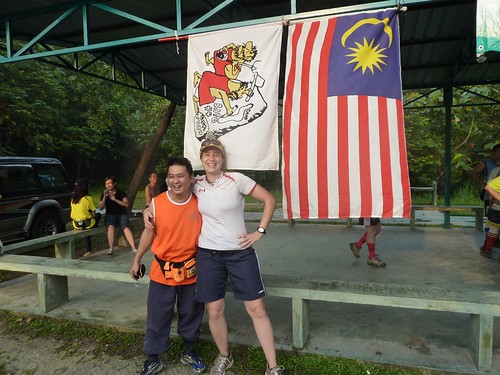
Me and the GM of the Batu Hash, posing before the run when I was still blissfully unaware of what was to come.

I suppose I should have guessed that hashing in birthplace of it all would be serious business. I just didn’t think I’d be stumbling out of the jungle an hour and a half after starting out, cursing, completely drenched in sweat, utterly exhausted, fed up, and bleeding (not badly, but the scratches on my legs did excite comment for several days after). It was the last twenty minutes of crashing through the jungle that really did me in – until that time I’d been having fun. But just as I was getting tired and it was getting dark the trail veered unexpectedly into much denser growth, up and down several more hills, through ankle-grabbing vines and leg-scarring thorns, and across one very small stream before finally spitting me out where we’d started.

I had to take a few minutes to calm down when I finished, and after doing that, and quizzing a few other people, I was amazed to be told that the trail I’d just run was considered by most to be on the wimpy side of average for a Batu hash. Well that’s just mental. I guess I’m just not KL hash material.

Despite the er… challenging nature of the trail, all the festivities after were definitely worth attending. There was a table of food set up when I emerged, and I had something to eat after I’d calmed myself and scraped off the top layer of grunge. Then I was informed that this was only the “warm-up” food – there was much more coming later. Remember how I said that eating is the national sport in Malaysia? Well this was a good example of that. There were snacks before the run, a respectable assortment of dishes immediately after, and a big buffet of home cooking after that. It’s like the evening was one big meal interrupted by some pesky interludes of running and drinking beer. Perhaps in Malaysia life is what happens to you in between eating.

This hash was one of the few I’ve attended that was predominantly local people; of the large group (about 90) only me and two others were not Malaysians. This meant that the circle was conducted almost entirely in Cantonese, which was very strange. I got some interpretation but mostly I just let it wash over me. Sitting there in the dark with a succession of bottles of Guinness, tuning in and out of what was going on, and chatting with the incredibly friendly people around me it really felt like this was the kind of thing I’d hoped to experience when I conceived of this whole crazy trip. Lots of people came up to talk to me like I was a bit of a celebrity for having traveled all that way. And it seemed they were all genuinely pleased and proud that of all the groups in KL, I’d chosen to run with them. I got home a little after 2:00 am that night, exhausted and convinced that hashing in KL is not for the faint of heart, but happy that I met those people and ran and ate and drank and talked with them.

I was also desperately, profoundly, extravagantly happy to go to sleep.

Procrastinated thoughts on Cambodia

Friday, May 7, 2010

Cambodia already seems like a hundred years ago. Here I am in Singapore, and I’ve already been through Kuala Lumpur, so it seems weird that I still haven’t finished telling you about Cambodia, which was two countries ago. Perhaps I need to be a bit more disciplined about the blogging, or I’ll end up writing about Singapore from Karen’s deck in Winnipeg. So, here follows a few thoughts about Cambodia.

----------

I know I said that the only reason to go to Siem Reap is to see Angkor, but there was a lot of time when I wasn’t out clambering around temples, and I did manage to fill the time somehow. For instance on my first night in Siem Reap, I went out to find dinner. I wandered around in the centre of town which is packed with restaurants and bars catering to tourists – I could have had pizza, Mexican, pasta, French, burgers, Cambodian BBQ, ice cream, organic sandwiches, and of course lots of Khmer food. This is the case in a lot of places – you think you’re in some tiny backwater town, and across the street will be a joint advertising Spaghetti Bolognaise and American breakfast all day. Sometimes it’s depressing and sometimes it’s comforting.

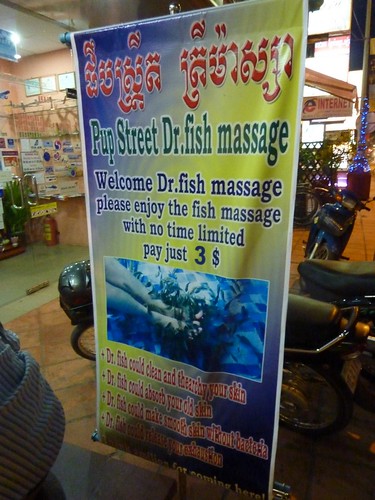
But before I had dinner I ran into this place:

Dr. Fish massage!

Here’s the deal – there’s a big tank of water filled with tiny, hungry fish, surrounded by a bench-like platform around the edges. You sit on the bench and dangle your feet in the water, and hundreds of tiny fish eat your feet. The idea is that they nibble away all the dead skin and bacteria and stuff that coats your feet. It is weird, but cool. For $3.00 I sat and let fish eat my feet. At first it felt ticklish, but eventually I got used to it and it felt more like the pins and needles feeling you get when your foot has fallen asleep and is just waking up. It was not altogether unpleasant. I sat for fifteen or twenty minutes, and when I pulled my feet out they did feel softer – almost like they’d been moisturized. I’d recommend it.

Yet another in the continuing series… Pictures of Pam’s Feet

----------

At the entrance to each of the temples at Angkor Wat there were always lots of local people selling books or trinkets or cold drinks and food. Sometimes they were even inside the temples themselves – there they mostly try and sell books about the history of the site or small woven bracelets or trinkets, or cold drinks. There were also groups of musicians sitting by the side of the road playing music, selling CDs, and soliciting donations. They were the most heartbreaking because the reason they were sitting is that they were all victims of land mines – missing one or more limbs. They usually had signs declaring that they’d become musicians so they wouldn’t simply have to beg. This way they could use music as their livelihood. It was kind of heartbreaking, partly because the landmine problem was and still is so huge.

The other hawkers of note were the little kids. Some just pestered until they made me crazy, but others were more clever. One little girl asked “Where are you from?” When I said “Canada” she rhymed off: “Canada. Capital Ottawa. Canada very large country but not very many people. Speak English and French. Lots of Snow. Now you buy something.” Other kids could recite the numbers one through ten in about seven different languages, which they’d do at the drop of a hat.

----------

Of course there was weird food in Cambodia, though I’ll admit right away that I did not go visit the Russian Market in Phnom Penh to try the fried spiders. Sorry Steve, but I have limits and chowing down on a three inch wide crispy tarantula is so far beyond those limits that I could travel faster than light and still not reach those limits in my lifetime. What I did try, in Siem Reap, was Cambodian BBQ. It was one of those cook-at-your-table affairs, sort of like the hotpot in Chongqing, except this one had a soupy part and a grilling part. There was a sort of clay pot full of burning coals that sat in a hole in the table, and then the cone-shaped bowl/grill sat on top of that, all brought by an attentive waiter who actually hung around for my whole meal, tending the grill. (That was a bit weird.) The donut-shaped part around the outside of the grill was full of boiling water, and the waiter stuffed that full of a load of veggies so they could cook into a soup.

Here’s the set-up

Ok, so where does the weird part come in? Well, the weird stuff is what went on the grill. I ordered the “degustation” menu, which came with an assortment of different meats: chicken, (yawn), beef (yeah yeah) and… frog legs, crocodile and snake! So that’s the weird part, ok? The frog legs went on first, because they take the longest to cook. The chicken and beef went on after that and were cooked first and were tasty. There were also four different dishes of sauce to dip the meat into when it was finished. As each piece was cooked, the waiter would pull it off the grill and put it onto my plate. They were small bits – just a few pieces of each, but enough to get a sense of the flavour. I’m not sure I needed a whole lot of snake or anything anyways. (How would you order a lot of snake, do you think? By the foot?)

And how did it taste? The frog legs were my favourite of the three weird meats. They were like tiny little drumsticks and they tasted, well yeah, they tasted like chicken, but with a finer texture. The crocodile was a bit tough, with a texture similar to beef but a flavour more like pork. The snake was my least favourite. It was python, it turns out, and it was really really chewy. There wasn’t a lot of flavour, and it was a real workout getting it down.

All in all it was a very successful Weird Food experience. It was fun and interactive, and it was tasty, and it was weird. I can’t ask for more than that.

----------

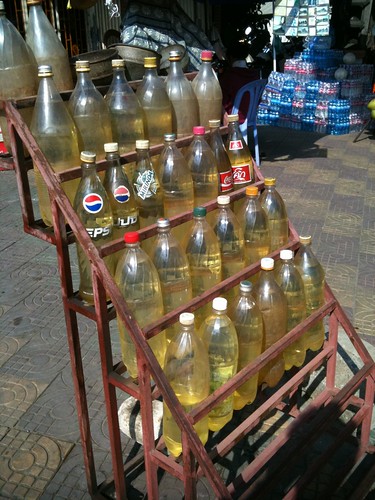
I noticed something a bit odd on the roadsides in Cambodia. Like all over Southeast Asia (and China, and India and Africa…) there are always little stalls selling things along the roads inside cities and towns and on the roads between them. Often it’s fruits and vegetables, or street food, or drinks and snacks, or, well, just about anything: foil helium balloons, car parts, underwear, whatever. But there was one thing I couldn’t readily identify. At first I thought it might be some kind of blindness-inducing homebrewed alcohol. This was at least partly because (though it’s not shown in this picture) a lot of the time the containers involved were recycled Johnnie Walker bottles.

Well what would you think?

Finally I got to ask a Cambodian about it – Ricky, my moto driver who ferried me all over Phnom Penh for three days for only slightly outrageous rates. It turns out that the stuff in teh bottles was gasoline, which made me feel much better. I guess there aren’t many proper gas stations in Cambodia, and the ones there are tend to be on the outskirts of the city. So vendors buy gasoline in bulk and re-sell it in small amounts. I suspect most of the customers have motorcycles, so they don’t need 50 litres of gas at a time. And the smaller amounts – one or two litres – are probably much more affordable for the average Cambodian. My Angkor Wat guide told me that the average yearly wage in Cambodia is $250, so it’s no wonder they like to buy gas a litre at a time.

----------

An open letter to every tuk tuk driver in Cambodia:

Dear Mr. Tuk Tuk,

No, I do not want a tuk tuk. I am walking down the street to my hotel, or to a restaurant, or to the convenience store, which is approximately 23 feet away. I think I can manage without motorized transport. Calling out “Tuk tuk lady?” will not make me change my mind. I will not suddenly realize, because you asked, that what I really need to make myself truly happy and fulfilled at this moment is to hire your tuk tuk. And if I were to have the sneaking suspicion that a ride in a tuk tuk would bring me great joy, I would have hired one of the 739 tuk tuks that I’ve just passed, all of whom also called out to me, and all of whom were rejected, with decreasing politeness, as I walked by. No offense, but please, for the love of God, shut up.

Yours sincerely,

Pam

P.S. For future reference, here are the other things I do not need: a massage, a book about Angkor Wat, a bundle of bracelets, a cold drink, an artfully carved pineapple, or any other knick knack or gew gaw that you happen to be selling. Sorry.

----------

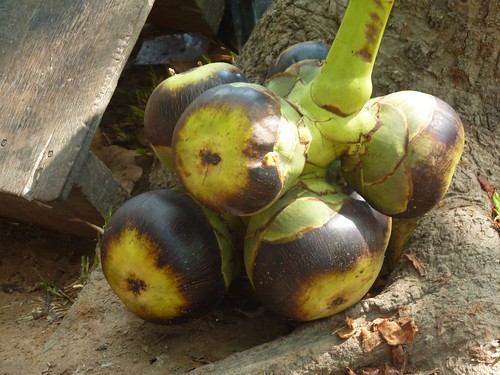
Bonus weird food: Palm fruit. On my second day at Angkor, my tuk tuk driver convinced me to try some local fruit that women were selling outside of one of the temples. It was palm fruit, and came in a little plastic bag that was kept marvelously cool in a bin of ice. Here’s what the palm fruit looks like when it comes off the tree:

Palm fruit

Inside the palm fruit are little white segments of white flesh. They’re sort of like jelly-ish little bags full of a mild, sweetish liquid, and they burst inside your mouth when you bite them. The juice was refreshing, especially while it was cold, but I wasn’t wild about the flesh. Still, chock up another new fruit.

----------

And that’s all I have to say about Cambodia, except to show you this photo of me while I”m having my feet eaten by fish in Siem Reap. I’m telling you, it was cool.

The Killing Fields

Monday, May 3, 2010

This is not a happy blog post – if you’re having a rough day, I’d recommend skipping it. There just isn’t a way to treat this subject lightly because frankly, it beggars belief. The atrocities committed by the Khmer Rouge on the people of Cambodia between 1975 and 1979 are so horrific that it’s difficult to process. For those of you who are, as I was, mostly ignorant of the history of Cambodia and the Khmer Rouge, here’s a primer of what I’ve absorbed from Wikipedia and the documentation at the sights I visited in and around Phnom Penh.

The Khmer Rouge were a communist organization that took power in Cambodia, seizing control of the capital Phnom Penh, on April 17, 1975. Led by the notorious Pol Pot, the Khmer Rouge’s particular brand of communism came to be guided by four principles:

  1. Total independence and self reliance
  2. Preservation of the dictatorship of the proletariat
  3. Total and immediate economic revolution
  4. Complete transformation of Khmer social values

In practice this meant that when the Khmer Rouge troops took Phnom Pen, they immediately started transporting its residents out of the city to become farm labourers - “rusticating” the urban population who would be transformed through hard labour into part of their new rural, classless society. Phnom Penh, a city of 2.5 million, became a ghost town in just three days; other urban centres were emptied as well. The Khmer Rouge abolished currency, banks, normal schooling, proper hospitals, free markets, foreign clothing, religious practice and traditional Khmer culture. There was no public or private transportation and no private property. Most of the population was bent towards attempting to triple rice production from previous levels – to help lead to independence from outside aid. Many died from starvation and disease, at least partly because what medical aid was available was often primitive because no outside medical expertise was allowed.

Food was available on communal farms where people were virtually imprisoned, but rations were small and hunger was constant. Even foraging for berries to eat was considered “private enterprise” and could result in death. Those who survived the back-breaking work and famine were subject to brutal and arbitrary torture and execution – anyone suspected of being a professional or intellectual was killed; in some cases simply wearing eyeglasses was considered an indication of literacy, and could mark someone for death. Others subject to torture and death included anyone with a connection to a foreign government or to the former Cambodian government, and those belonging to ethnic Chinese, Thai or other “non-Cambodian” ethnic groups, Christians, Muslims and Buddhist monks. The brutality of the regime is chillingly summed up in one of their mottoes:

"To keep you is no benefit. To destroy you is no loss."

Those marked for death were transported to the killing fields – and here I got a rude shock. Having heard the term “killing fields” before, I’d always assumed it was one area. In fact, there were 343 different killing sites around the country and 19,440 mass graves have been discovered, containing more than one million bodies. Add to that the number who died of starvation, overwork, or inadequate medical care and the total death toll rises to something in the neighbourhood of 2.2 million. People were trucked out to these killing fields and murdered as soon as they arrived, often bludgeoned to death with farm implements or simple chunks of bamboo in order to save on ammunition. Near the end of the regime the killings grew more and more frequent and so many condemned were brought to the fields that the Khmer Rouge had to create holding pens in some places because they simply couldn’t kill everyone who arrived each day. It’s a scale of atrocity that’s hard to fathom.

The most visited killing field is at Choeung Ek about 15 km southwest of Phnom Penh. It’s a heartbreakingly small area dominated by a large memorial stupa containing the clothing, skulls and other bones of some of the 8,995 people who died there. I paid the $2 entry fee and, unsure where to start, wandered over to the small museum on the site. There I watched a short video, read through the museum displays, and finally walked out into the site. It’s incongruously park-like. There are trees and grass and unpaved dirt paths that wind between depressions in the ground; those depressions are the excavated mass graves.

The scene at Cheoung Ek

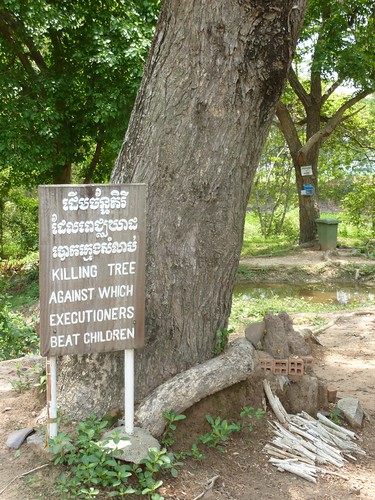
Nothing is innocent at the killing fields. Among the trees are two that stand out – one large tree had a placard beside it saying it was used to hang a speaker that broadcast loud noises to drown out the cries of the victims, so that those living nearby wouldn’t grow suspicious. The other tree of note was far more sinister – it’s the one where Khmer Rouge killed babies by swinging them by their legs and smashing their heads against the trunk, where nails had been imbedded. I’m sorry if this is graphic, but it’s simply reality.

The killing tree

Even the pathways are eerie. They’re bare dirt, and as you walk you among the graves you can see scraps of cloth poking up through the earth. These are pieces of clothing from victims that emerge from the ground after it rains. In one or two cases I could even see what looked like bone. It was hard to believe.

Scraps of clothing on the paths

Finally, I walked over to the stupa. Buddhists believe that human remains should be venerated and housed in special places so the stupa at Cheoung Ek contains the skulls of more than 5,000 victims of the Khmer Rouge excavated from the mass graves on the site. It’s got clear acrylic sides so you can see the contents of the different levels. The very bottom displays a mound of the clothing retrieved from the graves, and then it’s skulls as far up as you can see.

Level after level of human skulls

The whole place was sobering, and of course it was terribly hot out, so it was physically, emotionally and intellectually uncomfortable, and my day was only half over. Next on the agenda was the Tuol Sleng Genocide Museum back in Phnom Penh. Tuol Sleng was a high school until the advent of Khmer Rouge rule when it was converted into a prison and interrogation centre. The classrooms became cells for as many as 1,500 prisoners, the windows were barred, and the balconies were covered in barbed wire. Between 1975 and 1979 an estimated 17,000 people were imprisoned there, often tortured into confessing imagined sins against the regime, or coerced into naming friends or family members who might be considered enemies.

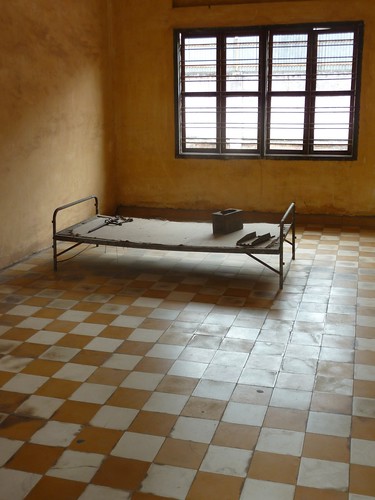
Like Cheong Ek, it was heartbreaking – it still really looks like a school. I found the orange and white checked floor tiles particularly out of place – oddly cheery next to the bare metal bedsteads and the stark, grainy photographs of the dead displayed on the walls.

One of the classrooms that was used as a prison cell. Some others had been subdivided with hastily constructed brick or wooden barriers into tiny cells for one person.

There was a large sign outside one of the buildings that listed the rules prisoners at Tuol Sleng were expected to follow. They were translated from Khmer into questionable English, and if the subject matter hadn’t been so dark, they would have been funny.

  1. You must answer accordingly to my questions – Don’t turn them away.
  2. Don’t try to hide the facts by making pretexts this and that. You are strictly prohibited to contest me.
  3. Don’t be a fool for you are a chap who dare to thwart the revolution.
  4. You must immediately answer my questions without wasting time to reflect.
  5. Don’t tell me either about your immoralities or the essence of the revolution.
  6. While getting lashes or electrification you must not cry at all.
  7. Do nothing, sit still and wait for my orders. If there is no order, keep quiet. When I ask you to do something, you must do it right away without protesting.
  8. Don’t make pretext about Kampuchea Krom in order to hide your secret or traitor.
  9. If you don’t follow all the above rules, you shall get many lashes of electric wire.
  10. If you disobey ant point of my regulations you shall get either ten lashes or five shocks of electric discharge.

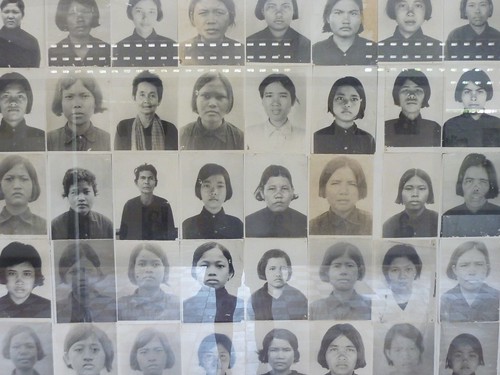
In addition to their rules, the Khmer Rouge required each prisoner arriving at Tuol Sleng to be photographed and to give detailed autobiographies. Several rooms of the museum were filled with these photographs – hundreds and hundreds of them.

Just a few of the victims of Tuol Sleng

I went through most of the buildings of the museum. Some rooms were empty, some had just a few artifacts, some had background information, and some displayed photographs like the ones above. At the top of one stairwell I saw a sign pointing to a movie theatre and remembered that I’d been advised there was a film on continuous loop that was difficult to watch, but worth seeing. By this time I was approaching overload, but I climbed the stairs anyways, only to discover that all the doors on that floor were locked. If there was a movie to see, I would not be seeing it, and that was a huge relief. Not long after, I left; I was done.

Though I finished with the killing fields and Tuol Sleng by lunchtime, it’s not the kind of thing you can just shake off. I went back to the hotel and did one or two small errands before showering and collapsing in my room with the lights out and the curtains drawn. I thought I might go out in the evening, but instead I spent hours uploading photos, thinking, researching, and trying to put together these thoughts on the day. Sometimes I let things percolate for a few days before I write about them, but in this case it was almost like I wanted to simply get it over with.

I started out so ridiculously ignorant of the whole episode of this country’s history that I was embarrassed when I learned how pivotal and scarring an event it was. And perhaps the most shocking thing of all was how recent this history is. When I visited the battlefields of France I was separated from those horrors by two generations, but the Khmer Rouge regime occurred within my lifetime. If I’d had the misfortune to be born in Cambodia, I’d have been six years old when Phnom Penh was taken. I’d have lived, or more likely, died, under their brutal rule. Anyone in Cambodia over the age of about 30 must have personal memories of the relocation, famine, torture and death that marked the three years of Khmer Rouge rule here. It’s all just staggering. I’m glad I’m here, and I’m glad I saw those sights and learned about the history behind them, but mostly I’m grateful to be going to bed in a peaceful and relatively safe Cambodia that seems, for the most part, to have recovered from its dark past. It’s not perfect, but it’s much much better than it was.

If you can’t stand the heat, get out of the temple

Sunday, May 2, 2010

There’s really only one reason people go to Siem Reap, and that’s to see Angkor. Angkor Wat specifically, and the entire complex of Angkor temples in general.

“Angkor” literally means “Capital City” or “Holy City”, and “Khmer” refers to the dominant ethnic group in modern and ancient Cambodia. In modern usage, Angkor has come to refer to the capital city of the Khmer Empire that existed between the 9th and 12th centuries A.D., as well as to the empire itself. The temple ruins in the area of Siem Reap are the remnants of the Angkorian capitals, and represent the pinnacle of the ancient Khmer architecture, art and civilization.”

- Seam Reap Angkor Visitor’s Guide

Angkor Wat is the largest and best known of the structures in Angkor Archeological Park, though it is by no means the only one. In fact, the area is littered with more than a thousand temple remains and other structures, large and small. Some have been reclaimed from the jungle and restored, while others are little more that unidentifiable heaps of stone overgrown with trees.

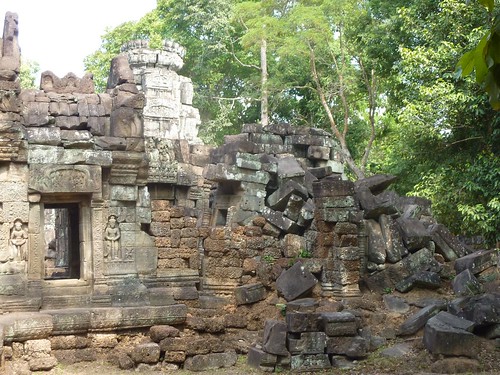
A tumbledown corner of Ta Som, one of the smaller and less loved temples, but a favourite of mine.

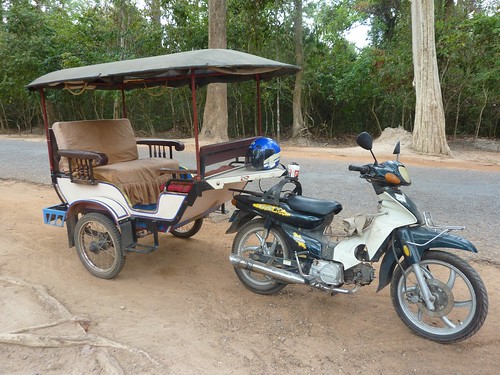
The area covered by Angkor Archeological Park is massive, and if you add the ruins that fall outside the site the whole area covered by Angkor monuments is purported to be about 1,000 square kilometers of ancient urban sprawl. This means it’s not the kind of place you can explore on foot. People use lots of methods to get around the site – car, motorcycle, and bicycle – but the most common method is to take a tuk tuk. This is a term you hear a lot in Asia, and they take different forms in different places. In Cambodia a tuk tuk is a two-person trailer attached to the back of a motorcycle.

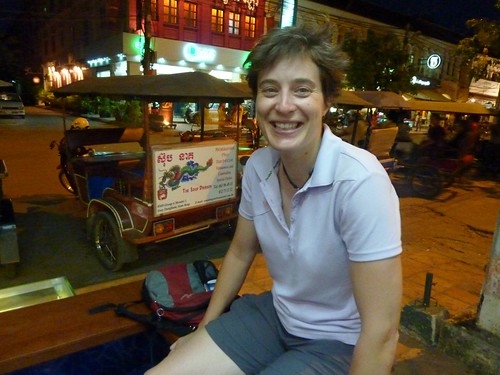
A typical Siem Reap tuk tuk

When I first arrived in Siem Reap I was really unsure about how to make the most of my time at Angkor. I’d planned three full days, but really didn’t know where to start. Should I book myself on a guided tour? Go it alone? Get a private guide? It was a bit bewildering. I wanted to make sure I saw what I came to see and that I understood what I was seeing at the same time. In the end I booked a tuk tuk and a private guide for my first day, and went guide-less on the second and third days. A tuk tuk for each day was $10, and the services of an English-speaking guide were $25. Those are U.S. dollars I’m talking about. Strangely, though Cambodia has its own currency – the real – U.S. dollars are used more frequently than real. Bank machines give out USD, and most prices are quoted only in USD. And though the actual exchange rate is about 4,100 real to the dollar, the locals simply use 4,000:1, and mix currencies as needed to make change. Anything less than a dollar is always given in real, so if you buy something for $3.50 and tender a five dollar bill you’ll get one American dollar back and 2,000 real. It’s odd, but it works.

But back to Angkor. I spent about 12-14 hours exploring Angkor over three days, which is not really much time. Many people start at sunrise and stay until sunset day after day, but they are obviously hardier than me (or perhaps haven’t been traveling for over three hundred days and hence are slightly keener). I decided, after my first long day of guided tourdom, that I really couldn’t appreciate more than about three or four hours of temple trekking on a single day. More than that and the heat turned me into a sweaty, cranky grump who wanted nothing more than a cold shower and a colder drink.

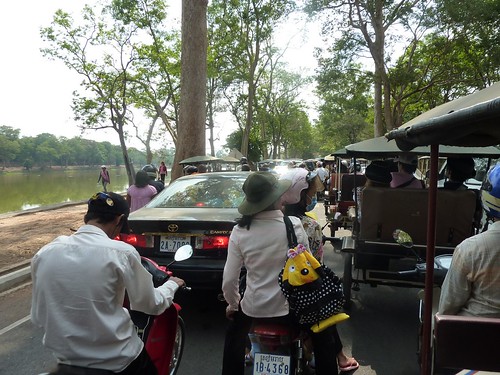
As seems to be my habit here in Southeast Asia, I unknowingly arrived in Siem Riep just in time for a huge festival. This one was a gathering of Buddhists from all over Asia – an event that happens only once every ten years. As many as 4,000 monks, and lots more lay people would descend on the Angkor sites while I was there. This was brought home to me by the traffic jam encountered on the way into the park. Luckily the jam cleared as we got a bit further away from Angkor Wat, and on to the first temple.

Tuk tuks everywhere! To the left is part of the square moat that surrounds Angkor Wat – more than one kilometer long on each side.

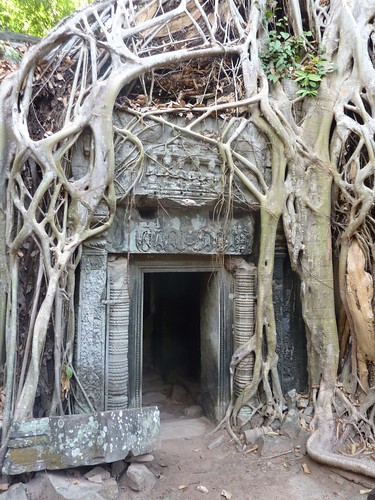
Ta Prohm (literally “Grandfather Mountain”) is a favourite for visitors and is sometimes called the Tomb Raider Temple, because it’s got some of the best tree-in-temple photo ops in the park. The trees – spung trees - actually grown on top of a lot of the temples with their roots stretching down into the rocks beneath; the suspicion is that the seeds are dropped by birds that land and deposit them. The larger ones are three or four hundred years old and though they’re picturesque, they are destroying the temples that support them. In some cases they’ve been left in place, but many others are eliminated, though this is difficult because they’re incredibly hardy and have to be completely removed, roots and all, to ensure they won’t grow back.

Remember this from the movie?

Ta Prohm is a Buddhist temple, but Angkor also boasts many Hindu temples as well. The Angkorian kings switched back and forth between Buddhism and Hinduism frequently, and built according to the prevailing religion of the time. When Hinduism was in ascendency, new temples were built in that style, and the images of Buddha in existing Buddhist temples were chipped away and discarded while Hindu imagery was installed. When Buddhism was back in vogue, the Hindu temples were cleansed and stocked with Buddhas, so even if a temple was built as one or the other, you can generally see imagery from both faiths in each.

I preferred the Buddhist temples for one simple reason – they are at ground level. The Hindus temples all involve climbing incredibly steep staircases up to a central tower. And in the stifling heat and humidity that pervaded my every moment at Angkor, those staircases were like the twist of the knife.

The steps up to Ta Keo, and these ones weren’t bad.

I also had a look around the Angkor Thom complex – the walled royal city surrounded by a moat, and the last capital of the Angkorian empire. This was the place that most of the Buddhist celebrants gathered, so there were grandstands set up and loads of people around. And here you could see the difference in attitude between the tourists and the faithful. The tourists were out in the heat, dragging themselves around the various temples and other structures within the city walls. The local people there for the festival had set out blankets in the shade or slung up hammocks, and were laying around napping, chatting, eating, and otherwise not expending much energy at all. Oh, how I envied them.

But of course there were ruins to see and photos to take so despite the fact that I was quickly melting, I soldiered on. I’m not sure whether I’m just particularly sensitive to the heat, but as I looked at the people around me, I couldn’t help but notice that for the most part they looked fresh and dry. Oh perhaps there might have been a discreetly mopped brow here or there, but none of them seemed to be suffering like I was, and many were wearing long pants and long sleeves. And then there was me, hair plastered to my head, sweat dripping off the tip of my nose, and embarrassing damp patches on my pants, feeling like I was back in the Russian banya. Really, I cannot overstate how much I dislike this climate. I’m showering two to four times a day, and sweating through my shirts in minutes. The moderate temperatures of Japan can not come soon enough.

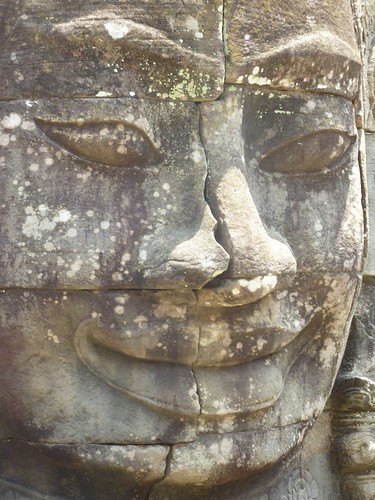
But back to Angkor – the biggest temple inside Angkor Thom is Bayon, a Buddhist structure (yay!) famous for the giant carved faces that adorn each side of the 37 towers still standing within its walls. The faces are said to be that of Jayavarman VII, arguably the greatest of the Angkorian kings, ruling the the late 12th century.

One of the giant faces of Bayon – I estimate most were six to ten feet high

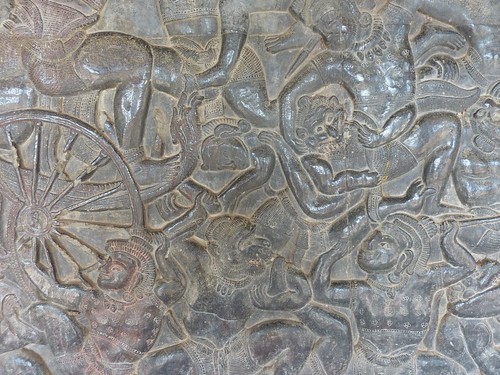
And of course there was Angkor Wat. And I might as well get this out of the way right now: it was smaller than I was expecting. Considering it’s claimed to be the largest single religious monument in the world I thought I’d be blown away by the scale. Instead, I found the actual temple to be pleasant, but not overwhelming. Certainly the grounds in which the temple stands are huge – the walls enclose an area of 302 acres. During the time Angkor was occupied they would have been filled with wooden houses and other buildings, but now it’s mostly jungle. True, the walls of Angkor Wat have some very impressive bas relief carvings, some of which depict scenes from history and others which tell stories from Hindu mythology (Angkor Wat is a Hindu temple… Boo!). But overall I found some of the other temples in the area more interesting and more fun. So sue me.

One small section of carving at Angkor Wat, burnished to a shine by the casual touch of thousands of hands over hundreds of years

I did climb to the top of Angkor Wat, though I waited until my last day to do that. The line to go up to the top was long and unshaded for the most part, and I was pretty underwhelmed when I got there. I’m sorry if this sounds jaded – but it just wasn’t that interesting. Still, I’m glad did it, if only so I can report back that it just wasn’t that interesting.

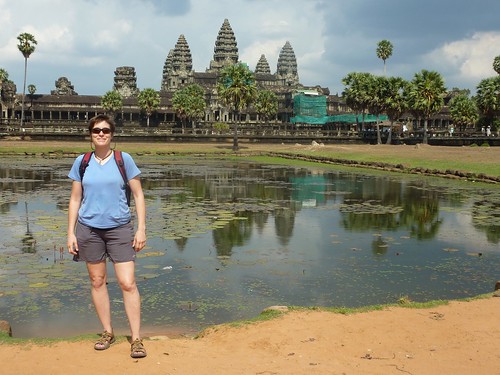
Mandatory shot of me in front of Angkor Wat

What was interesting were two temples I saw on my second day of exploring. Ta Som is the most far flung of the temples in the main area of the park. When I visited there weren’t many people around so I got to enjoy exploring the temple in relative peace. Ta Som was a small Buddhist monastic complex, and has a great spung tree on the eastern gate, and some nice ruined bits. It was small and quiet, and I liked it very much.

Part of the walls around Ta Som, and the encroaching jungle

However, by far my favourite site at Angkor was Preah Kahn (“Sacred Sword”). This is another Buddhist monastic complex, but much bigger than Ta Som. The guidebook calls it “highly explorable”, and they’re not kidding. Around the time I arrived at Preah Kahn there was a short rain shower. At first it was light enough that I simply ignored it and continued making my way through the complex. When the rain got harder I simply turned off into a little alcove, of which there were many, and sat down on a pile of stones and waited it out. It was quiet and blessedly cooler because of the rain, and only two people passed me the whole time I waited.

My resting place

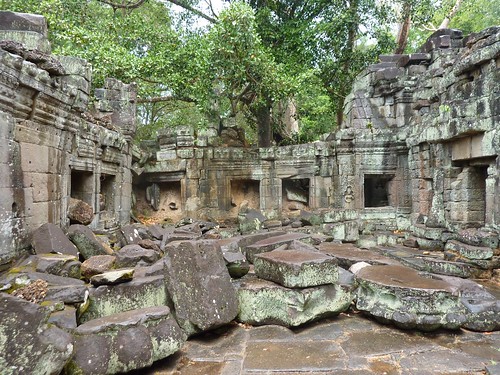
Once the rain stopped I continued my exploring, and it was great. There were lots of corridors and rooms, and some open courtyards, and spots where areas were blocked by rubble. You could wander just about anywhere – under archways and through narrow hallways that lead into small rooms and then into more hallways, across courtyards strewn with big cut stones, around the outer walls, into little crossings where an empty plinth once held a Buddha, and where, to this day, people still burn incense and say prayers.

One of the open courtyards at Preah Kahn

On my last day at Angkor I tried to see the sun set over Angkor Wat, along with every other tourist in the vicinity. I climbed to the top of Phnom Bakheng (Hindu), which is supposed to be the favoured spot for seeing Angkor Wat by sunset. Well that’s just crap. Viewed from Phnom Bakheng, Angkor Wat is about the size of your thumbnail, and mostly obscured by trees. There was a somewhat picturesque sunset over Tonle Sap lake in the other direction, but I thought the most interesting thing to look at were the crowds of other people there with their tripods and light meters and cameras with lenses longer than their forearms. The people watching was definitely better than the sunset watching.

The sunset crowd at Phnom Bakheng.

Overall, I’m not sure that I had the optimum Angkor experience. I didn’t flog myself out of bed to see the sun rise over Angkor Wat, and I wasn’t swept away by the majesty and grandeur of the thing. I found the heat sapped my energy and my enthusiasm a lot of the time, and I got very tired of the touts outside every temple plying me with cold drinks, books, food, bracelets and other gew gaws.

On the other hand, I did get to see some amazing ancient ruins. The temples, walls and monasteries of Angkor really are incredible. Some of them have survived for more than a millennium (despite the fact that no mortar was used between the stones) and represent the remains of an incredible empire. The city of Angkor Thom is estimated to have been home to more than a million people at a time when London could muster only about 30,000. The huge, beatific faces of Bayon, the corridors and back rooms of Preah Khean, and the fantastic spung trees at Ta Prohm and Ta Som were certainly worth the effort. I’m sure I didn’t do it all properly and with due reverence, I just did it my way, like I always do, and that will have to be good enough.